Custom Tire Labels
Start here for tire tread, ID, barcode, QR and private-label tire projects.
View detailsResource Guide
When tire labels do not stick, the problem is usually not one single thing. Tire surface texture, rubber compounds, storage conditions, adhesive construction, label size, liner format and application pressure all affect the result. A useful tire label inquiry should start with the surface and the workflow, not only the artwork.
Digital proof before production. Material and adhesive options are discussed according to your application requirements.
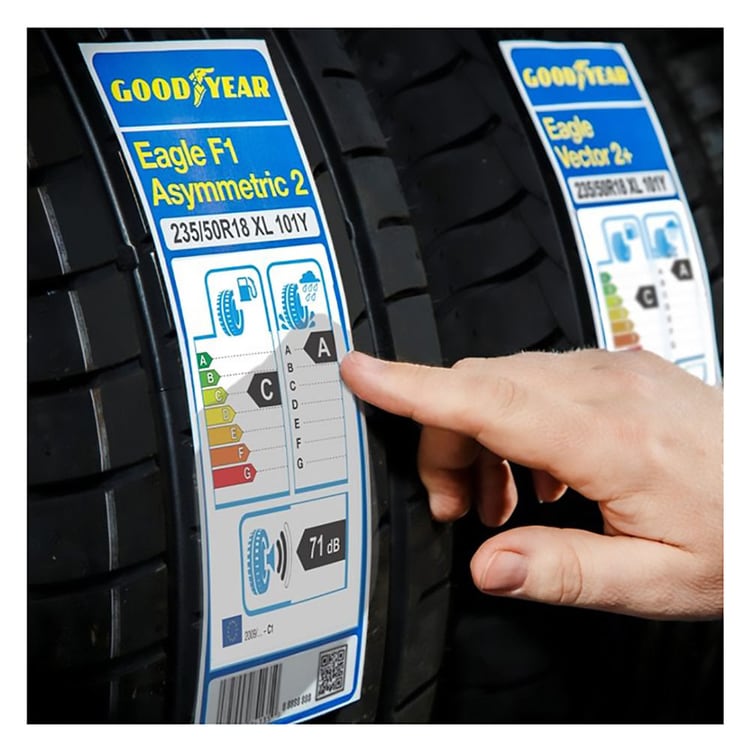
If a tire label curls, slides, stains or falls off, review four inputs first: the tire surface, the adhesive, the face material and the application process. For custom projects, send a photo of the tire surface, the intended label size, the quantity, the storage condition and one existing label sample if available. This gives the supplier enough context to discuss a more suitable construction and proof layout.
Tire tread is curved, textured and often harder to label than a smooth carton or bottle. Some labels must sit on deep grooves, raised tread patterns or slightly contaminated rubber. Before asking for a price, buyers should identify whether the label is for retail display, warehouse identification, production tracking or private-label branding. Each use case may lead to a different adhesive and material discussion.
A long tread label, a small barcode label and a removable point-of-purchase tire label may need different adhesive behavior. A larger label can curl if the liner, face material and adhesive are not matched to the curve. A small code label can fail if the surface is dusty, oily or too textured. For this reason, the quote request should describe the tire surface and expected journey from labeling to warehouse, retail shelf or shipment.
Tire label failure is not only about sticking. Buyers also ask about staining, curling, barcode readability and whether product information remains clear after handling. Film or paper constructions, barrier layers, lamination and print method should be discussed according to the final application. If the label carries barcode, QR code or tire size data, readability should be protected in the proof and production discussion.
The fastest path is to send a short technical brief. This keeps the supplier from guessing and gives the buyer a cleaner comparison between quotes. If you do not know the exact material, describe the application honestly and ask for a recommended option.
Many failed tire label projects begin with incomplete information. The buyer sends only a logo and asks for the cheapest sticker. That may work for a simple carton label, but tire labels need a clearer discussion. Avoid treating all tire labels as the same product, and avoid approving bulk production before the size, curve, adhesive and data layout are reviewed.
For CYJ tire label inquiries, the practical route is surface first, then data and format. We review the tire application, label dimensions, artwork, barcode or QR requirements, material and adhesive options, and roll format before quotation. A digital proof can confirm layout and readable content before production; physical performance should be discussed according to the selected construction and project requirements.
Start here for tire tread, ID, barcode, QR and private-label tire projects.
View detailsPublic supplier resources show why tire labels are treated as a special application: adhesive, barrier, staining, curl and code readability are often discussed together. These references are useful context, but the final construction still depends on the buyer project.
Supplier context on tire point-of-purchase label constructions and tire adhesive discussion.
View detailsPublic FAQ context about high-tack tire tread labels and RFID-style tire labeling.
View detailsFAQ
No. Tire tread, sidewall, rubber texture, label size, storage and handling can change the adhesive discussion. Send the application details before choosing a construction.
For demanding tire surfaces, sample or application evaluation is usually a safer discussion before bulk production. The exact process depends on the project.
Send tire surface photos, label size, quantity, printed data, barcode or QR needs, artwork and roll or sheet preference.