OSHA Hazard Communication Standard
Primary US requirements for shipped hazardous-chemical container labels.
View detailsResource Guide
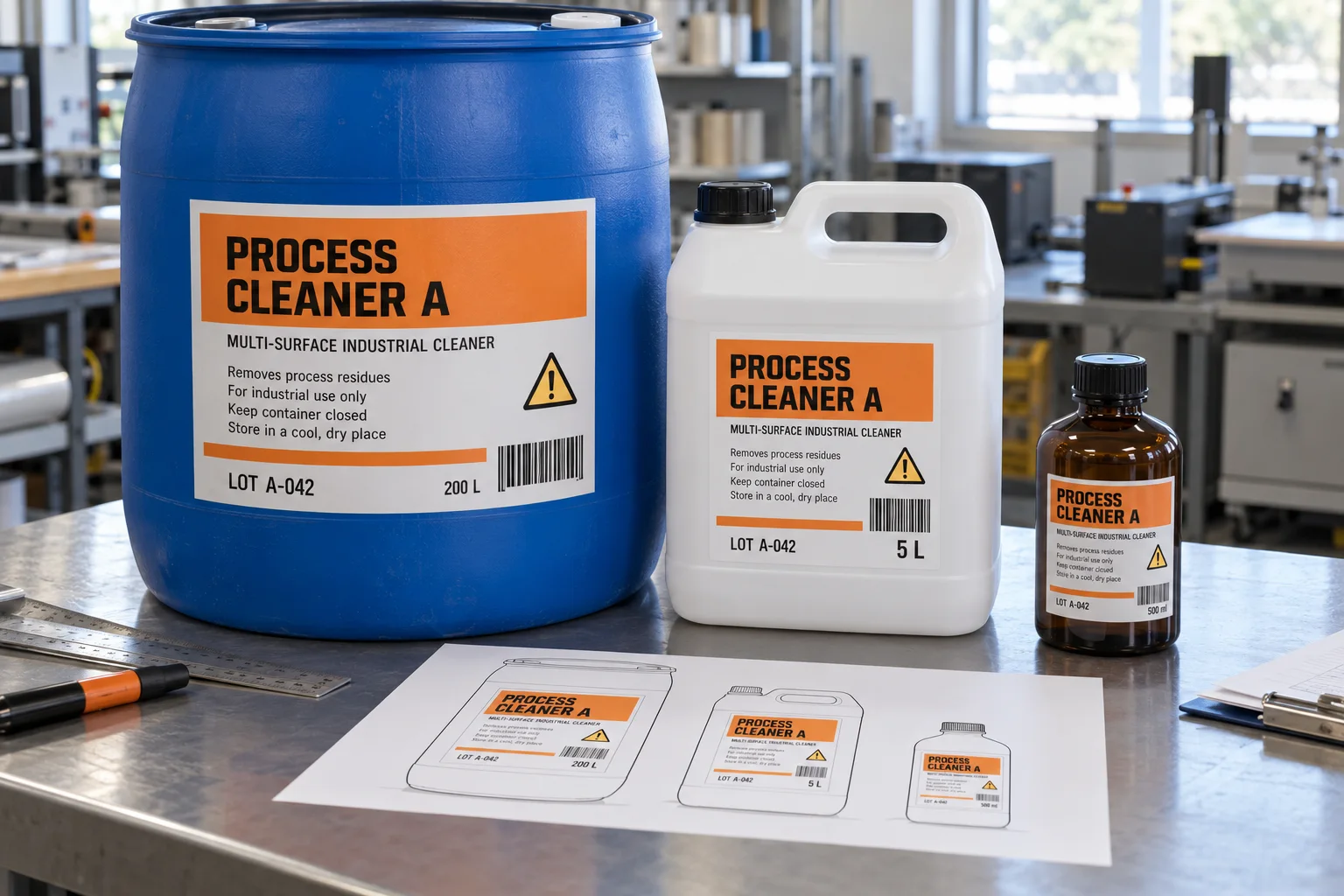
The 200-liter drum has room for a full information panel. The small bottle does not. A buyer can keep one product identity across both, but simply shrinking the drum artwork until the smallest text disappears is not a production plan.
Published 2026-10-07
Digital proof before production. Material and adhesive options are discussed according to your application requirements.
Start with the exact product identifier and buyer-approved safety content for each destination market and container. The print team can adapt hierarchy, label shape and material, but it should not rewrite hazard statements or choose pictograms from a photograph. For hazardous chemicals shipped under the US OSHA Hazard Communication Standard, the rule specifies label elements including product identifier, signal word, hazard and precautionary statements, pictograms and responsible-party information. The responsible company must determine what applies to its chemical and package; a mockup here is not a compliant label.
Primary US requirements for shipped hazardous-chemical container labels.
View detailsImagine the same fictional cleaner packed in a drum, a handled jug and a small amber bottle. This is a staged layout exercise, not a real chemical or approval record. The drum can carry a broad panel with a large identifier, hazard block and batch area. The jug needs a label that avoids the handle recess and curved shoulder. The bottle needs a separate small-format review instead of a reduced drum PDF. If required information cannot fit, the responsible compliance team must choose an approved approach before printing.
Photograph each actual container from the front and side. Measure the usable flat panel, circumference, shoulder, seam and any area rubbed by filling or packing equipment. A layout that reads well on a flat proof can wrinkle around a bottle or hide under a jug handle. Define whether labels are hand-applied or machine-dispensed, then test a finished-size sample on each representative surface. Discuss film, adhesive and finish based on the package and its exposure, not just on the chemical product name.
Keep one controlled content source and a separate artwork file for each package size. The buyer approval record should identify the product version, market or language, container size, artwork revision and effective date. Compare every proof with the approved content, not merely with the previous label. If one size changes while the others are still in stock, decide whether both versions can circulate and how mixed cartons will be prevented. A barcode or batch field must still point to the right product record.
Send container photos and dimensions, approved text and hazard artwork, quantity per size, application method, exposure and cleaning conditions, label material preference, market and language versions, variable lot or date fields, and any test specification. Request three applied mockups, not one scaled image. For a small package, ask the responsible compliance team to approve the information approach before any printer finalizes the die line.
FAQ
Usually the usable area and curvature differ. Keep approved content controlled, but proof each container layout at finished size.
The responsible buyer or compliance team must approve the applicable content. A print supplier should not infer classification or compliance.