Special Environment Labels
For moisture, cleaning, temperature and demanding-use application discussions.
View detailsResource Guide
Cold-chain labels are as much a data-layout question as a material discussion. Batch, date and storage information need a clear reading order in the condition where staff actually receive, move and check the product.
Published 2026-09-26
Digital proof before production. Material and adhesive options are discussed according to your application requirements.
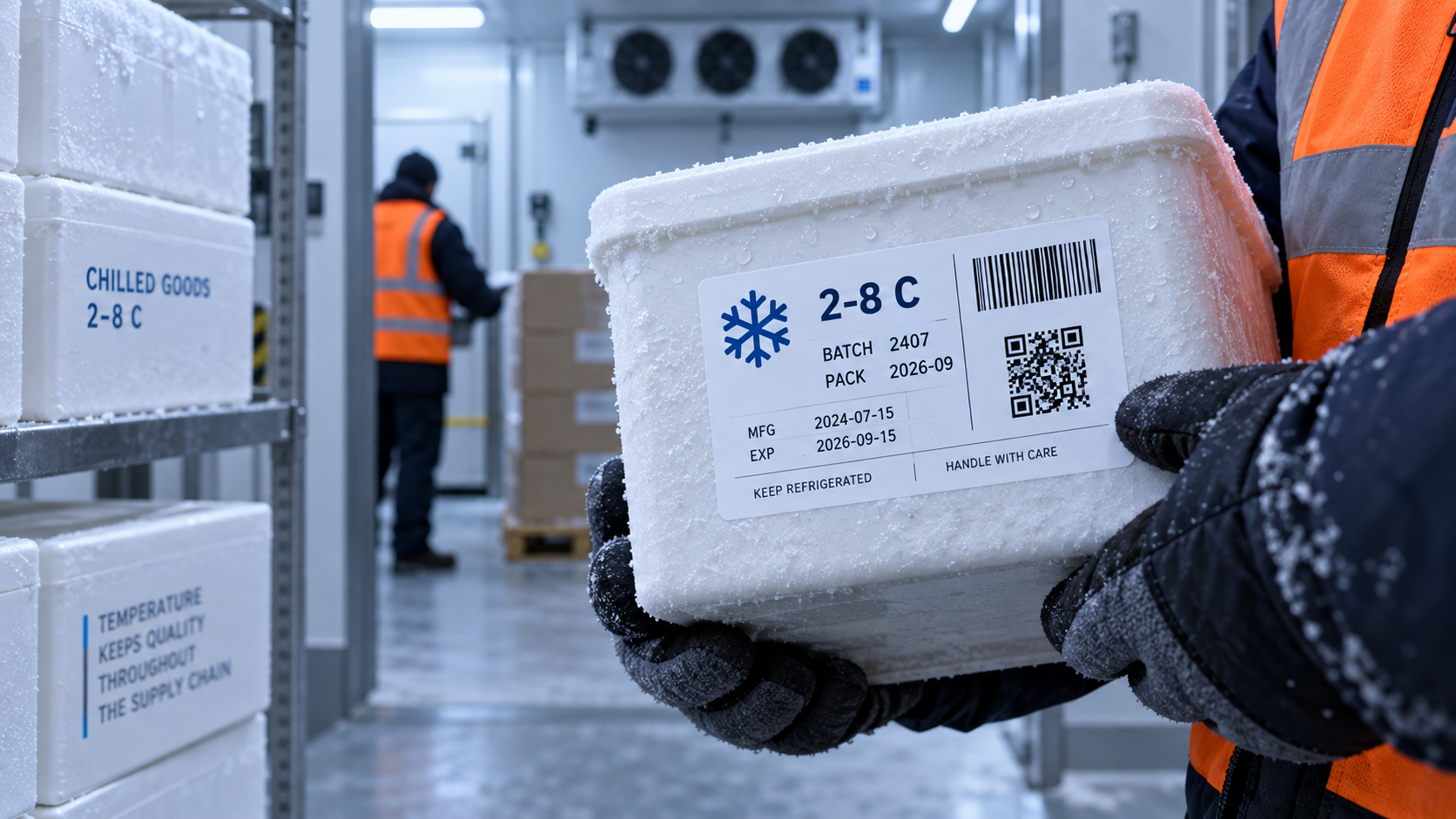
The label may need to be read during receiving, put-away, picking or a handoff in a cold room. Gloved hands, condensation, frost and rushed checking change what a usable layout looks like. A buyer should decide which field needs to be found first, which data must be human-readable and whether a code supports the workflow rather than replacing the visible information.
In a composite cold-room workflow, the required batch and date are printed correctly in a compact lower field. During receiving, a worker with gloves checks the tote under cool light and reads the large storage instruction first, then hunts for the small date. The error is not in the data file. The hierarchy did not match the moment of use. Putting batch, date and handling fields into distinct, visible groups gives the team a better check at the point of work.
Start with the buyer’s data rules, then give each critical field enough space and contrast at the finished size. Explain whether the label is applied before cooling, inside the cold room or after packing. Those are different material and application discussions, even when the printed data is the same.
A label may be applied to a dry tote before it enters cold storage, or it may be applied to a chilled container with moisture already present. State both the application condition and the later storage condition. A proof can confirm the batch/date layout; material behavior should be discussed against the selected construction and representative buyer evaluation conditions.
FAQ
The buyer should define the batch, date, storage, handling and product-identification fields that staff need in the actual receiving or storage workflow.
A code can support a controlled system, but visible human-readable fields are often still useful for fast checks when scanning is impractical.
Yes. Application condition and later storage condition are separate details that help guide material and adhesive discussion.