Special Environment Labels
For project briefs involving moisture, cleaning, outdoor exposure or demanding surfaces.
View detailsResource Guide
Before applying a label on a cold surface, confirm the actual surface temperature, condensation risk, application method and required hold time.
Digital proof before production. Material and adhesive options are discussed according to your application requirements.
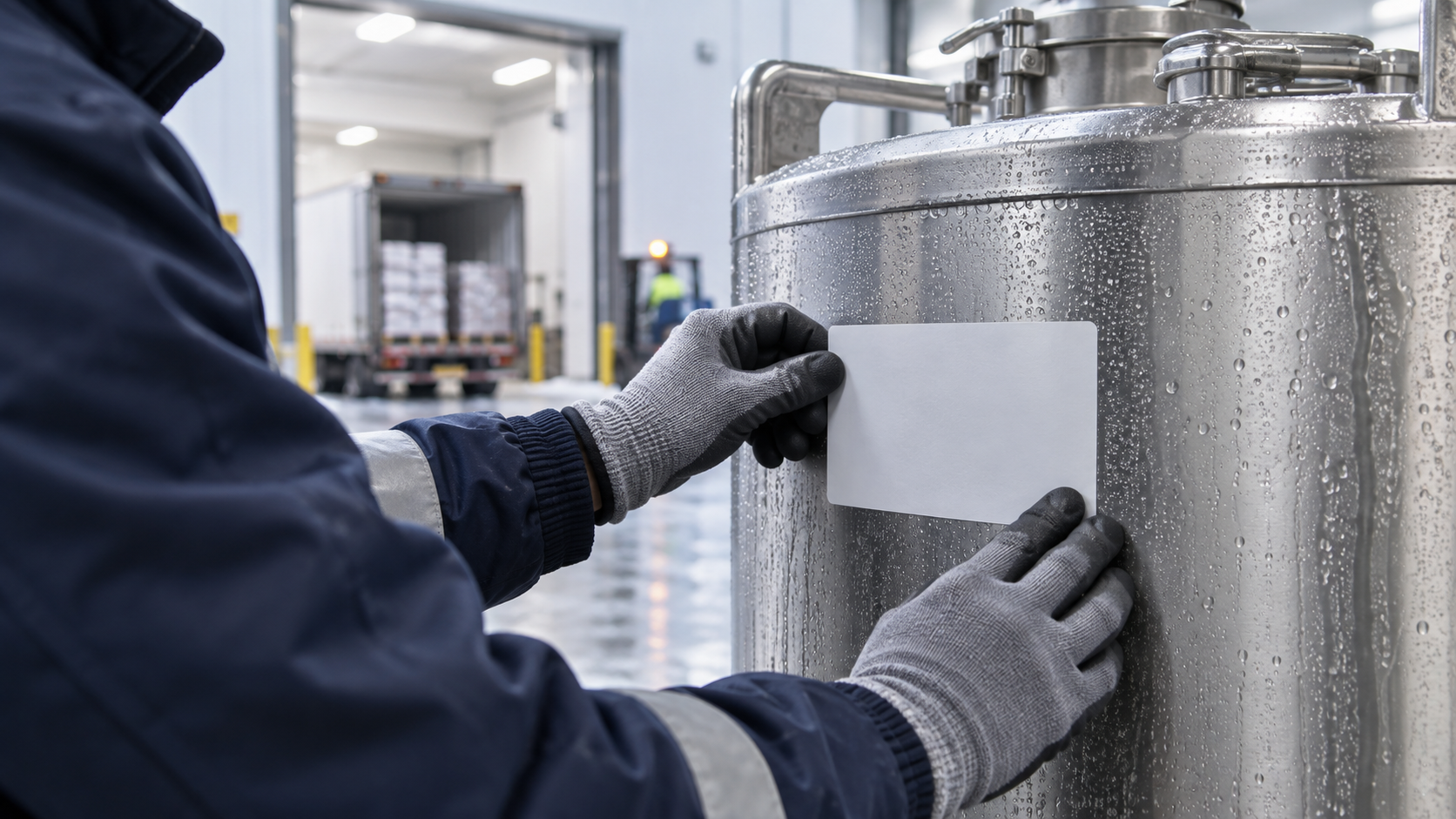
A cold-surface label project is often described as a cold-room project. That shortcut can hide the detail that matters: the temperature of the exact surface at the moment of application. A container can arrive from chilled storage, sit in a warmer bay and collect moisture while the room itself feels comfortable. Start the discussion with the real application point, not a general facility temperature.
Consider a composite procurement scenario. One shift applies labels after containers rest indoors; another applies them just after chilled transfer. The artwork and rolls are identical, but the surfaces are not. The useful decision is not to assume that one successful shift proves the construction. It is to describe both conditions before the quote and agree whether a representative sample check is needed.
A label may be expected to remain readable in a cold environment, but that is different from applying it to a cold or wet surface. Buyers should state both. The label supplier can then discuss face stock, adhesive and finish options against the actual brief instead of treating cold storage as the only requirement.
Photos of the exact placement area are more useful than a generic product photo. Include the substrate, its condition before application, the sequence of cleaning and drying, the label dimensions, how rolls are dispensed and what happens immediately afterward. For a new construction, a controlled sample on a representative surface is often more informative than a confident assumption.
FAQ
That depends on the actual surface condition, construction and application method. Share the temperature, moisture condition and substrate so the project can be reviewed against a representative brief.
No. Storage after application and the surface condition during application are separate parts of the project. Both should be included in the label brief.
For a new surface or unfamiliar application sequence, a controlled sample review on representative material can help confirm the discussion before bulk production.