Zebra: Scanning Considerations
Manufacturer guidance on reflection, distance and scanning angle.
View detailsResource Guide
A glossy barcode can look sharp and still be awkward to scan. Check reflection, reading angle and the finished label before changing materials.
Published 2026-09-27
Digital proof before production. Material and adhesive options are discussed according to your application requirements.
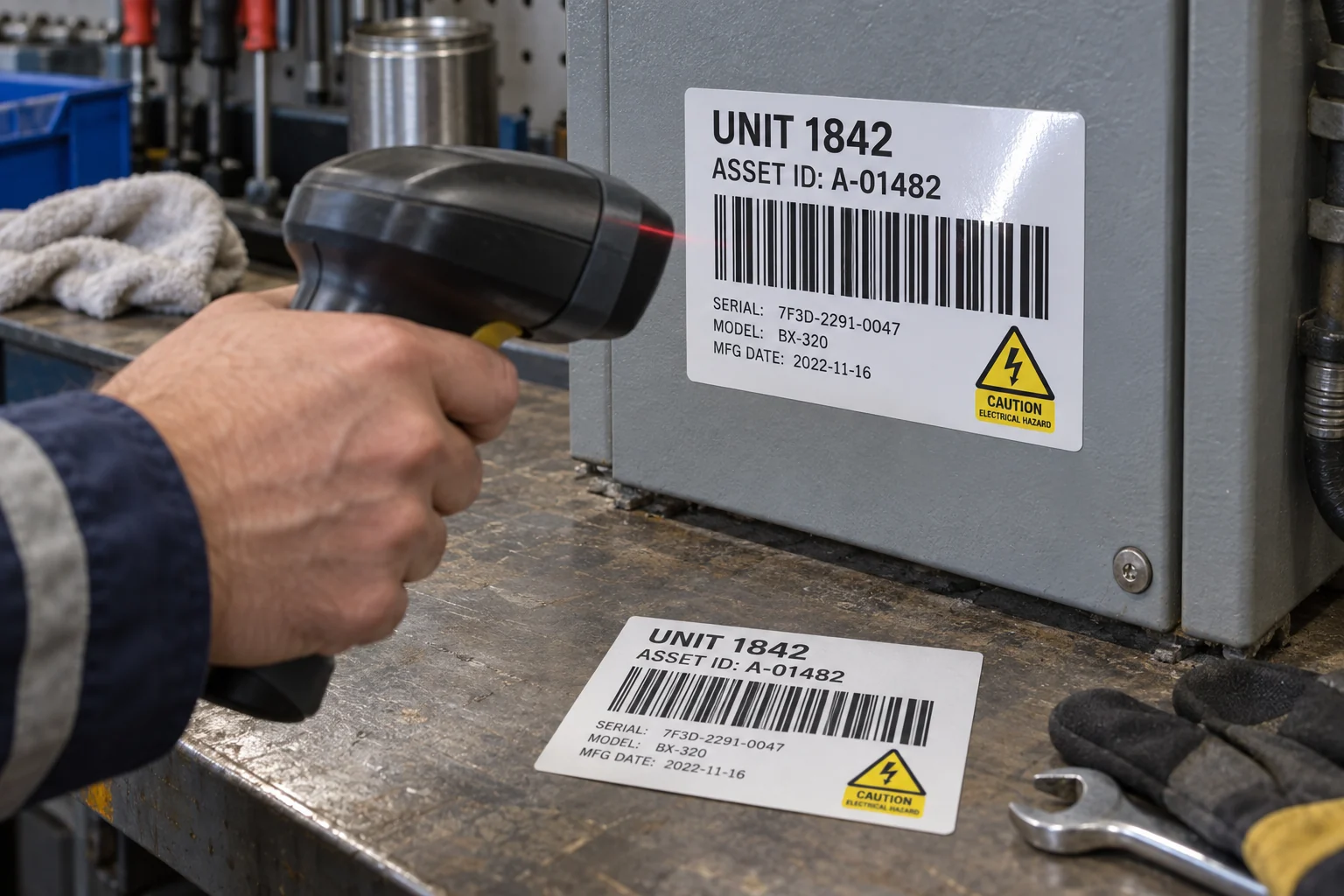
First try the actual scanner at a slightly different angle and within its specified working range. If a bright reflection moves away and the code reads, finish and lighting deserve investigation. If it still fails under controlled light, check the encoded data, print quality, code dimensions and quiet zones. A matte surface can help with glare, but it cannot repair an incorrect barcode. Ask for a sample of the complete printed and finished construction, not just an unprinted material swatch.
Picture a worker checking equipment before dispatch. The label is readable to the eye; the scanner needs two or three attempts. Someone proposes a new scanner. Someone else wants matte labels. Both suggestions could be sensible, but neither explains why the same unit scans when it is moved away from an overhead light. This is an illustrative scenario, not a reported customer case. The useful observation is the change in conditions. Record where the failure happens before buying another solution.
Use the same payload and the same finished-size label for each comparison. Changing the code, material and scanner together makes the result hard to interpret. Zebra explains that direct reflected illumination can interfere with an imager and that distance and angle also affect decoding. That is a reason to test the installation, not a reason to declare every glossy barcode unsuitable.
A glossy protective finish may already meet the appearance or cleaning requirements of the product. If operators can reliably scan it at the normal working position, removing that finish may solve nothing. Matte is worth comparing when reflections keep appearing in an unavoidable position. It is not automatically the more durable choice: assess the selected material, print system and protective layer together. Keep an easy-to-read asset number beside the code so a failed scan does not leave the worker with no identification route.
Send a photo of the applied label and scan location, the scanner model, code type, actual payload, finished label size, typical distance and cleaning conditions. Request otherwise comparable finish samples. Define success in your workflow: correct records returned, repeatable reading by normal operators, legible fallback text and acceptable appearance after the agreed handling trial. A successful phone scan on a supplier desk is useful evidence, but it does not substitute for the scanner used on your line.
Cover image: AI-generated editorial illustration. Its printed code is illustrative, not a verified production barcode.
FAQ
No. Results depend on lighting, scanner optics, angle, print quality and the finished construction. Compare both at the actual scan point.
A reflective protective layer can change how light reaches the scanner. Test the final laminated label rather than approving only the unlaminated print.
No. A decode test checks practical reading in that setup. Formal barcode verification, if required, should be specified separately with the applicable method and acceptance criteria.