3M Polyimide Label Material 7812
Product-specific technical data illustrating why heat limits need a named construction.
View detailsResource Guide
Specify surface temperature, duration, cycles and application conditions. A peak number alone cannot describe a high-temperature equipment label job.
Published 2026-09-27
Digital proof before production. Material and adhesive options are discussed according to your application requirements.
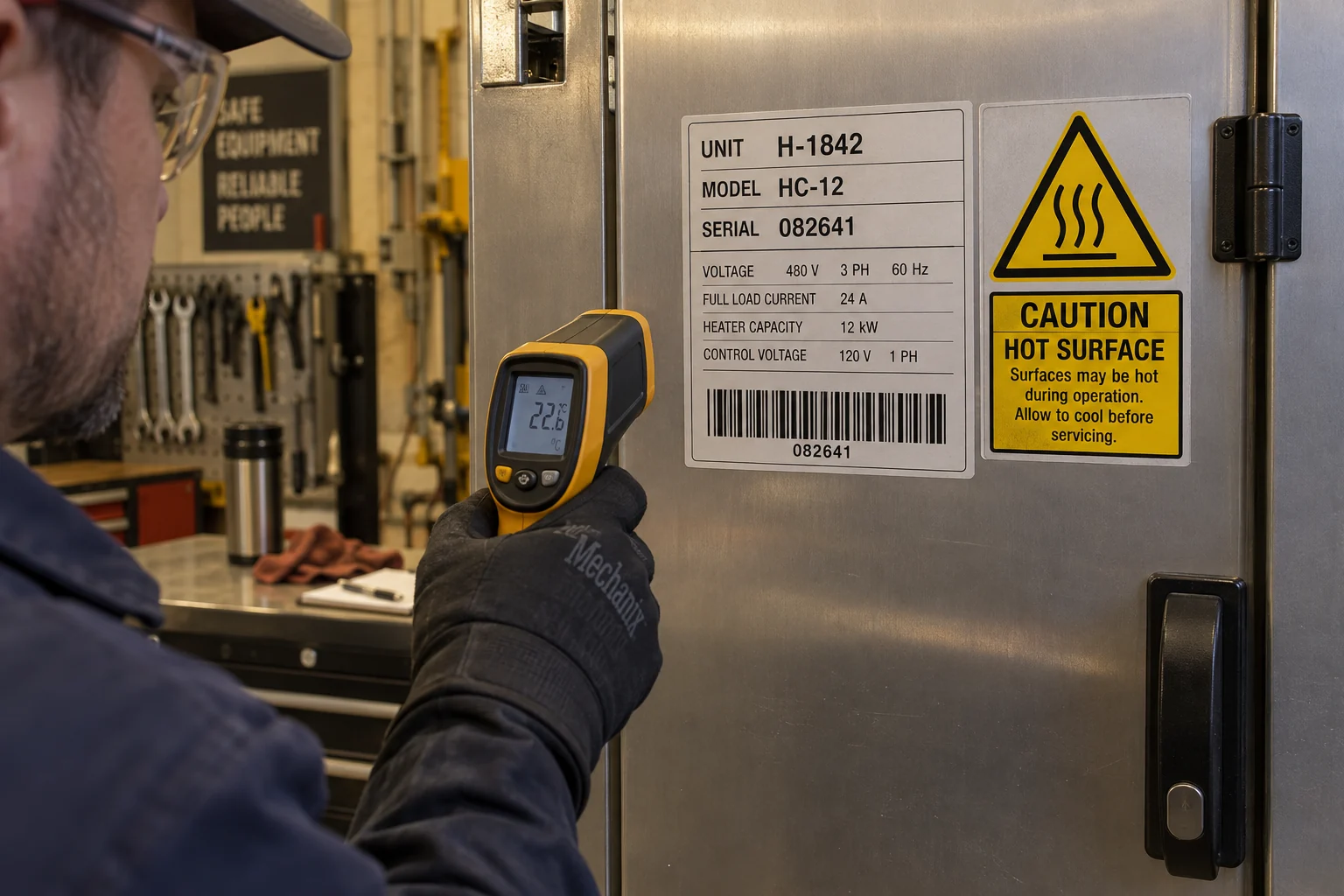
A useful heat-resistant label brief states where the label sits, the temperature at that surface, how long exposure lasts, how often it repeats and when the label is applied. Separate application temperature from the service conditions after bonding. Then assess the face material, adhesive, ink or ribbon and any protective layer as a complete construction. A film surviving heat does not by itself establish that its adhesive holds or its serial number remains readable.
Imagine a buyer asking for a label that withstands a hot process. The engineer knows the internal operating temperature; the purchasing sheet repeats that number. But the label belongs on an external guard, while another sticker briefly passes through a heated production step. Those are different jobs. This is an illustrative purchasing scene, not a measured installation. The first useful question is where the label will actually be, followed by the temperature history at that point. A qualified technician should establish those conditions using the site safety procedure.
Ask for the selected material data sheet and its test conditions. Manufacturer specifications may distinguish short exposure from longer service and state separate application limits. For example, the 3M polyimide label-material sheet linked below describes one particular construction; its limits cannot be transferred to another film or to products offered here. Numbers only become useful when tied to the exact material and printing process.
The most specialized adhesive label is not always the best purchase. Where the design permits, moving an ID label to a cooler accessible surface may reduce the exposure while preserving identification. Where mechanical damage or sustained heat dominates, a mechanically attached nameplate may deserve comparison. Neither option should relocate a safety instruction away from the point where it is needed without the equipment owner approving that change. Start with the information function, then compare constructions and placement.
Agree a trial that reflects the actual process rather than an unspecified heat test. Identify the sample construction, print method, application preparation, exposure sequence and acceptance criteria. After exposure and cooling, review adhesion, edge lift, shrinkage, cracking, readable text and correct barcode decoding. Keep an unexposed sample for comparison. Ask who owns the test and records the result. Do not authorize bulk production on a material description such as high-temperature film alone.
Cover image: AI-generated equipment inspection illustration; it is not a thermal test result or proof of a temperature rating.
FAQ
No. Application conditions concern placing and bonding the label; service conditions concern subsequent exposure. Check both in the selected construction documentation.
No. Selection depends on actual label-surface exposure, print system, adhesive, service requirements and placement. Do not choose solely from the internal process temperature.
An initial discussion is possible, but a final suitability decision needs defined exposure conditions or an agreed method to establish them.