Printing Capabilities
For color, finishing, variable information and proof-discussion context.
View detailsResource Guide
A custom label proof can look finished on screen and still fail at trim when critical text or codes sit too close to the cut line.
Digital proof before production. Material and adhesive options are discussed according to your application requirements.
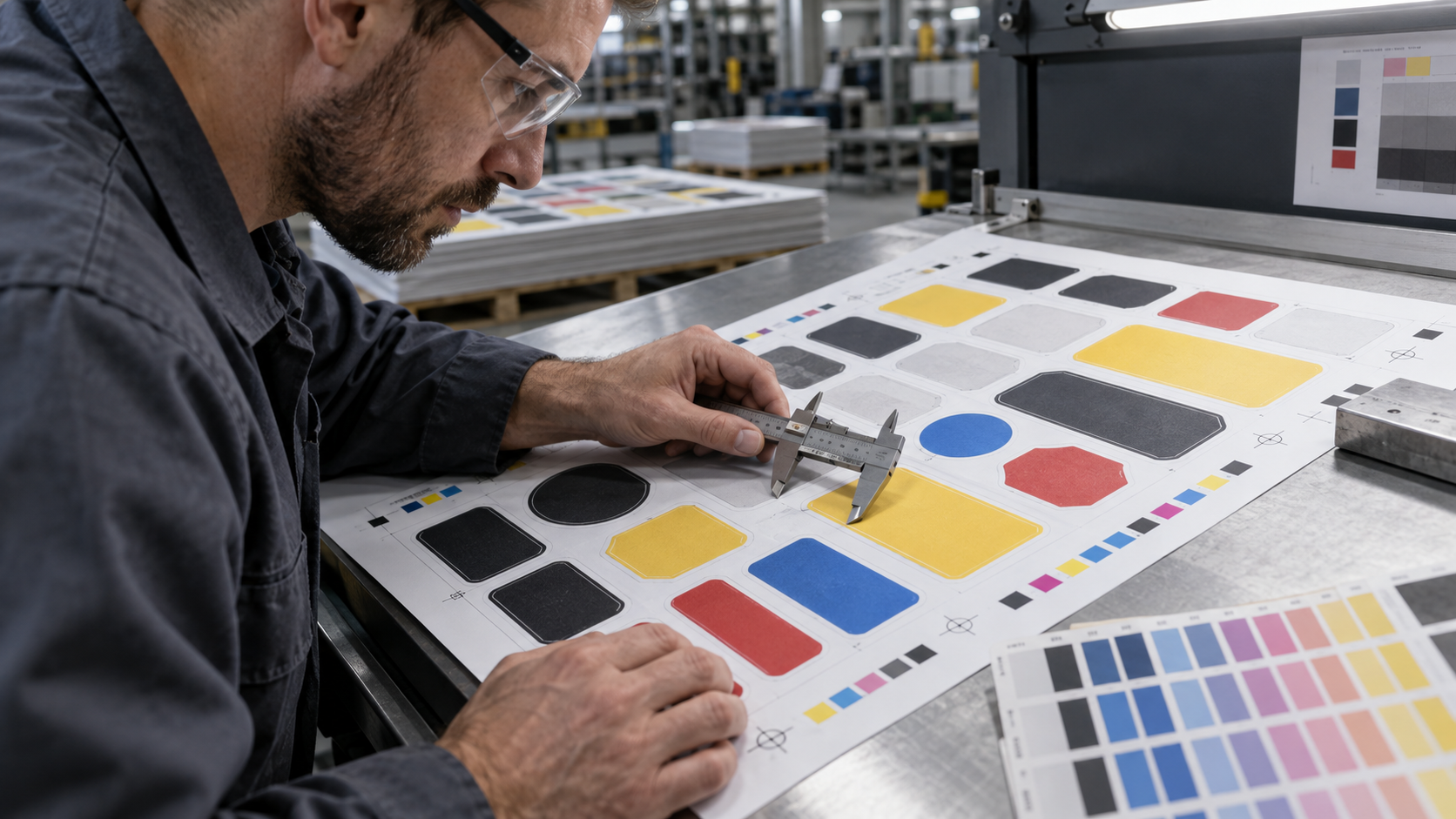
A clean PDF can make a label look complete, even when the live content is too close to the intended trim. Bleed gives background color or imagery room to run beyond the cut; a safe area keeps critical information away from that edge. The point is not to make artwork more complicated. It is to make the production risk visible before a roll is printed.
In a composite prepress scenario, an engineer opens a proof for a small equipment label. The warning icon is present, but it sits tight against a rounded corner. The first reaction is often that it still fits. The better question is whether it remains clear after trim variation, laminate alignment and the physical curvature of the final product. Moving it inward on the proof is cheaper than debating it after production.
Treat the safe area as protected territory for information a user or scanner must receive. That normally includes serial fields, barcode edges, QR code margins, warning icons, small legal copy, rating data and any border that must appear visually even. Backgrounds can extend into bleed; data should not depend on the edge being perfect.
Ask for the finished size, cut shape, material and any variable-data locations to be visible in the review. A roll label may be applied to a curve, a small electrical label may carry dense copy, and a drum label may need a large quiet visual field. The same artwork rule does not solve every application; the proof should show the constraints that matter to the buyer.
Before approving industrial label artwork, verify the version, final size and the content that cannot move after production.
FAQ
Bleed is artwork that extends beyond the finished cut so the edge can print cleanly. A safe area is an inner zone where critical text, codes and icons are kept away from the cut line.
Yes. Barcode placement should preserve the clear space and print conditions required for the selected code and scanning workflow.
A production proof can be reviewed for size, placement and print setup, but the buyer should still approve all supplied copy, codes, symbols and final artwork content.