Offline Tire Scans: Reconcile the Transactions Before Reprinting Labels
Published
A tire is scanned while the handheld is offline. After reconnecting, the operator sees an uncertain result and scans it again. The warehouse record now appears to contain a duplicate event. That does not necessarily mean two tires share a printed identifier.
Separate the identity on the label from the transaction created when it is scanned. Review pending, retried and synchronized events with the warehouse-system owner before changing or reprinting the label. A new sticker cannot reliably repair an unresolved transaction history.
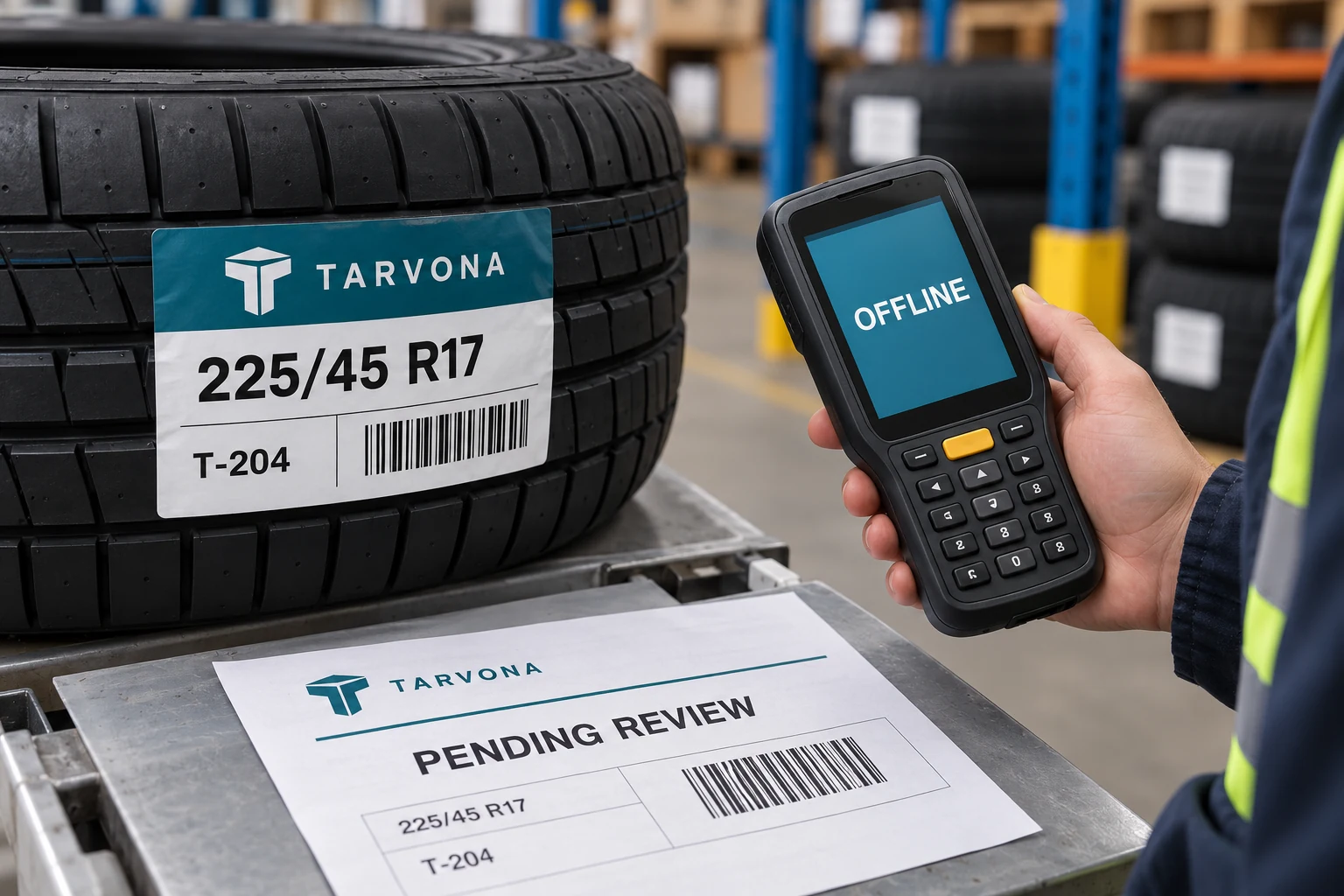
Define what one scan is supposed to create
A product code can repeat legitimately across tires of the same item. An individual-tire identifier serves a different purpose. Neither, by itself, tells the system whether a scan represents receipt, movement, count or a repeat attempt at the same action.
Have the system owner describe the intended event. Identify the object, operation, location context and expected outcome. Keep that description separate from the label payload. The tire inventory guide covers the underlying identification brief; this review concerns what happens when the event cannot be confirmed immediately.
Do not infer offline capability from the presence of a scanner. Different applications queue, reject or handle disconnected work differently. Obtain the actual product documentation and configured behavior from the owner before designing a field test.
Keep uncertainty visible to the operator
The application should provide an owner-approved way to distinguish an action awaiting confirmation from an action that is complete or failed. If the current interface makes that distinction unclear, record the observed behavior rather than asking staff to guess whether another scan is needed.
The buyer's operating procedure must say what to do with an uncertain event. That may involve waiting, checking a pending queue or using an authorized exception route. This article does not prescribe software behavior or promise that a particular warehouse system supplies it.
A label can help by keeping the human-readable identity available. It should not carry a permanent completed status for a transaction that changes. Keep temporary operational status in the approved system or a separately controlled workflow.
Build a controlled disconnect-and-reconnect record
Use an authorized test environment or a method that cannot accidentally change live stock. Select representative labels with known approved identities. Record each action and the resulting state before trying the next one.
| Event | Evidence to retain | Question for the owner |
|---|---|---|
| Initial scan | Decoded ID, intended action and time | Was an event accepted locally? |
| Disconnection | Visible state and pending indication | What work is permitted now? |
| Repeated attempt | Same or different action reference | Is this a retry or a new transaction? |
| Reconnection | Synchronization result | Was the intended event committed? |
| Reconciliation | Final stock or movement record | Does it match the authorized physical action? |
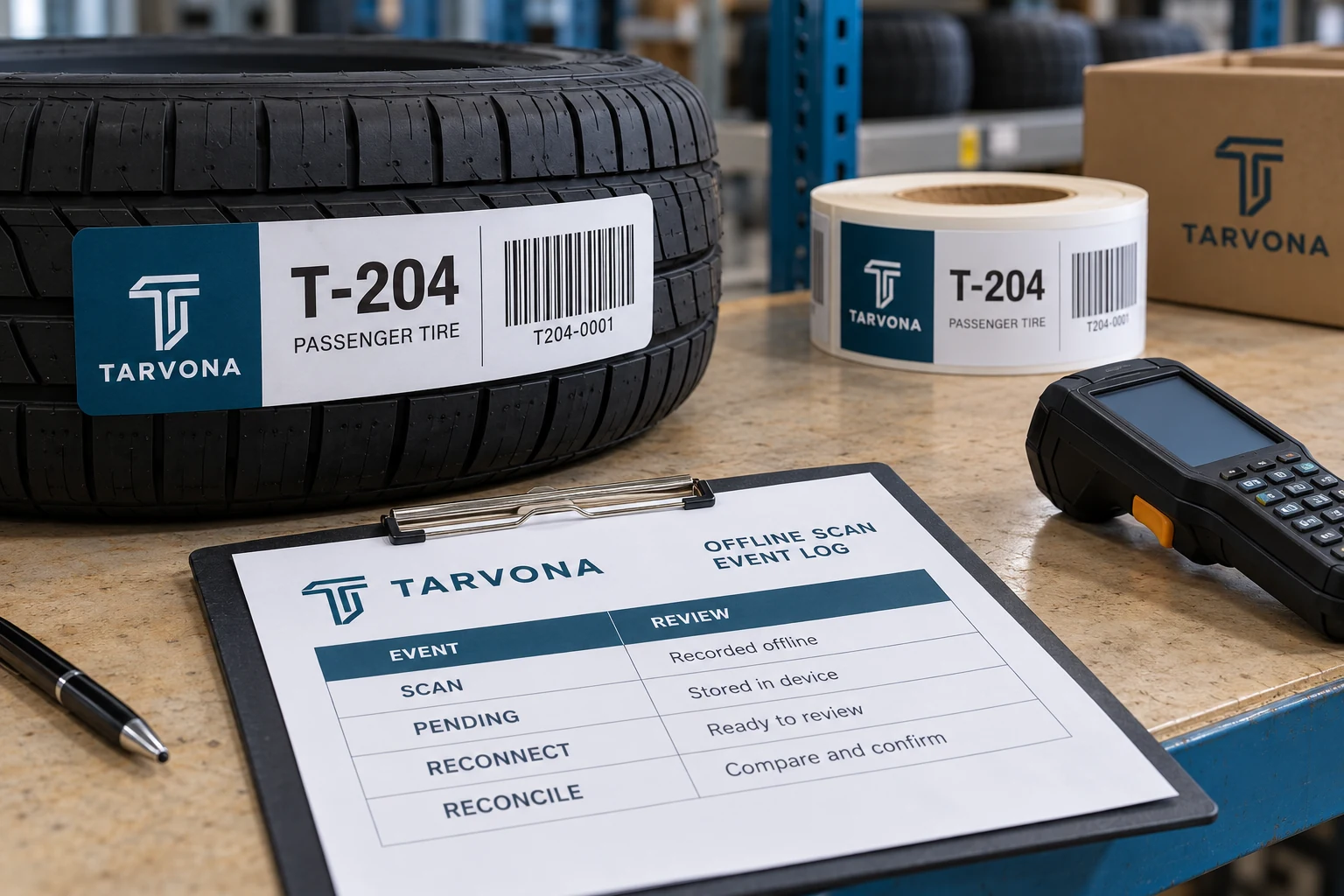
Do not use this table to design an improvised production synchronization mechanism. It is a buyer's observation record that helps the technical owner explain and validate the actual system behavior.
Investigate a duplicate at the right level
Compare the printed identifier, decoded value and transaction records. If two physical items were assigned the same supposedly unique ID, the label-data process needs investigation. If one item generated two events after a retry, the capture and transaction process needs a different review.
If the label carries a shared product code, seeing the same code twice may be normal. The system still needs the appropriate quantity or event interpretation. Do not call repeated SKU values a serialization defect when the approved design never assigned a unique ID to each tire.
Preserve the original event history while the owner decides the correction. Deleting an unexplained row can make the screen look tidy without establishing which physical action actually occurred. The warehouse owner should control any stock adjustment and its audit record.
Choose a process correction before a label replacement
If the approved label identifies the right item and remains readable, keep it while the system owner resolves retry handling or operational instructions. A reprint with the same data adds work without changing how pending events are reconciled.
If the investigation shows that the operation requires individual identities but the current labels only identify product types, that is a genuine design decision. Review the data ownership, assignment process and software support before ordering serialized labels. Do not add serial numbers that no downstream process is prepared to use.
An online-only controlled workflow may be preferable where disconnected transactions cannot be supported reliably. In another operation, a qualified offline workflow may be necessary. The comparison belongs to the operational and system owners, with the label specification following their approved decision.
Release the label and event assumptions together
Keep the approved identity rule, human-readable fallback, application configuration reference and exception procedure in the handoff. Record what was actually tested and which conditions remain outside the approval. A successful reconnect test for one event type does not qualify every inventory operation.
When software changes, recheck the relevant capture path before assuming the same printed labels and procedures still form a reliable workflow. The label may remain entirely suitable; the point is to verify the relationship rather than automatically buy new stock.
For tire barcode labels, prepare an identity-and-event brief with approved sample data, the intended operation, readable fallback, scanner details, representative output, tire photos and quantity. Send supporting files through the contact page's email or WhatsApp path. The first decision is whether the problem is the tire's identity or the record of what happened to it.