Brady: Valve Tagging Standards
Manufacturer explanation of complementary pipe and valve identification.
View detailsResource Guide
A pipe marker answers what is in the line and where it flows. A valve tag identifies the particular control point. One should not be forced to do the entire job of the other.
Published 2026-09-29
Digital proof before production. Material and adhesive options are discussed according to your application requirements.
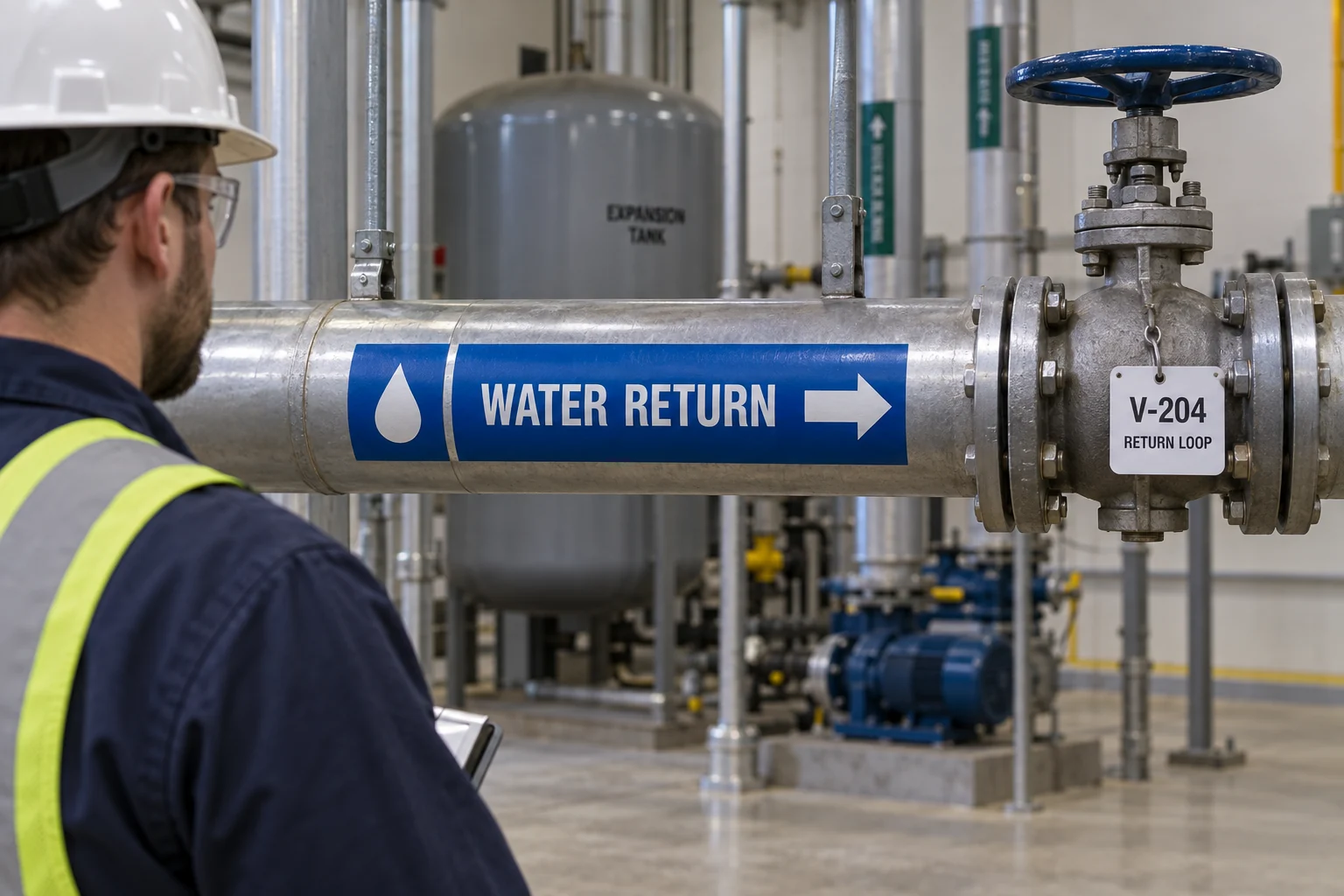
The pipe marker presents the line identity, relevant legend and flow direction at a readable point. The valve tag identifies a specific valve so a maintenance record or procedure can refer to it. Brady describes these as complementary systems and notes that the tag should stay visible without obstructing valve operation. Applicable marking rules depend on the facility, fluid, location and authority. Obtain the site-approved legend, color and placement specification before ordering; this article is not a universal compliance template.
Manufacturer explanation of complementary pipe and valve identification.
View detailsImagine a technician told to inspect valve V-204 on a water return loop. A line label says WATER RETURN, but three nearby handwheels have no individual IDs. The pipe marker helps identify the system; it does not identify the exact valve. This is a composite example, not a safety incident report. A separate V-204 tag linked to the controlled drawing closes the reference gap. Conversely, V-204 alone tells a new operator little about the pipe contents or flow.
Ask the facility owner to supply the approved pipe legend, flow arrow, color convention, valve numbering rule and revision. The ASME A13.1 context discussed by Brady includes legend, color, size, placement and direction, but the project must use its current applicable standard and site procedure. Do not let an image model or print shop guess a hazard class from pipe color. A label that looks official but names the wrong fluid is worse than an unfinished proof held for approval.
Manufacturer discussion of marking elements and placement around valves.
View detailsA flat artwork proof cannot show whether a marker disappears behind insulation, a pipe support or the valve handwheel. Photograph the actual pipe diameter, insulation jacket, direction of approach and nearby bends. Choose self-adhesive, wrap, strap or tag construction based on the surface and service conditions, then test in place. On a small pipe, a large legend may need a separate carrier rather than a cramped wrap. A valve tag should remain attached after routine maintenance without hiding the nameplate or impeding use.
Send a schedule listing pipe sizes, marker quantities, valve IDs, material environment, text lengths and photographs. Specify whether the site supplies an approved color and symbol library. Ask for one installed-size proof at a representative straight run and valve. The label producer can check construction and legibility, but the facility owner must approve the meaning and safety-critical placement.
FAQ
Not when the reader also needs the line contents and direction. The information has different purposes.
No. The site owner should provide the applicable standard, approved legend and color rule for that facility.