OSHA Hazard Communication Standard
Primary US rule on shipped and workplace container labels.
View detailsResource Guide
A plant transfer bottle is not necessarily labeled under the same rule as a container leaving the supplier. The employer must approve the hazard information and the workplace system before the printer makes the sticker.
Published 2026-10-01
Digital proof before production. Material and adhesive options are discussed according to your application requirements.
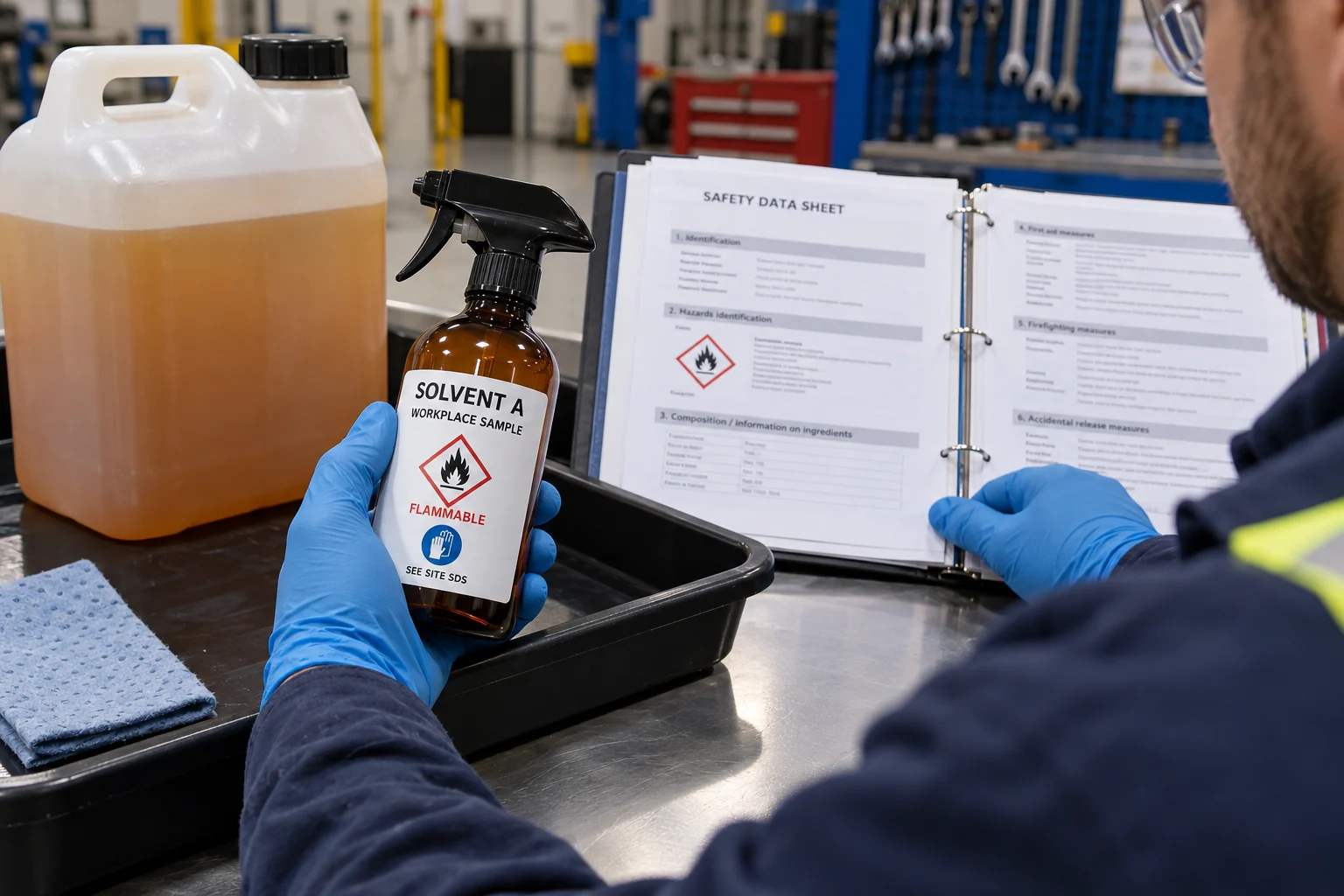
For a US workplace, OSHA Hazard Communication rules distinguish shipped-container labels from workplace labeling. Under 29 CFR 1910.1200(f)(6), workplace containers can use the full shipped-container information or a product identifier plus words, pictures or symbols that give general hazard information when the program makes specific hazard information immediately available to employees. Exceptions and state or sector requirements may affect a specific use, so the site safety professional should approve the exact scheme. This page is a print-buying guide, not legal certification or a substitute for the current rule.
Primary US rule on shipped and workplace container labels.
View detailsOfficial explanation of the workplace-label option and information access.
View detailsPicture a maintenance room with a supplier drum, two smaller spray bottles and a printed sheet of generic hazard diamonds. A worker fills one bottle for a cleaning job. This is an illustrative situation, not a documented customer installation. Copying every pictogram from a different chemical would be dangerous, and printing a blank label for staff to guess later is not a system. The employer should identify the actual product, hazard communication method and responsible person before ordering preprinted or variable-data labels.
The safety owner defines the chemical name and applicable hazard communication; the label supplier defines what can be printed and how the material may attach to the bottle. Ask whether containers are reused, washed, exposed to spills, stored wet or handled with gloves. A curved, squeezable spray bottle needs a different layout trial from a flat jerrycan. Keep text and symbols legible at the intended viewing distance. Use accurate functional icons when approved; do not add decorative GHS diamonds, a supplier identity or a certification mark that has not been authorized.
OSHA has specific exceptions for portable containers intended only for the immediate use of the employee who performs the transfer. Do not turn that narrow exception into a universal no-label rule for shared or stored bottles. The employer should evaluate each workflow against the current standard and its own program. For a repeat-use bottle, a clear, controlled label is often easier to manage than relying on memory. The printer should not decide which legal exception applies.
Provide approved wording and symbols, bottle photos and material, label area, quantities by chemical, exposure and wash frequency, required languages, and whether variable fields such as fill date or batch are needed. Identify who signs the safety proof. Ask for a physical sample on the real bottle, including a wet-handling check. Never claim a generic mockup demonstrates regulatory compliance: only the responsible employer can approve the content in context.
FAQ
No. The employer and its qualified safety team should approve the exact hazard information and workplace labeling system.
OSHA has a limited immediate-use exception. The employer must apply the current rule to the actual handling situation rather than assume it covers stored or shared containers.