Tire Label Quotes: Compare the Same Delivery Scope
Published

One quotation has the lower label unit price. The other includes more of the delivery route. Purchasing puts both numbers into a comparison sheet, but the missing logistics work has no line of its own.
That comparison is unfinished. Before ranking tire-label quotations, give both offers the same technical brief and a common delivery boundary. Record included, excluded and unknown costs separately. An unpriced item is not a zero-cost item.
This guide proposes a purchasing worksheet, not a shipping offer or a recommended trade term. Actual costs, responsibilities and arrangements must be confirmed for the order. The purpose is to expose differences before the buyer selects a supply route.
Match the labels before comparing the route
Start with the same finished specification: tire SKU quantities, artwork and data revisions, construction, roll format, packing and required approval evidence. A delivery comparison cannot repair two quotations for different products.
The custom label MOQ and quote guide explains those production inputs. Keep its specification discipline, then add the delivery scope. Do not reopen an already agreed construction just to make one quotation resemble the other financially.
If an offer contains a technical alternative, identify it as a separate option. The buyer needs to know whether a lower amount reflects a different label, a narrower delivery service or a genuine difference against the same requirement. Combining all three makes the decision harder to explain later.
Write the comparison boundary in ordinary language
Name the place and stage up to which the buyer wants to compare costs. State the delivery location precisely enough for the parties arranging transport to use it. A country name alone may leave substantial work undefined.
Ask each supplier what its quotation covers and which responsibilities remain with the buyer. Where an Incoterms rule is proposed, retain the named place, edition and agreed wording with the offer. Do not treat three letters copied from another purchase as a substitute for reviewing the actual route.
ICC's Incoterms 2020 overview describes the allocation of costs, risks and obligations. It also identifies consolidated costs under A9/B9 of the rules. That is a reason to review the applicable allocation, rather than assuming that every offer includes the same work. This article does not select a rule, interpret a particular contract or calculate import charges.
Use three statuses instead of one unexplained total
Mark each relevant cost item included, excluded but separately priced, or unknown. Keep its source beside it: supplier offer revision, carrier estimate or the responsible buyer-side review. If an item does not apply, record that conclusion and its basis instead of quietly deleting the row.
Possible review items include the finished labels and packing, origin handling, carriage, any arranged insurance, destination handling and any clearance or import items relevant to the actual transaction. Their allocation depends on the agreed arrangement. Listing a category does not say that CYJ charges it or that the buyer owes it.
Use one currency and a stated comparison date where conversion is needed. Have the responsible commercial or logistics owner provide the conversion basis. Avoid presenting an unconfirmed exchange rate or duty assumption as a fact about the order.
Walk two offers to the same boundary
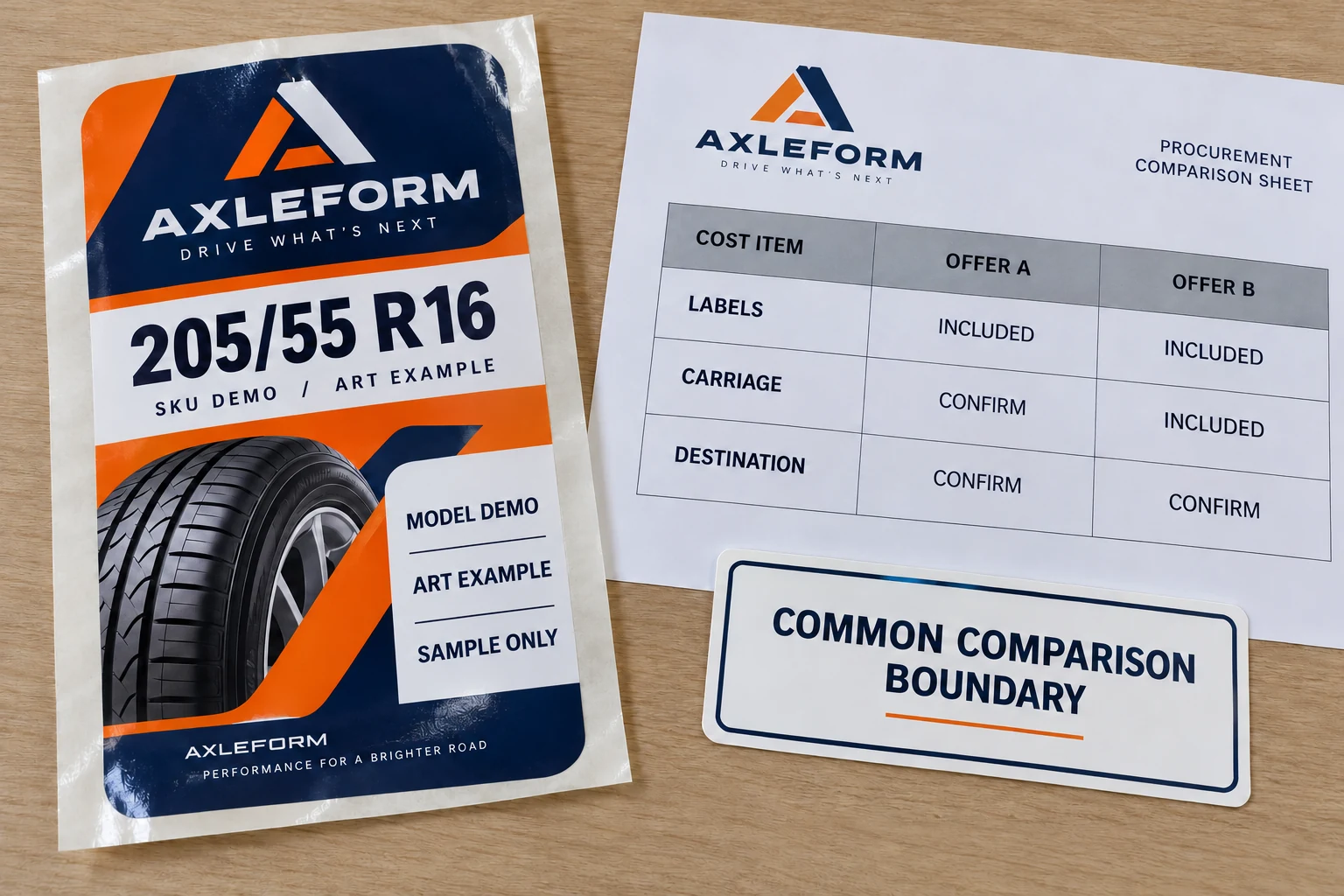
Consider a deliberately non-numeric example. Offer A includes the labels but leaves carriage to confirmation. Offer B identifies a carriage amount within its stated scope. Both offers still need the same destination and responsibility check.
The next action is not to add a guessed freight allowance to A. Obtain the missing scope and price from the appropriate party, then reconcile it once. If B already includes an item, do not add a second estimate for that same work merely because the spreadsheet has a logistics section.
| Review item | Offer A | Offer B | Action before ranking |
|---|---|---|---|
| Matched label specification | Confirm revision | Confirm revision | Resolve any technical difference |
| Carriage within stated scope | Unresolved | Included as stated | Obtain A's basis and compare boundaries |
| Destination and delivery stage | Confirm | Confirm | Use one defined comparison point |
| Other applicable items | Identify | Identify | Price or explicitly retain unknowns |
The table illustrates a method. It contains no real supplier conditions, prices, tax treatment or promise that either offer will win.
Keep the cheaper route available
A narrower quotation can be the better choice when the buyer has an appropriate logistics arrangement with independently confirmed costs and responsibilities. The additional coordination may be acceptable, especially if it fits the buyer's existing process.
A broader quotation can be simpler when its scope is clear and the buyer prefers the included arrangement. Simplicity still needs a defined boundary. A broad label such as delivered does not answer every question about the actual receiving stage.
The comparison should allow either route to win for a stated reason. Do not assume that the lower unit price is a saving, or that the offer containing more services is automatically more expensive after reconciliation. Leave unresolved items visible until the responsible owner closes them.
Preserve the basis for the next order
Retain the offer revision, specification, delivery boundary, item sources and exclusions with the decision. If quantities, dispatch timing or destination change, identify which assumptions need renewed confirmation. A previous route estimate is a reference, not permanent pricing for every reorder.
For custom tire labels, I would keep the scope worksheet next to the technical comparison. It explains what the selected amount actually buys without implying a supply policy that has never been agreed.
Comparing offers? Prepare a tire-label comparison brief with the matched specification, SKU quantities, artwork references, roll and packing format, delivery location, proposed comparison boundary and clearly marked scope questions. Organize the requirements on the contact page, then send the supporting offer or specification references through the existing email or WhatsApp path for a project-specific discussion.