Equipment & Machinery Labels
For panels, enclosures, operating information and maintenance-label projects.
View detailsResource Guide
When industrial label edges lift, the cause is often in the surface, the application moment or the placement geometry. Treat the visible corner as a process clue, not simply an artwork problem.
Published 2026-09-26
Digital proof before production. Material and adhesive options are discussed according to your application requirements.
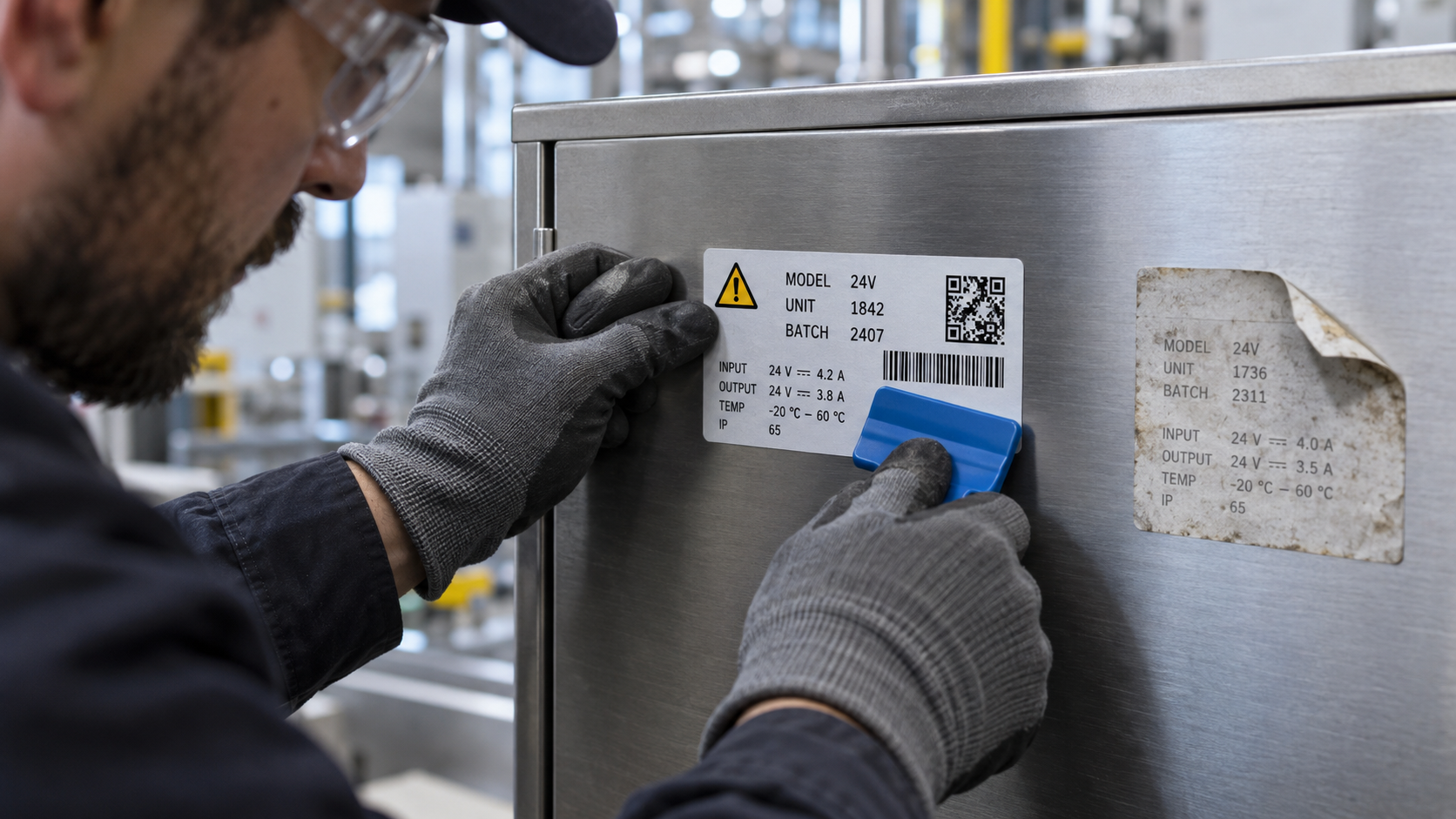
A label edge can encounter dust, residue, texture, a panel seam, a sharp bend or repeated contact long after it leaves the application station. The outward symptom is small, but the source may be earlier in the workflow. A buyer gets a better discussion by identifying where the lift begins, what the label crosses and what happens to that spot during normal use.
In a composite control-panel project, the installer smooths the label onto a clean-looking cabinet and photographs the finished result. The next shift opens the nearby door repeatedly; the label corner sits close to the seam and begins to catch. The factory did not need a more decorative proof. It needed the panel photo, seam position and use motion before the label size and placement were finalized.
Use the quote brief to describe these stages separately. The surface as received can differ from the surface after cleaning, and the application location can behave differently once the equipment is in service. This lets the team review construction and placement with fewer assumptions.
A revised logo or a heavier border cannot correct a label that crosses a difficult seam or reaches into a contact zone. The artwork proof should show the finished dimensions and placement on a representative photo. For a critical location, discuss a physical sample and the buyer-owned application method before a larger order.
FAQ
Common variables include residue, texture, seams, curves, application method, nearby contact and service conditions. A placement photo helps make the discussion specific.
That depends on the intended function, surface geometry and opening motion. Show the seam and label position before the layout is approved.
A proof can confirm intended size and placement, but it does not by itself validate surface preparation or performance in the final application.