Industrial Barcode & QR Labels
Compare product options and send an industrial label request.
View detailsResource Guide
A barcode label is only useful when the scanned value identifies the right physical object in the buyer system. Before requesting industrial barcode labels, decide what is being labeled, where it is scanned, which data is encoded and how long the print must remain readable.
Digital proof before production. Material and adhesive options are discussed according to your application requirements.
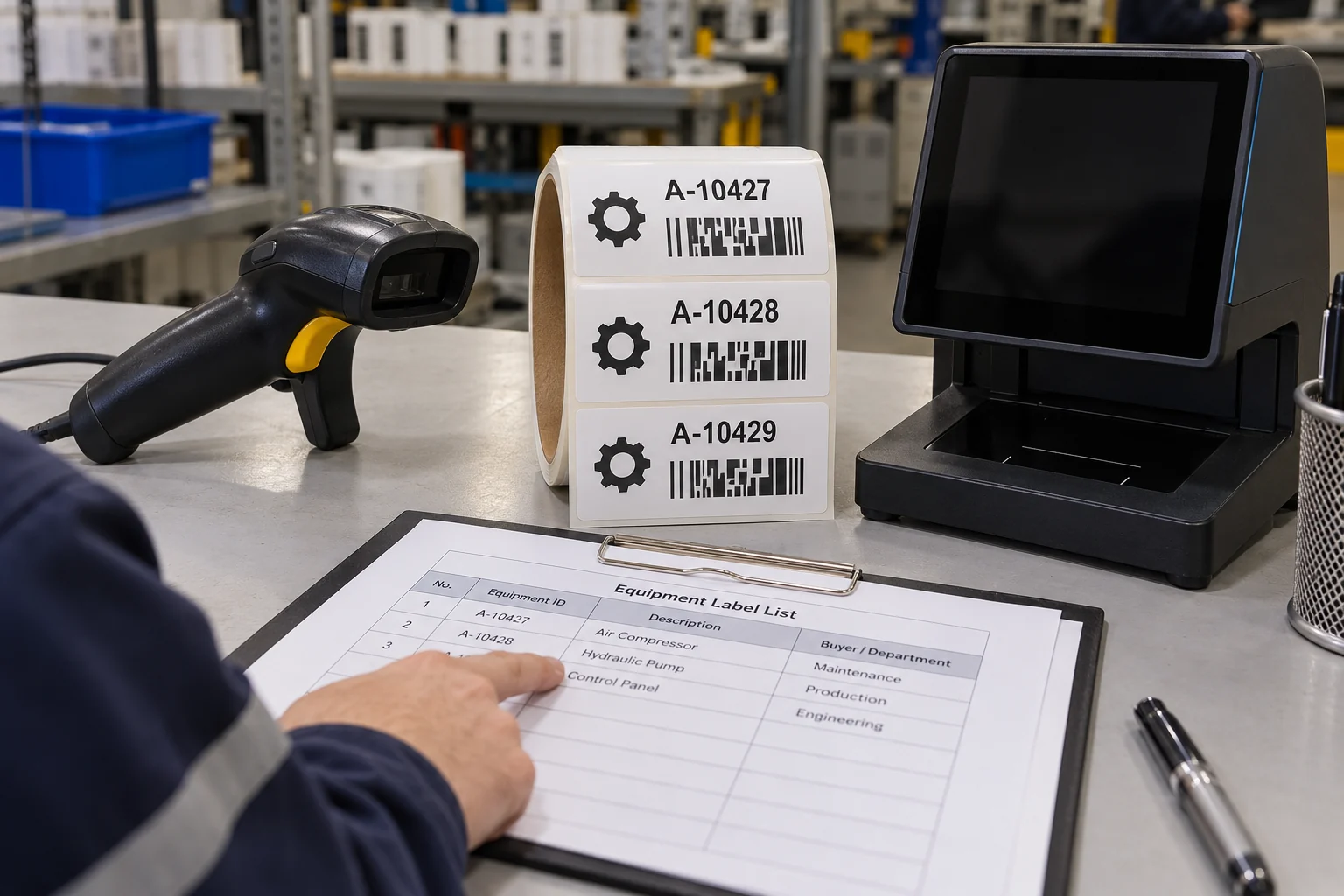
A machine, removable component, warehouse bin and shipping carton can each need a different identifier. Put the code where the operator can reach it without covering an original nameplate or safety warning. Record the expected scan distance, scanner type and normal lighting before choosing label dimensions. A barcode should point to an approved record; the printer should not invent the ID system.
Some product labels repeat one SKU code; an asset or serialized part often needs a different value on every label. State whether the data is fixed, sequential or supplied in a file. If the number printed below a code must match its encoded value, identify that rule explicitly in the proof.
Photograph a representative metal, painted, plastic or carton surface. Describe any texture, curve, moisture, cleaning, oil or abrasion. A digital print proof cannot establish adhesion or field life; request an applied sample when performance matters. Also state whether labels are hand-applied or dispensed from a printer or applicator.
Test the intended scanner against a finished-size sample on the actual object, at the normal scan point. Check quiet space around the code, contrast, glare and nearby text. A successful scan is not automatically a verified print-quality grade or proof that the data maps to the correct record. If a graded verification report is required, send the required method and acceptance criteria with the request.
Send the physical-object photo, finished label size, quantity, surface and exposure, approved code symbology if specified, data file, human-readable fields, sample artwork, roll or sheet preference and scanner requirements. For unique codes, include example first and last records and state how the finished rolls should be sequenced.
Compare product options and send an industrial label request.
View detailsFAQ
Variable data can be discussed when you provide an approved data file or numbering rule, the required quantity and duplicate-handling instructions.
No. Check the code on a finished-size sample at the intended scan point and confirm that the decoded value maps to the correct record. A formal barcode grade is a separate requirement.