Cover-Up Equipment Labels: Test What the Old Print Can Still Reveal
Published
The replacement equipment label looks clean on its release liner. Applied over the old internal reference, it leaves a faint line of characters underneath the new number. Purchasing ordered a white label. The job needed a construction that could actually conceal the approved obsolete information.
For a cover-up project, review the complete printed label over the real underlying graphic. Separate permission to hide the information from the physical questions of opacity, coverage and attachment. Cover-up labels, also called blockout labels, are a correction format; they are not lockout tags or permission to obscure an equipment plate.
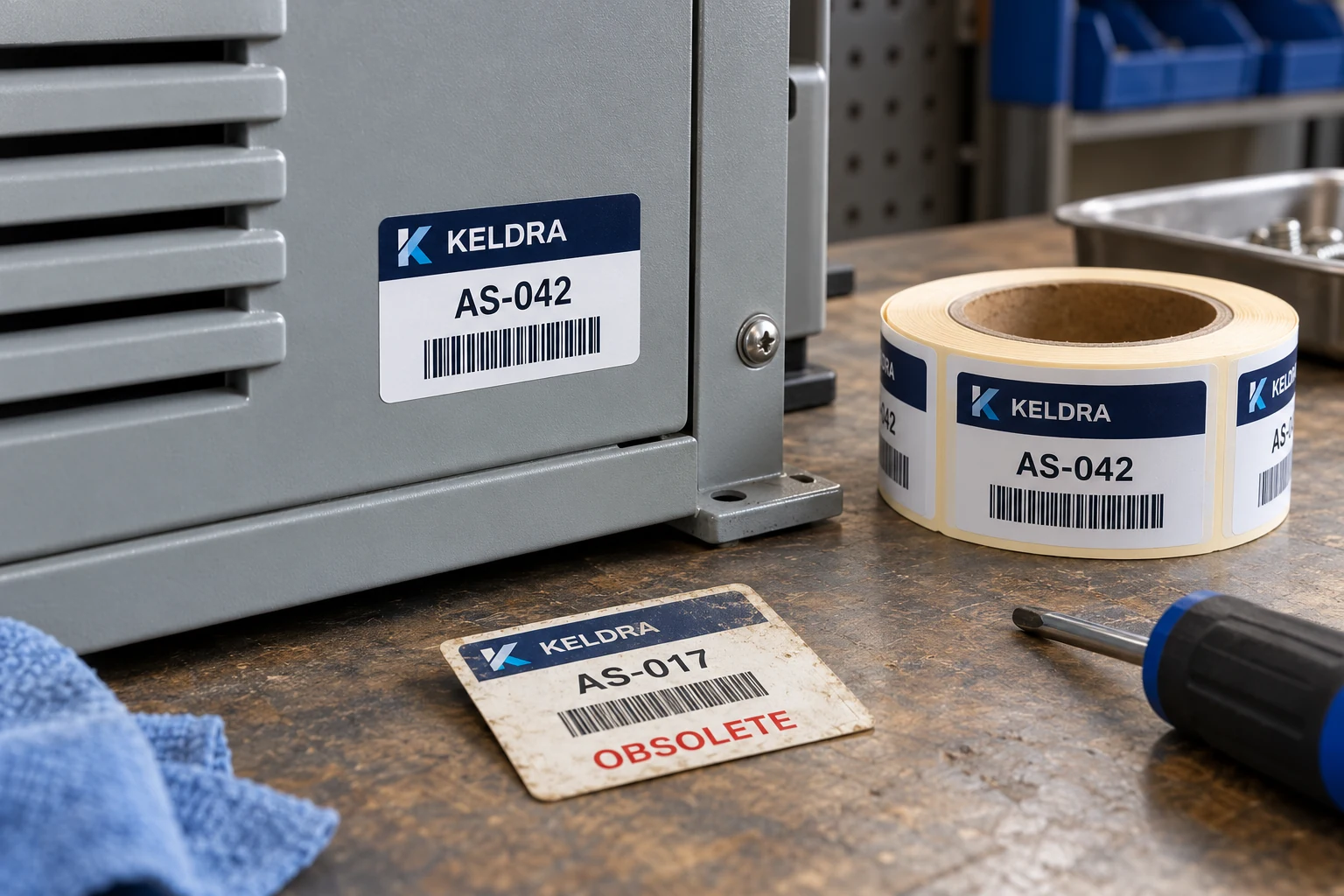
First get permission to hide the old information
Identify exactly what is underneath and who can retire it. An obsolete internal routing reference is different from an original manufacturer serial plate, rating information or a warning. Do not treat the ability to cover an area as authority to conceal its contents.
The equipment owner should approve the information change and any record relationship before artwork release. If the same asset keeps the same valid number, preserve that approved identity. If an earlier value was wrong, record the authorized correction rather than allowing a designer to invent a replacement number that happens to fit.
Where information must remain available, choose a different position or obtain the appropriate authorized replacement process. A neat new sticker cannot resolve missing authority. The replacement-machinery-label guide covers recovery and approval of the information itself; this guide adds the physical concealment decision after that approval exists.
White on the proof does not establish opacity
A white face viewed on pale liner does not show how dark underlying print will appear after application. The face, backing layers and complete construction influence the result. Increasing the strength of the adhesive does not, by itself, answer the visibility question.
Avery Dennison's cover-up material overview describes high-opacity paper and film constructions intended to conceal underlying graphics. That establishes the category of material to discuss. It does not demonstrate that CYJ supplies those particular products or that any proposed construction has passed your application review.
Ask the supplier to identify the actual proposed construction and provide a representative finished sample where feasible. A material description such as white film is incomplete if the purchase decision depends on what remains visible through it. Include the new print and protective finish in the sample discussion rather than judging an unrelated blank swatch.
Review the actual underlying graphic
Use the most demanding relevant background from the approved application: dark old characters, a dense code, a colored band or another real variation. Show the supplier a clear photo and retain an agreed physical reference. Do not replace the underlying graphic with a lighter convenient example simply because it makes the new sticker look better.
| Observation | Record for the proposed sample | Keep the conclusion limited |
|---|---|---|
| Underlying information | Authorized obsolete content and its position | Permission applies only to the agreed area |
| New construction | Material reference, print and finish | Another white stock is not equivalent evidence |
| Coverage | Outline, edge exposure and placement | Hidden center text does not hide an exposed old code |
| Show-through | Relevant lighting and viewing positions | Appearance is separate from attachment |
| New information | Readable text and decoded payload | Concealment does not validate the replacement data |
| Record closure | Owner approval and old-reference disposition | The image is not the asset register |
This is an illustrative buyer review sheet, not a standardized test method or measured result. The responsible team should define any acceptance criteria required by its application.
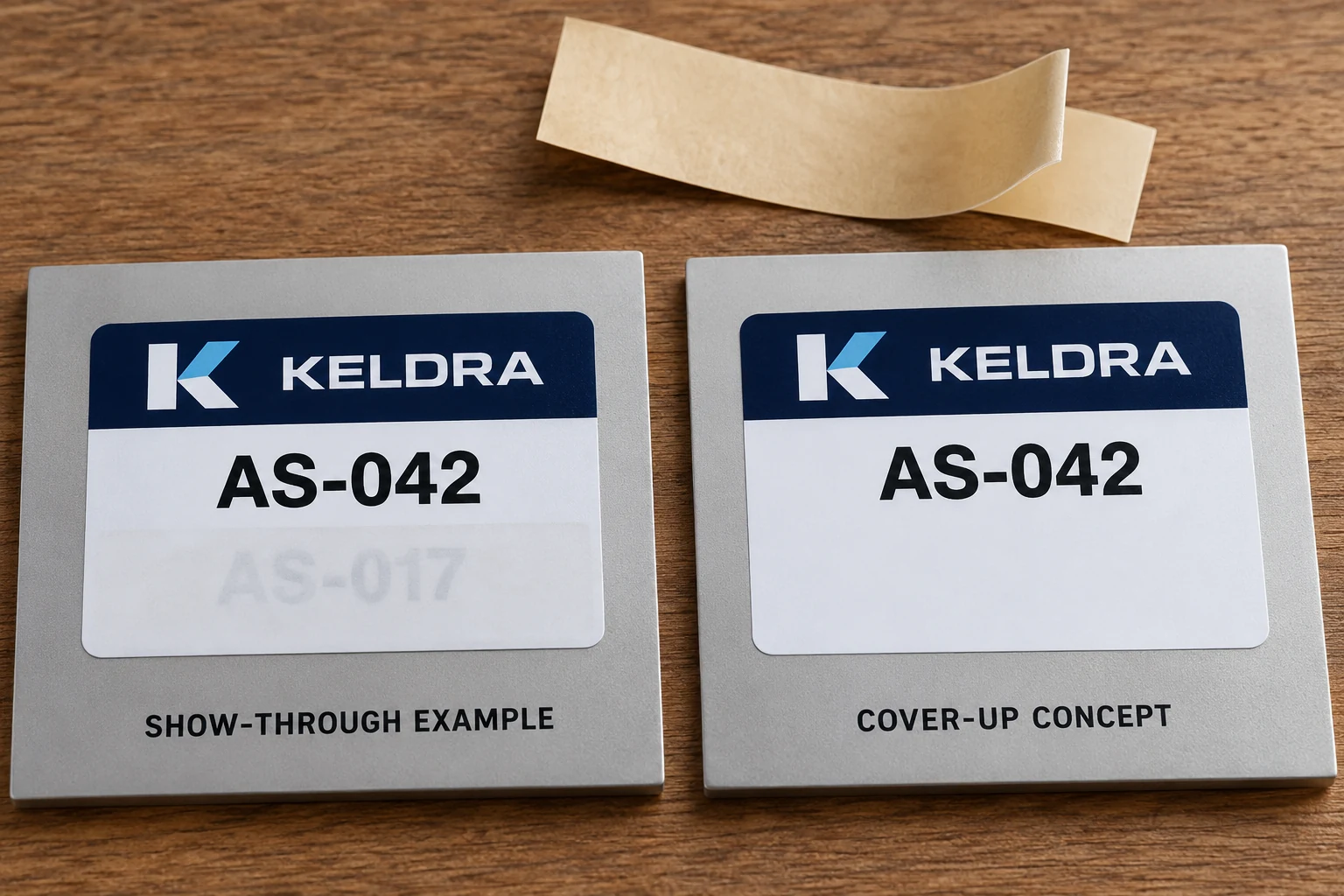
Check the applied outline as well as the face. An old code protruding beyond the new label can still create a competing scan target. Do not solve that by casually enlarging the sticker across adjacent warnings, vents, controls or access features. Return to the approved placement drawing and available area.
Review the finished sample from the positions where people actually read the equipment. Keep any required operational scan check separate from visual concealment. A code can look good while carrying the wrong replacement value, and an opaque face does not establish that the application will remain attached.
Treat the old label as part of the surface
When one label is applied over another, the new adhesive contacts the old label's face or finish rather than the bare equipment panel. The old label's condition and attachment become part of the proposed assembly. Curling edges, contamination or a poorly attached underlying layer deserve an explicit disposition before another layer is added.
Tell the supplier about the underlying film or paper, finish where known, cleaning history, texture and use environment. Obtain the equipment owner's preparation instructions. Avoid guessing a solvent or removal method that could damage a coating or retained marking.
Do not promise that a cover-up construction will compensate for an unstable old layer. Nor should a successful appearance review be written up as an adhesion or service-life test. Keep those observations distinct and obtain the construction-specific evidence the actual use requires.
When removal is the better choice
If the old internal label can be removed safely under an approved procedure, a single replacement on a suitable prepared surface may be simpler than building a stack. Removal can also make it easier to eliminate exposed fragments or competing codes. The tradeoff is the effort and the need to protect the underlying equipment finish.
A separate new location can win where the old information must remain visible, provided the resulting identification is unambiguous and owner-approved. Sometimes the correct response is to correct the database and retain the existing valid tag. Cover-up printing should solve an authorized physical information problem, not create a reason to replace a working identity system.
For equipment and machinery labels, prepare a cover-up brief with old and proposed artwork, the authorized information change, clear surface photos, dimensions, underlying label details, cleaning exposure and quantity. Use the contact page to organize requirements and send supporting files through email or WhatsApp. The useful sample is the complete new label on the actual old graphic, with a clear statement of what the review does and does not prove.