Changing Tire Label Suppliers? Match More Than the Artwork
Published
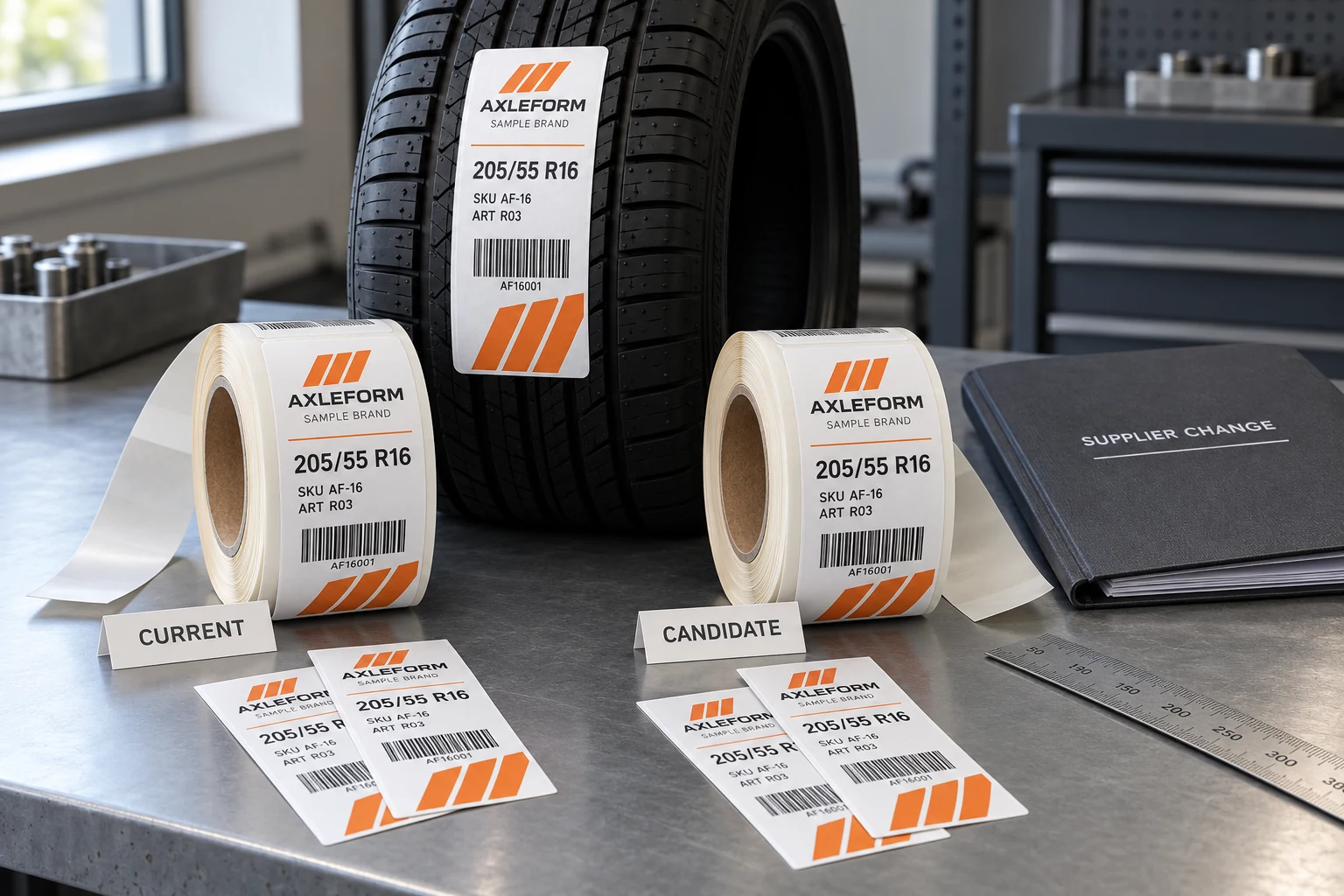
Consider this illustrative purchasing situation. A buyer puts a current tire-label roll beside a replacement supplier’s sample. The logo looks right. The tire size is readable. The proposed unit price is attractive. Production wants the purchase order released before the existing rolls run out.
The sample has answered a useful question: can the new supplier reproduce the appearance? It has not yet answered whether the replacement will behave the same on the tire, leave the liner correctly or preserve the intended barcode record.
If I were comparing those quotations, I would put one document ahead of the price comparison: a change record stating what stays fixed, what changes and what evidence releases the new supply.
A retained sample is a reference, not a complete specification
Keep the old sample. Just do not make it carry information it cannot reveal reliably.
A printed label can show layout, approximate appearance and the location of important fields. It does not, by itself, establish the adhesive formulation, barrier construction, liner release characteristics or the conditions under which it previously worked.
Avery Dennison’s tire-label material overview identifies uneven tread, rubber surface characteristics and oil migration as material-selection challenges. Its catalogue also lists different face and liner constructions. That is a reason to request a defined replacement construction, not evidence that every listed material suits your tire.
A matching color band is easy to see. A changed construction needs a question on the purchase record.
Give both suppliers the same transfer brief
Start with the buyer’s controlled requirement, supported by the current specification and retained sample where available. Ask the proposed supplier to identify differences rather than simply confirm that the replacement is equivalent.
| Transfer item | Record before comparing the quotations |
|---|---|
| Intended job | Tread identification, warehouse scanning or another defined use; actual application location |
| Finished label | Drawing revision, width, height, cut shape and agreed tolerances |
| Construction | Current material reference if known, proposed construction code, relevant technical data and declared differences |
| Printed information | Approved artwork, buyer SKU, barcode payload, readable text and data-file revision |
| Roll delivery | Liner, core, winding direction, labels per roll, splice arrangements and carton identification as applicable |
| Approval basis | Representative tires, application process, observations, acceptance criteria and named release owner |
Do not turn an unknown old specification into a confident new one. If the original adhesive code is unavailable, mark that gap and discuss how the proposed construction will be evaluated against the job it must perform.
The supplier may protect formulation details. You can still ask for an identifiable supply construction, relevant performance information and an agreed notification process for future substitutions. A useful specification does not require owning someone else’s recipe.
For the broader application brief, use the existing custom tire labels page. This transfer record addresses the additional decision created by changing the source.
Compare the application, not two unrelated test numbers
The old sample might have been tried on a warm, recently handled tire. The new one might arrive on a cooler day, go onto a different tread or be pressed down differently. If several conditions change together, a difference in behavior does not tell you which change caused it.
Agree a representative comparison before bulk release. Identify the tire model and surface condition, sample batch, application location, application method, environmental conditions and observation times. Use equivalent conditions for the current and candidate materials where practical, and record any differences that cannot be controlled.
The supplier’s laboratory figures also need context. Avery Dennison explains that peel angle and speed influence adhesion measurements. A number obtained under one method is not automatically comparable with another supplier’s number under different conditions. A standard test surface is not your actual tread, either.
Ask which method and substrate produced each result. Then agree the application evaluation needed for your particular project. Neither a short hand-peel demonstration nor a visually tidy sample proves the full storage and handling route.
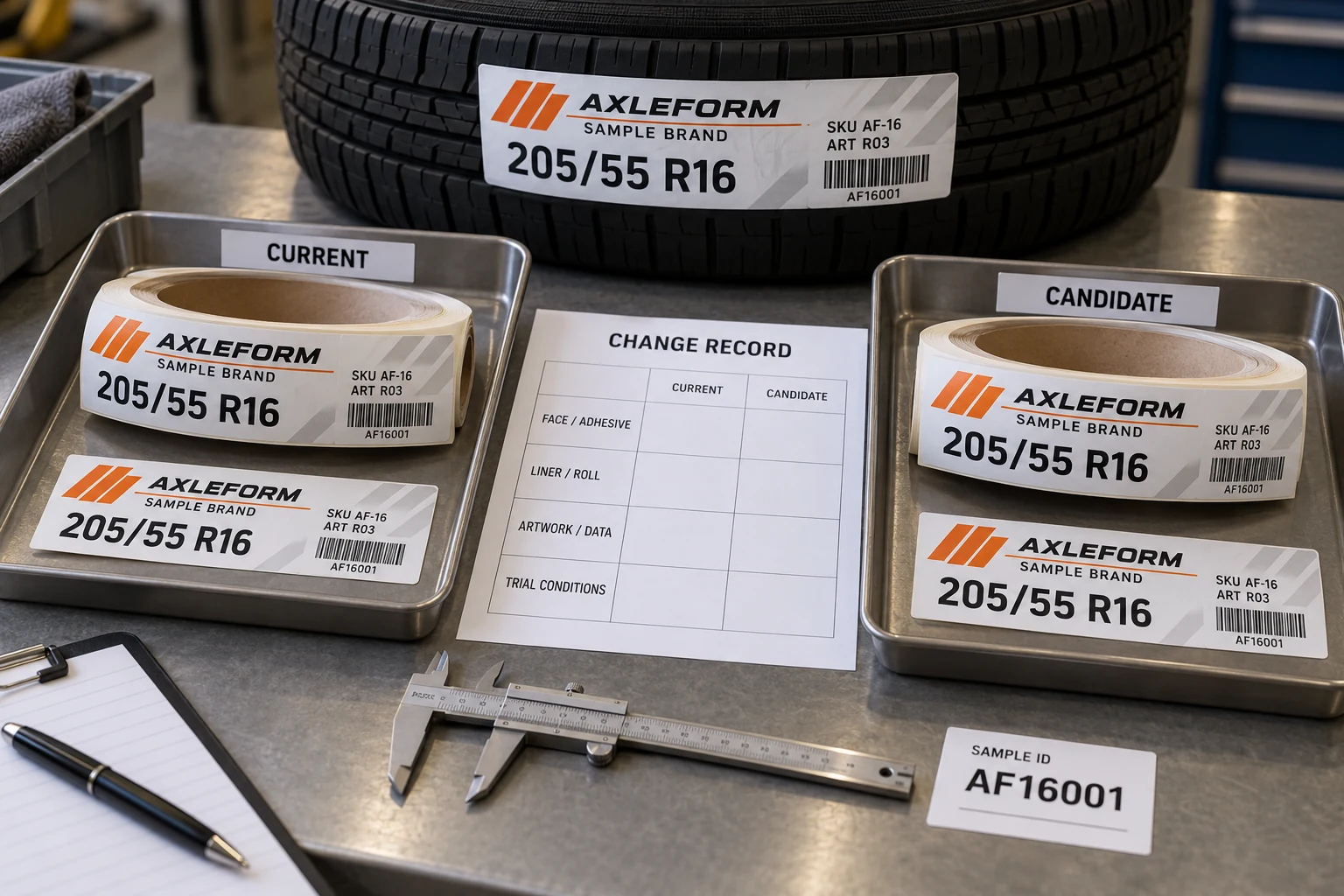
Keep the data decision separate from the material decision
For tire barcode labels, looking familiar is only half the transfer.
Keep the approved SKU-to-code mapping and artwork revision under buyer control. Check the candidate’s actual printed proof against that source, including the decoded value and readable tire information. Changing printers is not a reason to silently invent a new identifier or recycle a convenient value from an old sample.
If the finished supply will be overprinted, include the intended printer, ribbon and settings in the discussion. If it arrives fully printed, identify the supplier’s data handoff and proof responsibilities instead. These are different purchasing workflows.
The existing tire barcode labels page helps frame the print-data requirement. Keep any required barcode verification distinct from an ordinary operational scan check; agree the applicable method rather than treating a scanner beep as the whole acceptance decision.
A planned second source and an emergency switch need different decisions
A buyer building a second source can usually organize a controlled comparison while retaining an existing approved supply route. The candidate does not need to win every cosmetic comparison if it meets the actual requirements. A slightly different finish may be acceptable when agreed; an undocumented material substitution is a different matter.
An urgent shortage creates another pressure. Purchasing wants continuity, production wants rolls and nobody wants to own the delay. That does not make an unqualified roll qualified. If a limited trial is appropriate, define its quantity, application scope, observations and release authority. Keep it identifiable and separate from unrestricted production stock.
The cheaper quotation can still win. It should win against the same written requirement, with the agreed evidence—not against a more demanding specification quietly assigned only to the incumbent.
Release a defined version, not an open-ended promise
Close the transfer with one record linking the approved construction, sample batch, artwork, data revision and roll format. Record deviations and decide whether each is accepted, requires further evaluation or prevents release. State what future changes require notification or renewed approval.
Our label sample approval checklist covers the general signoff. For a supplier change, attach the old-to-new difference record so the next reorder does not restart the comparison from two loose samples.
Preparing a replacement-source inquiry? Send the tire-label requirements for review with the current specification or clearly identified sample, proposed changes, tire-surface photos, approved artwork and data example, roll requirements and quantity. Note any information you do not have. Prepare the requirements through the contact page, then send files through your chosen email or WhatsApp conversation.