OSHA Hazard Communication Standard
Current US primary rule for hazard communication, labels and safety data sheets; confirm applicability to the product and transaction.
View detailsResource Guide
A revised safety data sheet arrives while pallets of printed chemical labels are still on the shelf. The question is not whether the new PDF exists; it is whether the approved hazard classification and label content changed, who releases the next artwork, and what happens to old stock.
Published 2026-10-08
Digital proof before production. Material and adhesive options are discussed according to your application requirements.
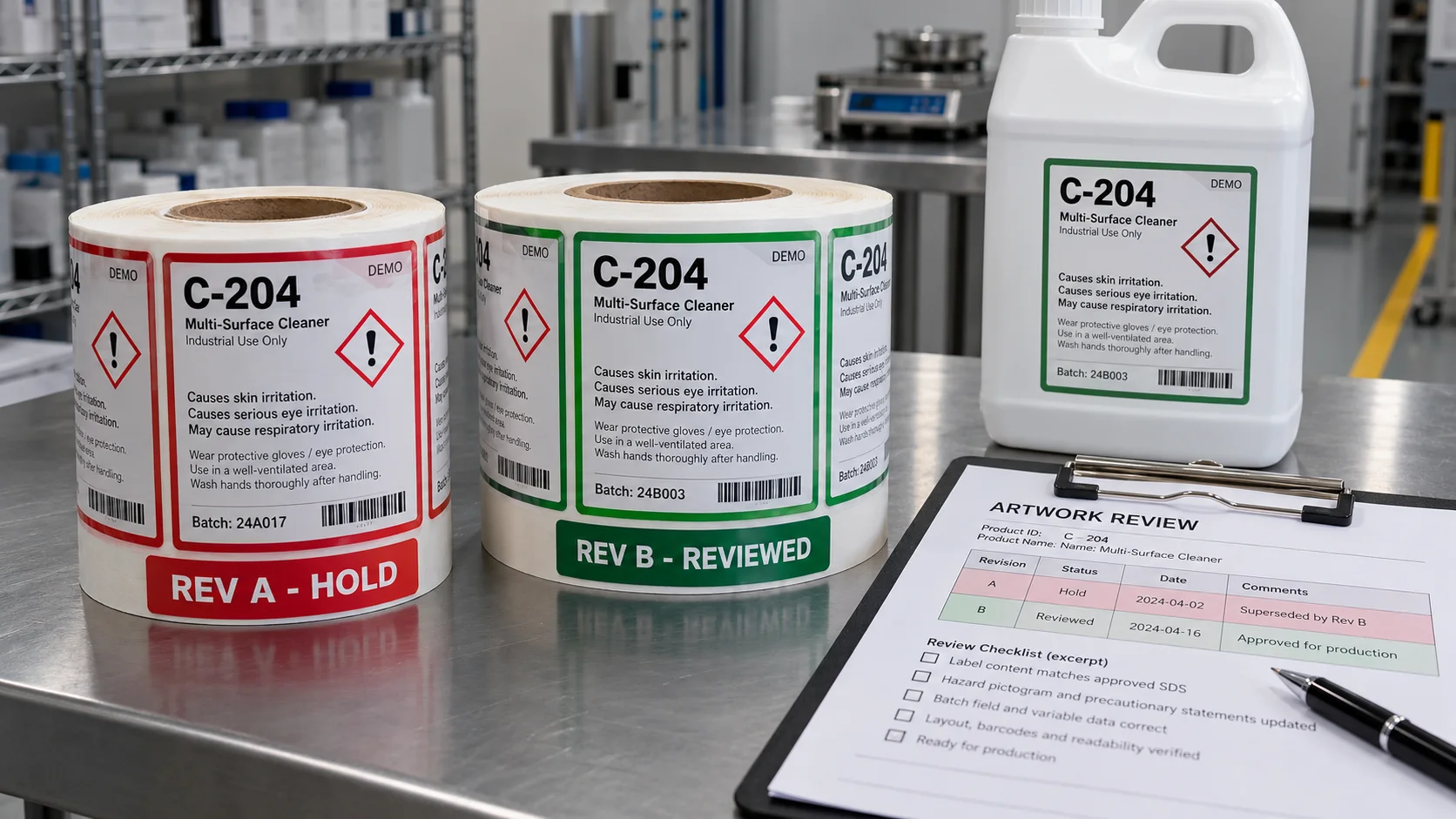
Put the old printed rolls on a controlled hold while the chemical owner compares the current approved SDS, hazard classification, market requirements and label artwork. An SDS revision does not automatically mean every label field changes, but the printer cannot make that determination from a version date alone. The responsible chemical manufacturer, importer or employer must decide the required content and timing under the applicable rules. For US hazard communication, OSHA specifies shipped-container label elements and provisions for updating labels when significant new hazard information becomes available.
Current US primary rule for hazard communication, labels and safety data sheets; confirm applicability to the product and transaction.
View detailsImagine a sample cleaner identified as C-204. A red-tagged Rev A label roll is still in the stockroom while the approved artwork team reviews Rev B. This is an illustrative scene, not a real chemical formulation or compliant label. The easy mistake is to send both rolls to the line because the product name matches. The safer workflow is to keep the old roll segregated, record its count and lot, and release only the exact version authorized for the next labeling job.
The qualified reviewer should compare product identifier, supplier details, signal word, pictograms, hazard and precautionary statements, language, container size and any required supplemental data against the approved source for each destination market. The design team checks space and legibility after content is approved. If the container size changes, a revised small-bottle layout may be needed even when the core hazard text is unchanged. Do not copy a pictogram from an AI image, an old drum photo or a competitor label into production artwork.
Define who can authorize continued use, rework, relabeling, return or destruction of Rev A material. Include labels already applied to containers, rolls in transit and cartons staged for filling; those are different states. The answer can depend on jurisdiction, shipment timing and product status, so a printer should not promise that one generic over-label will fix every case. Record the decision against the affected roll identifiers and production orders, then prevent automatic replenishment from the obsolete file.
Ask for a Rev B proof marked with product ID, market, language, container version and artwork revision. Check all required text at finished size on the real drum, jug or bottle. Match the proof to the approved content record and verify the print run is not mixed with Rev A. A sharp picture of a warning diamond is not proof that the wording is correct or that the label is compliant.
Send the buyer-approved new artwork and revision, affected container dimensions, surface and exposure details, quantities by version, deadline after internal approval, and disposition instructions for old rolls. If the label supplier is asked to review regulatory content, define that service and its qualified owner separately. The quote should state which version is being printed and how cartons and rolls will be identified at receiving.
FAQ
Not necessarily. A qualified responsible party must compare the change with required label content and applicable market rules before deciding.
No. The product owner or qualified regulatory reviewer must approve hazard classification and required label content; the printer can proof reproduction and readability.