HellermannTyton Identification Guide
Manufacturer overview of cable marker formats and sizing.
View detailsResource Guide
The deciding question is often not which product looks tougher in a catalog. It is whether the cable still has a free end when the marker is installed.
Published 2026-10-16
Digital proof before production. Material and adhesive options are discussed according to your application requirements.
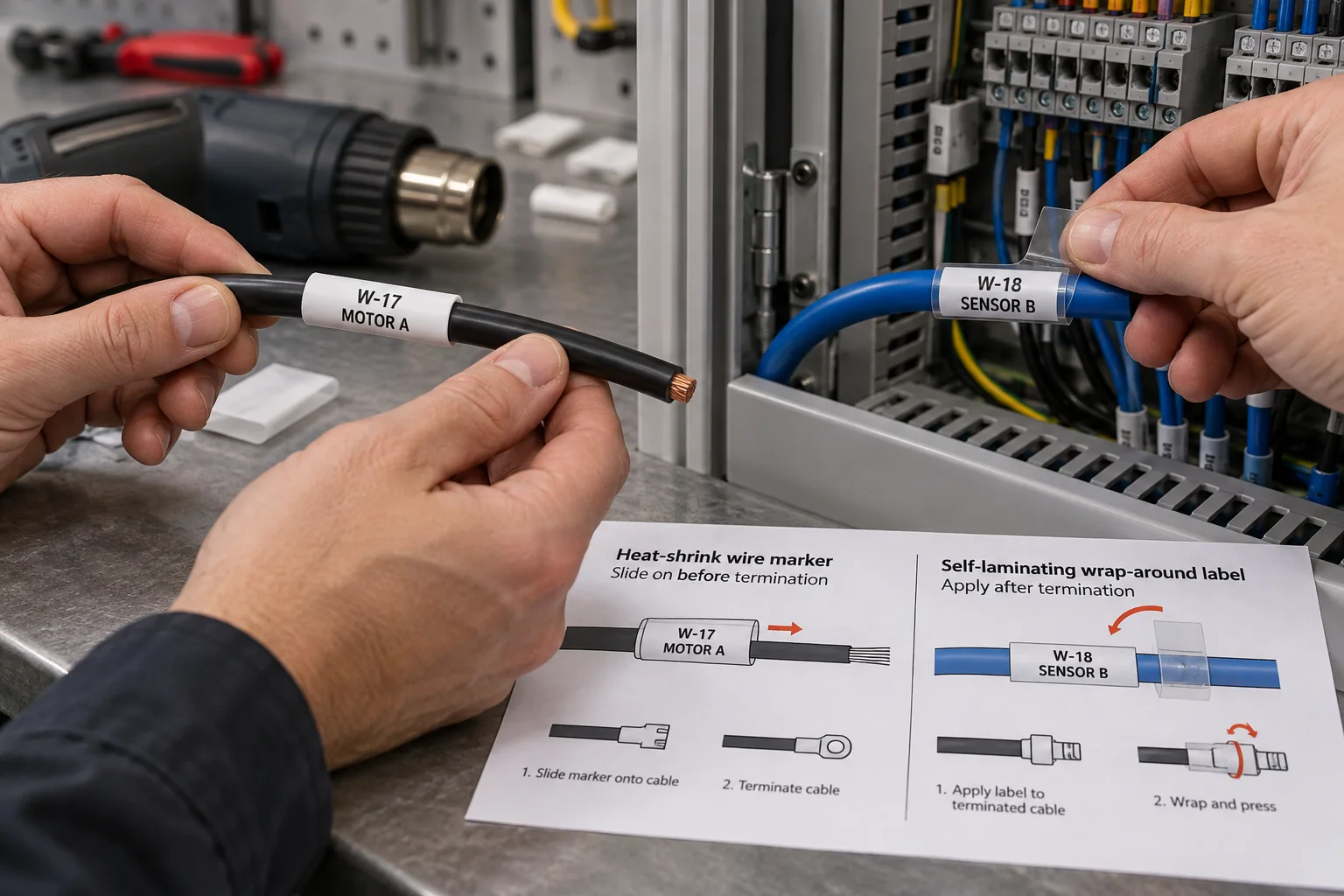
A conventional heat-shrink sleeve slides onto a cable before an end fitting blocks the path, then is shrunk under its product instructions. A self-laminating wrap-around label can be applied around an accessible cable after termination. Specialty products may differ; check the exact construction. HellermannTyton presents printable heat-shrink tubing and self-laminating labels as separate cable-ID options and recommends matching dimensions to the cable diameter.
Manufacturer overview of cable marker formats and sizing.
View detailsPicture a fictional electrician adding IDs inside an existing panel. The wires are already landed and the maintenance window is short. This is a composite example, not a customer project. A sleeve that needs a free end could force unnecessary disassembly. A correctly sized wrap may be simpler at the accessible sheath. During new harness fabrication, sleeves can be staged before termination and may fit the production flow better. The purchase decision follows the process.
Send smallest and largest outside diameters, insulation material, available straight section, viewing distance and whether cables move or rub. A wrap needs a sufficient overlaminate area without covering the printed ID. A sleeve needs a suitable recovered dimension and compatible print method. Do not assume one length reads equally well on a sensor wire and a larger power cable.
Each printed wire ID must match the buyer-approved wiring drawing or terminal schedule. The marker does not prove conductor rating, safe isolation or successful testing. Proof fictional sample IDs such as W-17 and W-18 first, then compare production data to the controlled schedule. A qualified electrical owner decides permitted placement and whether required terminal or manufacturer markings remain visible.
Fit a small batch on representative cables and close the cabinet. Read from the normal service position. Check whether a wrap edge catches adjacent conductors, a sleeve shifts, or either marker hides the relevant termination. Review the expected cleaning and handling routine. These are buyer acceptance checks, not a blanket claim of certified durability. A new harness and a field retrofit can justify different formats with identical printed text.
Provide cable diameter range, installation stage, cabinet photos, approved ID list, text height, color rule, quantity, printer or applicator constraints, exposure and sample owner. Ask for separate price and process notes for sleeves and wraps. Include how the marker would be replaced during service.
FAQ
A conventional sleeve needs a free end; confirm any specialty alternative against the exact product instructions.
No general comparison follows from the format alone. Compare specified materials and installed samples under the actual exposure.