Avery Dennison: Storage Conditions
Technical guidance for pressure-sensitive materials and finished labels.
View detailsResource Guide
Storage is part of a label purchase. Protect rolls, track batches and follow construction-specific conditions before judging the first application.
Published 2026-09-27
Digital proof before production. Material and adhesive options are discussed according to your application requirements.
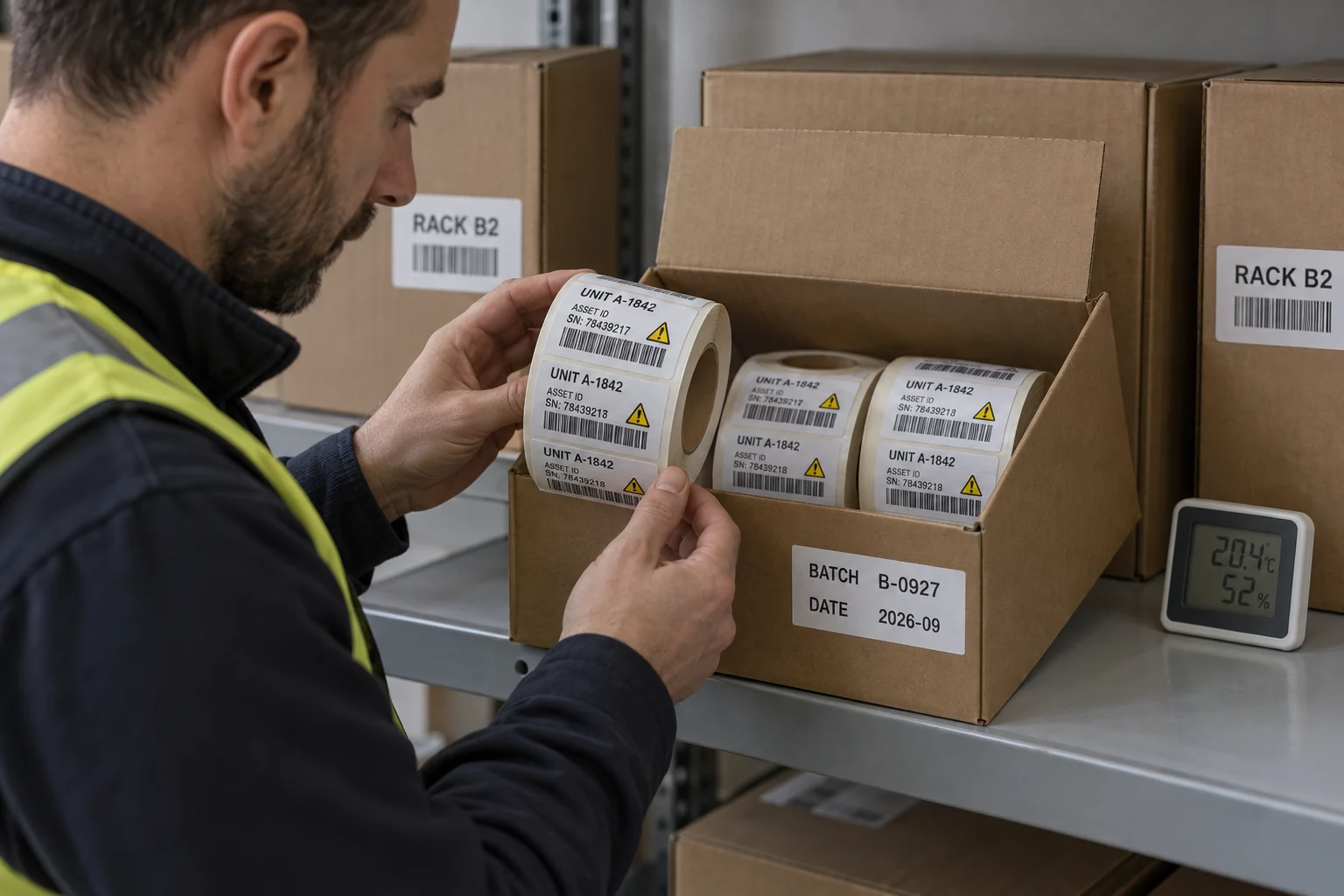
Keep rolls in suitable protective packaging, away from avoidable heat, moisture, direct sunlight and contamination. Record receipt and batch information, and follow the supplier storage and shelf-life guidance for the specific finished construction. Do not apply one universal temperature or expiry rule to every paper, film, adhesive and liner combination. Shelf life before application is also not the same as service life after the label is attached.
Imagine a roll arriving from a cold delivery vehicle and going straight onto a warm packing line. The first labels do not behave like the sample reviewed earlier. It is tempting to call the adhesive wrong immediately. Yet receipt condition, storage, conditioning and dispensing may all have changed. This is an illustrative warehouse situation, not a diagnosed failure. Start by recording what happened to that roll, and compare it with the supplier instructions before drawing a material conclusion.
Avery Dennison storage guidance explains that face stock, adhesive and liner influence aging and that both unconverted material and finished labels need appropriate conditions. Treat that as manufacturer guidance, not a universal guarantee for another supplier. Ask for the construction-specific instructions and clarify whether the stated shelf life relates to raw stock or your converted, printed label. Keep the batch identifier when removing outer packaging so a problem can be traced without guessing.
Before production, inspect an accessible label for print condition, flatness, liner damage, dispensing behavior and adhesion on the intended clean substrate. Check a populated code if the roll carries variable data. A roll can look fine while its storage history is uncertain; a successful trial does not automatically reset its shelf life. Conversely, an older unopened roll is not automatically unusable. Obtain supplier guidance for that batch and construction, especially after known exposure outside the recommended conditions.
A larger order may lower purchasing frequency but leave more stock sitting through seasonal changes or artwork revisions. Smaller planned deliveries may be worthwhile when storage is uncontrolled, demand varies or the label content changes frequently. Compare that tradeoff with setup and freight costs rather than assuming the biggest lot is cheapest overall. Include storage and delivery cadence in the quotation brief. If a suspect roll causes problems, preserve its packaging and batch record, set it aside, and compare it with a known-condition sample using the same application process.
Cover image: AI-generated indoor storage illustration. Meter readings and example batch markings are not a recommended universal storage specification.
FAQ
It depends on the specific material, adhesive, liner, conversion and storage history. Obtain the applicable supplier statement rather than using a universal number.
Check the supplier conditioning instructions and actual application conditions. Do not assume the delivered roll is ready simply because the room is warm.
Not automatically. A trial provides observations; it does not replace supplier guidance or extend a stated shelf life on its own.