Label Weathering Reports: Test Hours Are Not a Service-Life Promise
Published
One label proposal includes more weathering-test hours than another. Purchasing wants a clear winner and asks how many outdoor years each result represents. The quality reviewer has a different problem: the reports may describe different specimens, exposure cycles and definitions of failure.
Compare the reports before comparing the numbers. Accelerated weathering can support a useful material decision, but a universal hours-to-years multiplier cannot turn unrelated tests into a service-life guarantee. Identify the construction, conditions and evaluation criteria, then decide what conclusion the evidence actually supports for the equipment application.
Ask what was exposed
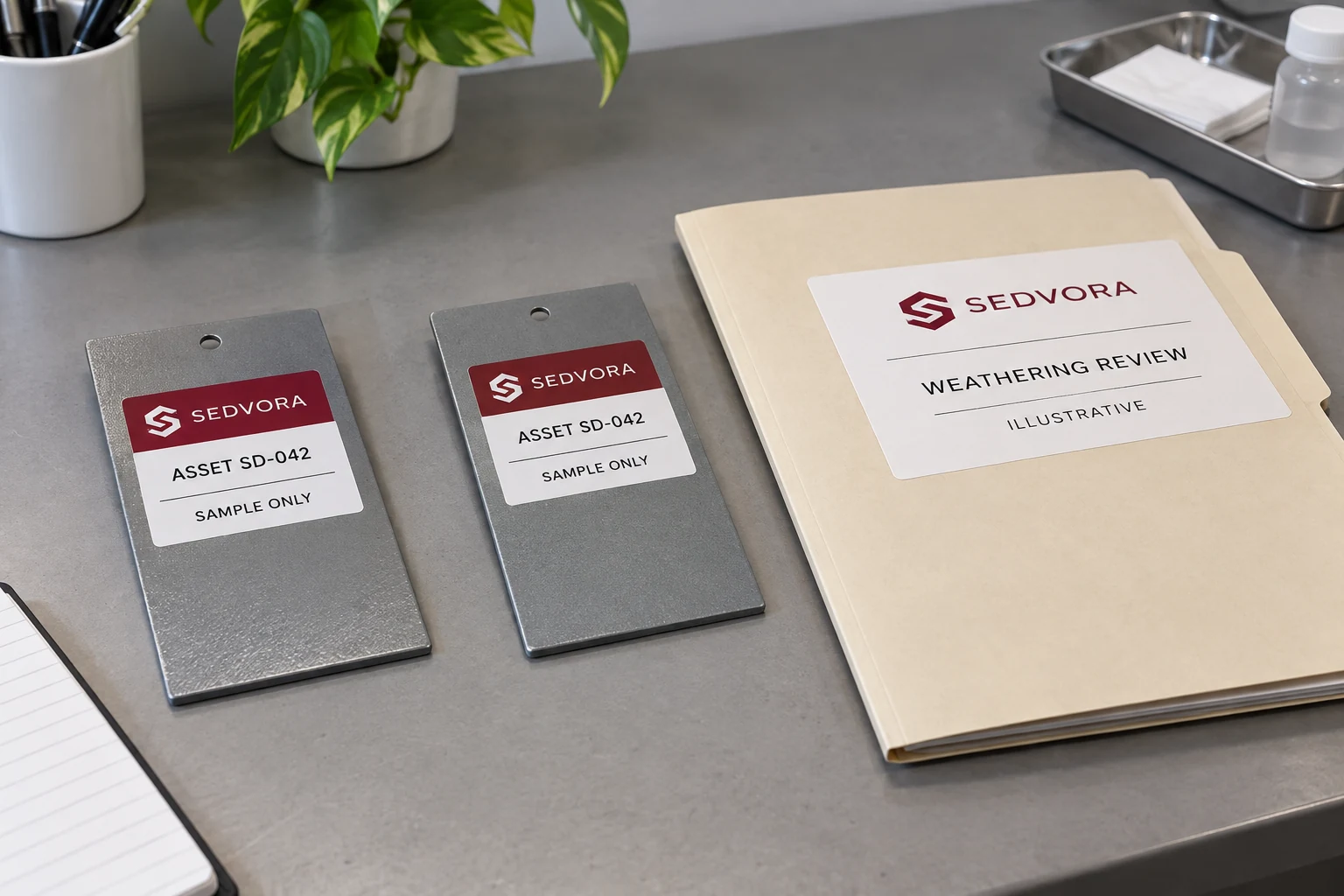
Start with specimen identity. Was the report about an unprinted face film, an adhesive construction, or a finished printed and protected label applied to a defined substrate? These are different objects. A result for a film alone may be relevant to material research without demonstrating the legibility or attachment of the finished equipment label.
Match the report reference to the proposed item. Ask whether the material, ink, finish, adhesive and preparation correspond to the order under review. Where a difference exists, record it and ask the qualified reviewer whether the evidence can still support the intended decision.
Do not silently expand the report's scope because the same supplier name appears on the quote. A supplier may legitimately offer several constructions with different purposes. The purchasing record needs to identify which one is supported by which evidence.
Read conditions alongside duration
Q-Lab's correlation bulletin explains why there is no universal conversion from accelerated weathering hours to years outdoors. It describes the importance of material, laboratory conditions and outdoor exposure, and distinguishes comparative results from an unrestricted prediction of service life.
That limitation does not make a report worthless. It changes the question. Instead of asking which number sounds longest, ask whether the candidates were evaluated under a sufficiently comparable method and whether the observations address the failure modes that matter to the buyer.
Obtain the full method reference and relevant cycle information from the actual report. A standard number printed on a summary sheet is not enough if the reviewer cannot identify the conditions used. The responsible technical reviewer should judge equivalence; procurement should not invent a normalization factor between incompatible reports.
Define the endpoint that matters
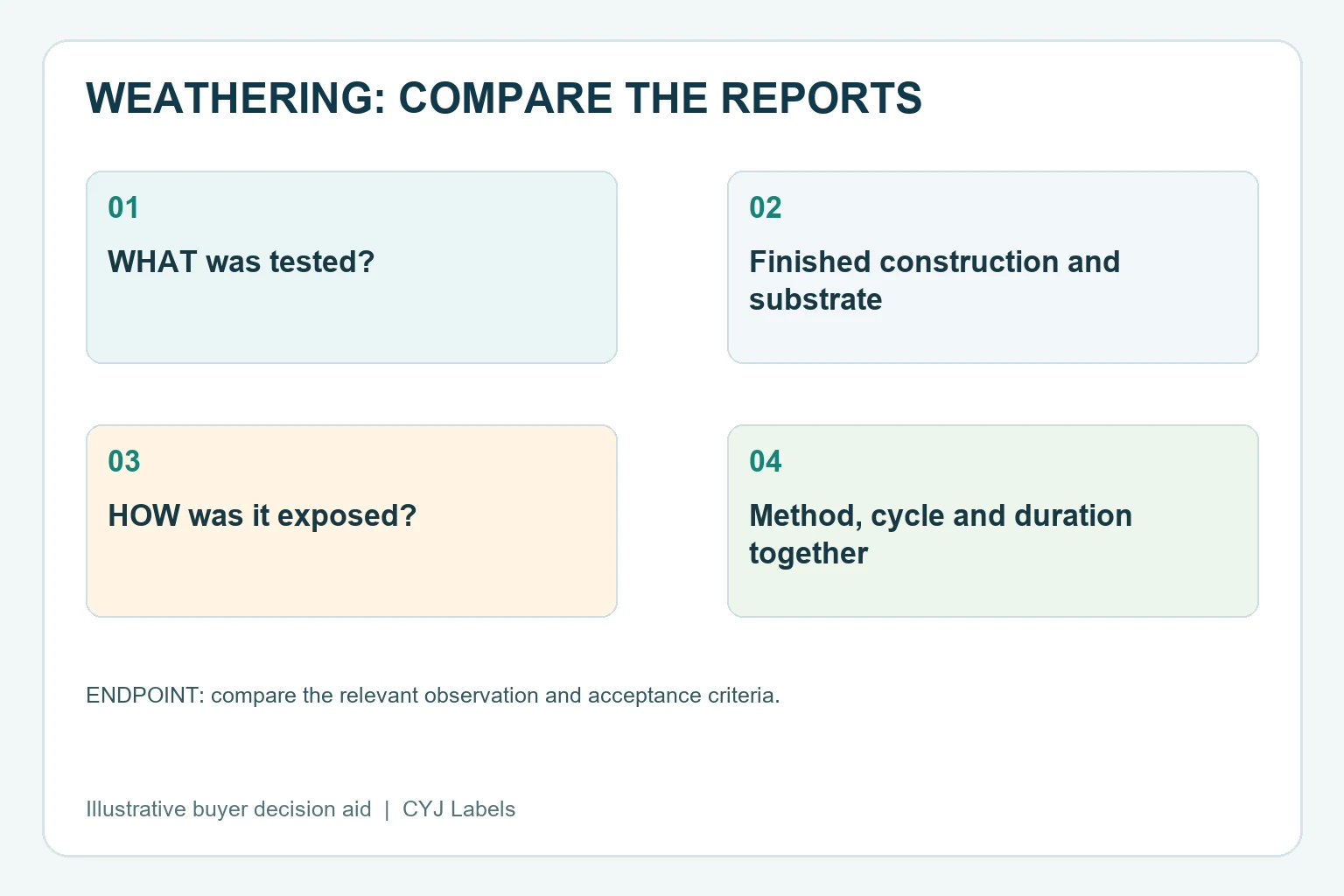
A label can remain attached while its important text becomes unreadable. Its color can change while an internal asset number remains usable. A barcode may decode in one viewing arrangement but fail the project's specified assessment. Decide which observations matter to the application before interpreting the reported result.
The outdoor equipment-label checklist helps define the actual exposure and information task. Carry those requirements into the evidence review. Do not import an unrelated supplier endpoint simply because it produces a convenient pass statement.
Ask what was measured or assessed, at which intervals, using what criteria, and whether the report contains the underlying observations. Keep qualitative photographs distinct from numerical measurements. Neither is automatically sufficient for every acceptance decision, and an attractive before-and-after picture cannot establish an unreported measurement.
| Comparison field | Candidate A | Candidate B | Reviewer decision |
|---|---|---|---|
| Finished construction | Record exact reference | Record exact reference | Same scope or documented difference? |
| Exposure method and cycle | Copy report reference | Copy report reference | Comparable for this question? |
| Applied substrate and preparation | Record actual specimen setup | Record actual specimen setup | Relevant to the equipment? |
| Evaluation endpoint | Record observed property and criterion | Record observed property and criterion | Answers the required failure question? |
| Duration and observations | Preserve both, without conversion | Preserve both, without conversion | What ranking or limitation is supported? |
| Service claim | State proposed wording separately | State proposed wording separately | Evidence sufficient for that wording? |
This is a proposed purchasing comparison table. It contains no test result and is not a substitute for the original reports or the technical owner's judgment.
Keep real service experience in context
Documented field experience may help the reviewer understand whether an accelerated comparison is relevant. Preserve the location, mounting, construction and observed period. Do not turn an anecdote about another installation into an unconditional life expectancy for the proposed label.
If a supplier presents an empirically established relationship for a specific construction and exposure, ask for its supporting scope and limitations. The correct response is to examine that evidence, not to accept every conversion or reject every effort at correlation. The claim must remain no broader than the conditions that support it.
Likewise, distinguish a commercial warranty from a test conclusion. The warranty may have terms and exclusions that do not appear in a laboratory report. Procurement should review the actual offered terms separately rather than assuming that a report creates a guarantee of replacement or a promised number of years.
A better next step may be a comparison, not a bigger number
If two existing reports cannot answer the decision fairly, the buyer may request a controlled evaluation using representative finished constructions and agreed criteria. The qualified owner should define the method, sample scope and interpretation. More hours under an irrelevant setup are not necessarily more useful evidence.
If the current qualified label already meets the application and the proposed change offers no established benefit, retaining it while investigating the alternative may be sensible. Where replacement is necessary, record the remaining uncertainty and obtain an appropriate decision rather than disguising it with a longer duration headline.
The sample-approval checklist remains useful for checking the actual label and application. A report review and a physical sample review support different parts of the purchase; neither should silently stand in for the other.
For custom industrial labels, prepare a weathering-evidence brief with the complete reports, proposed construction references, equipment location, surface, required readable information, exposure description, artwork and quantities. Organize those materials on the contact page and send files through email or WhatsApp. Ask what the evidence permits you to approve before asking how many years can fit into the quotation.