Equipment & Machinery Labels
For panel ID, operating information and machine warning labels.
View detailsResource Guide
Powder-coated metal can look like one uniform surface in a catalog photo. On the production floor, texture, coating, bends and cleaning determine where a label can be applied and how a sample should be reviewed.
Published 2026-09-27
Digital proof before production. Material and adhesive options are discussed according to your application requirements.
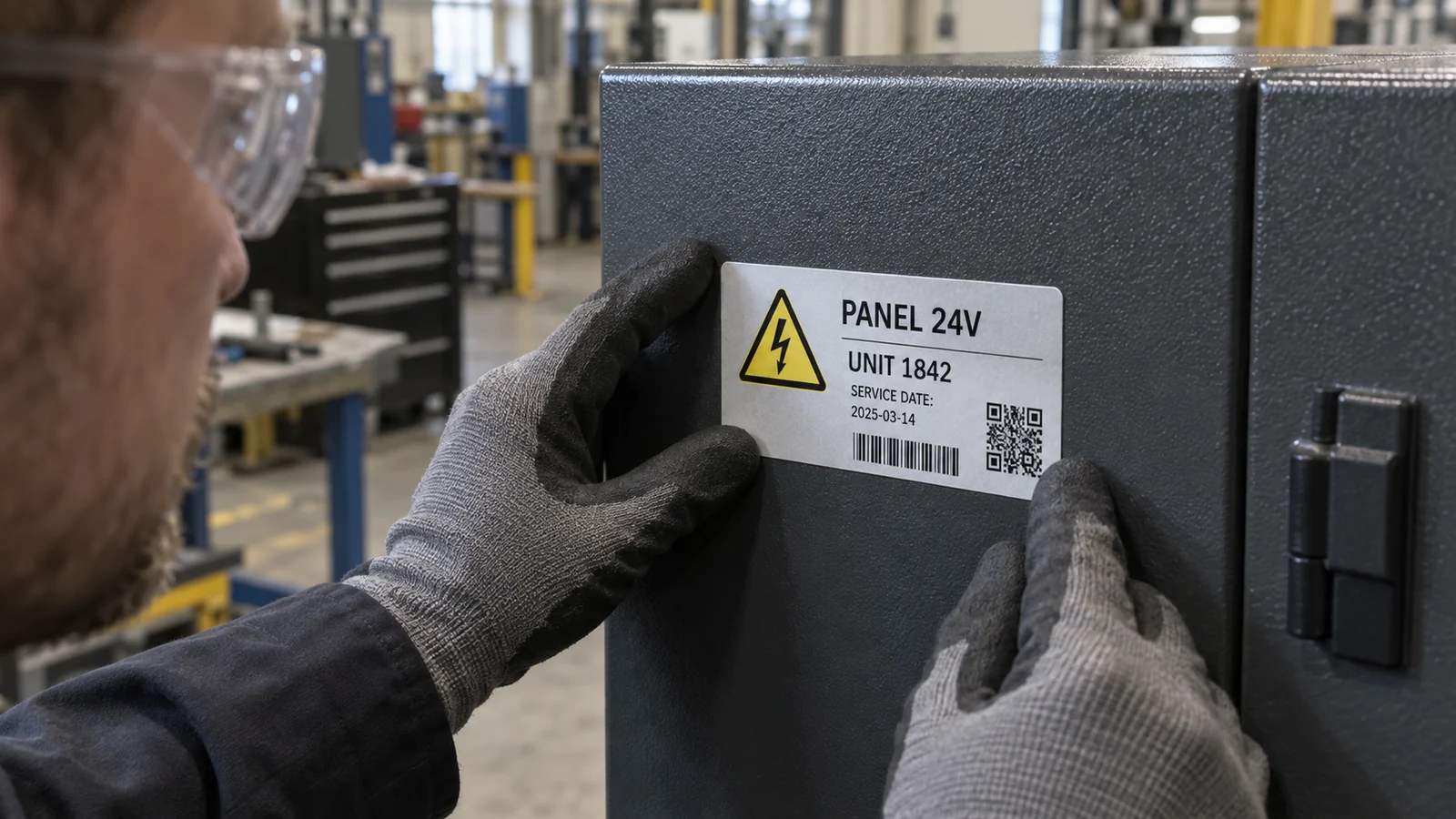
The adhesive meets the coating, not bare steel. Two enclosures made from the same metal can present different label conditions when the coating texture or finish changes. A material name alone therefore cannot settle the purchase. Photograph the actual panel at close range, including a side angle that reveals texture, and mark the proposed label area. The decision starts at that spot.
In a composite control-cabinet order, the team approves a neat warning and serial label on a PDF. The installer later places it beside a door bend so the operator can see it. One edge reaches into the curve while the other sits on a flatter panel. The print is correct, but the placement has changed the job. A slightly smaller label on a flat zone may be more useful than a large label that crosses the bend. That is a choice to make with the actual cabinet in view.
Give the factory enough detail to discuss construction and sample placement. A close photo and a measurement are more actionable than saying the label must be strong. If the coating supplier or specification is known, include it; if it is not, a representative physical part can help the review.
Discuss a sample on the production coating rather than a conveniently smooth test plate. Review initial placement, edge contact and readability, then evaluate it under the buyer’s own handling and cleaning conditions. If a coating change is planned, flag it before the label construction is treated as final. The sample is useful because it makes a surface decision visible, not because one quick hand peel proves every future condition.
3M lists powder coatings and textured surfaces among the applications considered for a specific thermal-transfer label material. That product example is context for the surface discussion, not a specification for this site’s products.
Manufacturer information on label constructions for powder coatings and textured surfaces.
View detailsFAQ
Some constructions are designed for powder coatings, but the actual coating, texture, placement and use conditions should be reviewed on a representative part.
A sample on the finished coating is more useful when that is the surface used in production.
Send a full-panel photo and a close side-lit photo of the exact application area, with measurements and nearby bends or seams visible.