Resource Guide
Labels for Textured Plastic Housings: Surface, Placement and Readability
A molded plastic housing may offer a rough outer shell, a smoother recessed panel and a curved edge within a few centimeters. A good label brief chooses the reading position and the real application surface together.
Published 2026-09-27
Digital proof before production. Material and adhesive options are discussed according to your application requirements.
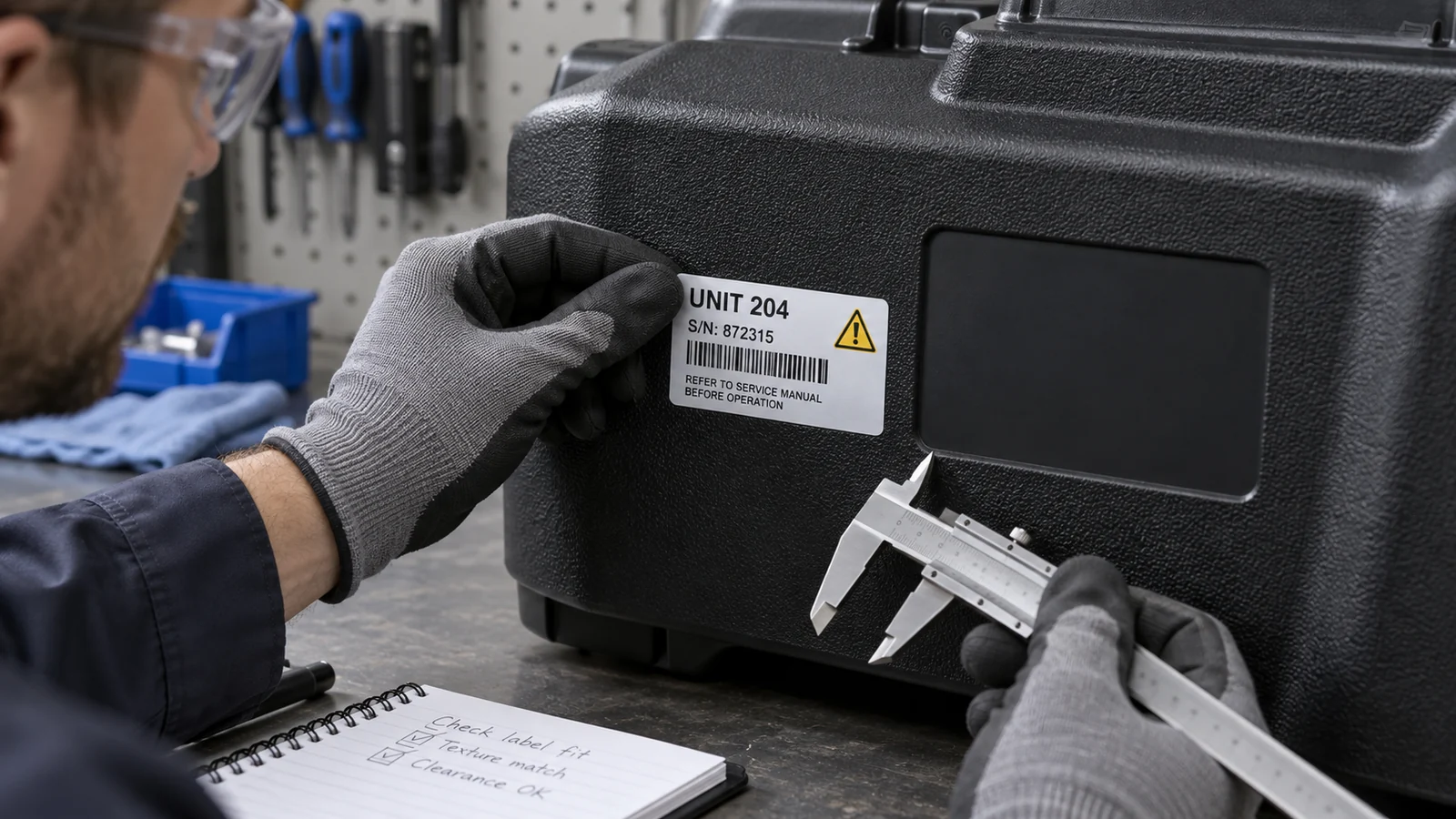
The Best Reading Spot May Be the Hardest Surface
The front of a housing is often where a technician will look for the serial number. It can also be the area with the deepest molded texture. The label has to solve two problems at once: stay in the intended position and leave the ID, warning or code easy to read. Before enlarging the label to fill the front, check whether a smoother molded recess is available and whether that position remains visible when the equipment is installed.
A Composite Service Case: The Code Was Easy to See Until the Lid Closed
In a composite service-equipment project, the proof shows a clear asset code on the case lid. A small smooth patch is available near the hinge, so the team first chooses it for easier application. In use, a strap covers that patch. The rougher front is visible but needs a different label discussion. This is the real tradeoff: placement cannot be judged by surface alone. The worker who scans the code has to reach it.
Identify the Plastic and the Molded Detail
Plastic families and surface texture affect label selection, but a generic word like plastic does not describe the part. The same housing may contain a smooth inset, a curved lip, molding texture and release-agent residue. Show the specific zone in a photograph and describe how it is handled before anyone recommends size or construction.
- Plastic type if known, plus a representative finished part
- Close photos of grain, molding marks, recesses and curved edges
- Application zone, finished dimensions and reading distance
- Cleaning, handling, abrasion and temperature after application
- Asset ID, warning text, serial and code fields that must remain readable
Prove the Use Position, Not Just the Flat Artwork
Apply a sample to the actual housing and view it after the lid, strap or adjacent component is in its normal position. Confirm that the label does not bridge a step, the code has room, and the human-readable identifier can be found without turning the product over. If the housing material or molding texture changes between suppliers, raise that before bulk production. A sample cannot stand in for a different plastic part.
Technical Reference
Avery Dennison explains that plastics such as PP and PE can be challenging for standard adhesive wet-out, while texture reduces contact area. The actual label choice still depends on the buyer’s finished part.
Avery Dennison: Application and Adhesive Considerations
Manufacturer guidance on low surface energy and textured substrates.
View detailsFAQ
Questions Buyers Ask
Can a label be applied to a textured plastic case?
It may be possible with an appropriate construction and placement, but review the actual texture, plastic, cleaning and use conditions on a representative part.
Should I move the label to a smooth molded recess?
A smooth recess may help the surface discussion, provided the code and essential text remain visible and reachable in normal use.
Do all plastic housings need the same adhesive?
No. Plastic type, texture, geometry, contamination and service conditions can differ substantially between housings.