Laser-Printable Equipment Labels: Qualify the Stock Before the Artwork
Published
Maintenance already has a color laser printer. The proposed equipment label is described as polyester and waterproof. It is tempting to buy blank sheets, load the serial-number file and avoid a separate printing arrangement. Neither description, however, answers whether that exact sheet belongs in that printer.
Obtain explicit compatibility information for the complete supplied media and the actual print path before committing to stock. Then evaluate the finished print and attachment in the equipment application. A sheet can be suitable for a printer without meeting the service requirement; an outdoor material can still be unsuitable for the chosen office device.
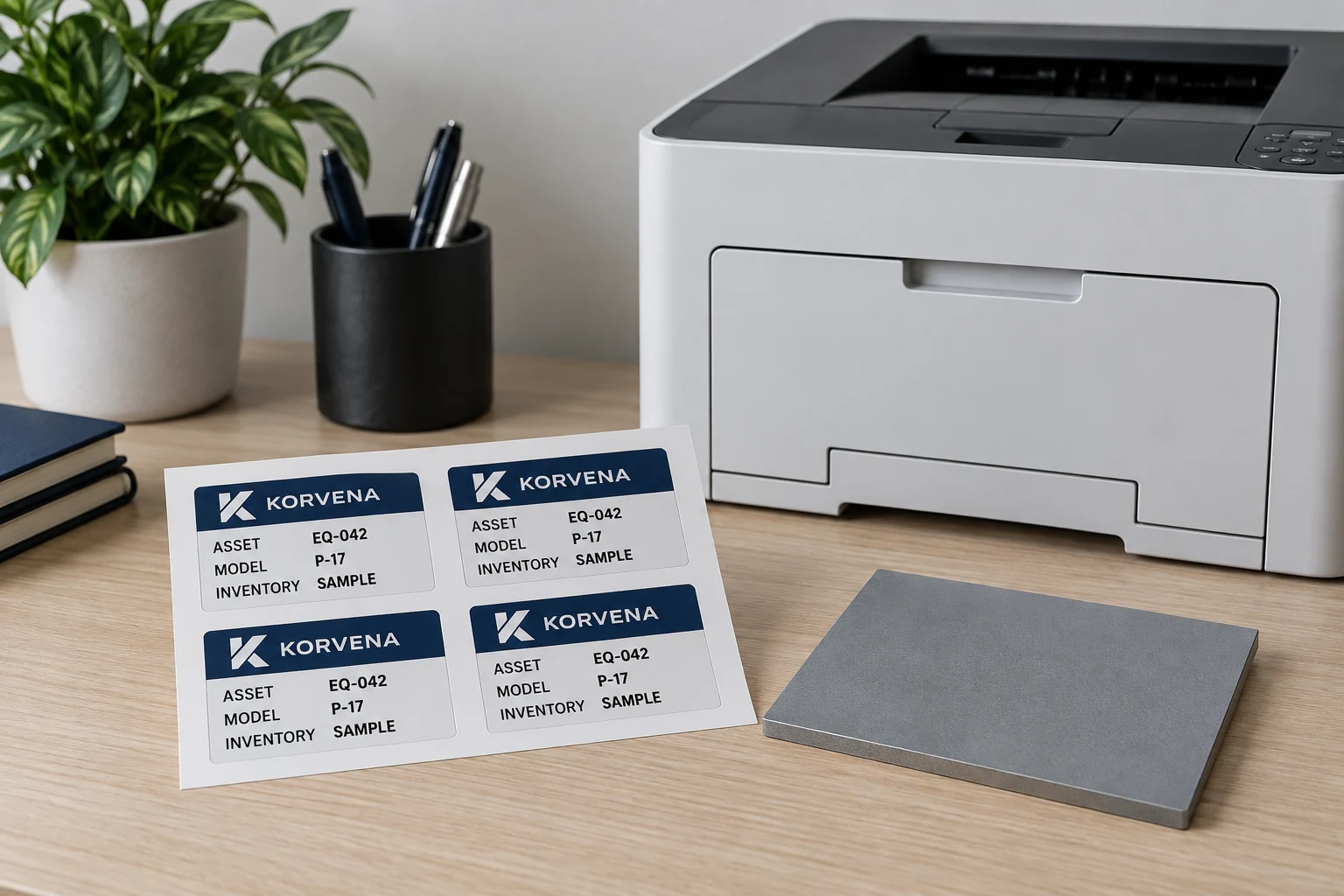
Start with the device, not the polymer name
Record the exact printer model and the intended tray or approved feed route. Obtain its current media guidance, including any restrictions relevant to labels. Ask the media supplier for documentation covering the particular finished sheet, not a statement about polyester labels in general.
The face film is only one part of the supplied product. The coating, adhesive, liner, thickness, cut pattern and any existing print or finish also belong in the compatibility question. Do not assume that a familiar material name makes two constructions interchangeable.
Avery's guidance on clear laser labels explains that its film products for laser and inkjet use require different print coatings. That product-specific explanation supports checking the intended printing technology. It does not certify another supplier's material or identify a suitable CYJ product.
Ask what will pass through the printer
A buyer may be asking for a fully blank printable sheet, a preprinted brand design with variable fields added locally, or a finished label requiring no local print. Write down which arrangement is intended. A reference sheet approved without a coating or overlaminate does not automatically cover a later finished version that includes one.
For preprinted stock, ask whether the supplied face and existing print are intended for the proposed second printing process. Identify the variable area, required black or color output, and the longest actual field. Keep the fixed and variable layers clear in the proof so a supplier can evaluate the real request.
Do not experiment with unknown media simply because the sheet fits the tray. The equipment owner should decide whether the documentation is adequate and what controlled evaluation is permitted. Loading instructions and restrictions come from the device and media documentation, not from a generic label article.
Separate three approval questions
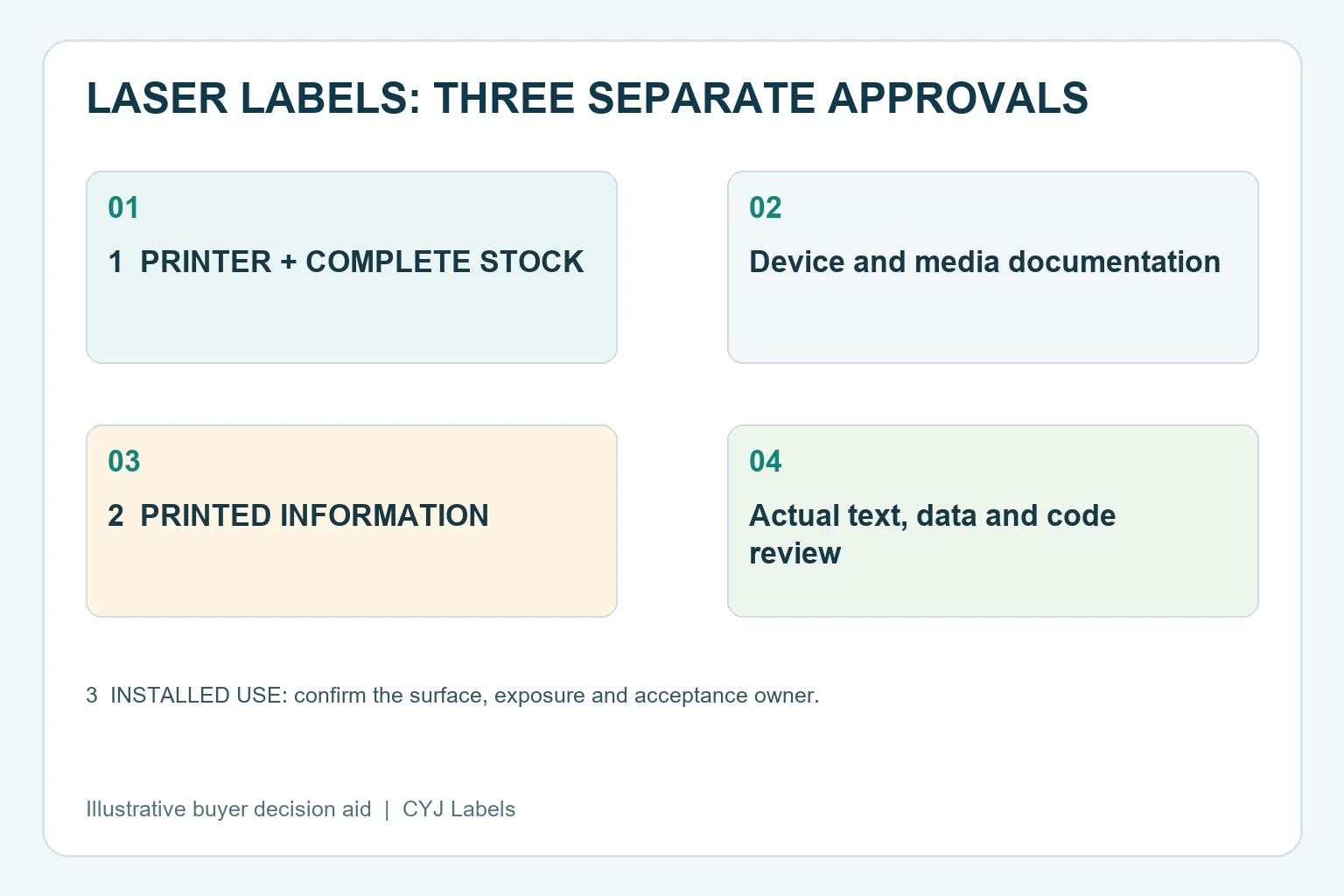
The thermal printing comparison covers direct thermal and thermal transfer systems. An office laser proposal creates a different device-media decision. Keep that decision visible rather than filing every printing method under the same approved material description.
| Approval question | Evidence needed | What it does not establish |
|---|---|---|
| Can this device process the sheet? | Exact device and media guidance; owner-approved evaluation | Long-term label attachment |
| Does the printed information work? | Real output with required text, codes and content checks | Resistance to every cleaning exposure |
| Does the finished label suit the equipment? | Actual substrate, application and relevant exposure review | Compatibility of another printer or revised stock |
Assign an owner to each question. IT may know the printer configuration, maintenance may know the cleaning process, and quality may own the readable-ID requirement. A purchasing signature should not silently substitute for all three decisions.
Review actual output before copying the approval
Once the processing route is accepted, use representative approved data. Include the smallest important text, longest field and required code. Confirm that the output contains the right information before examining its appearance. A beautifully printed but incorrect asset reference is still an incorrect label.
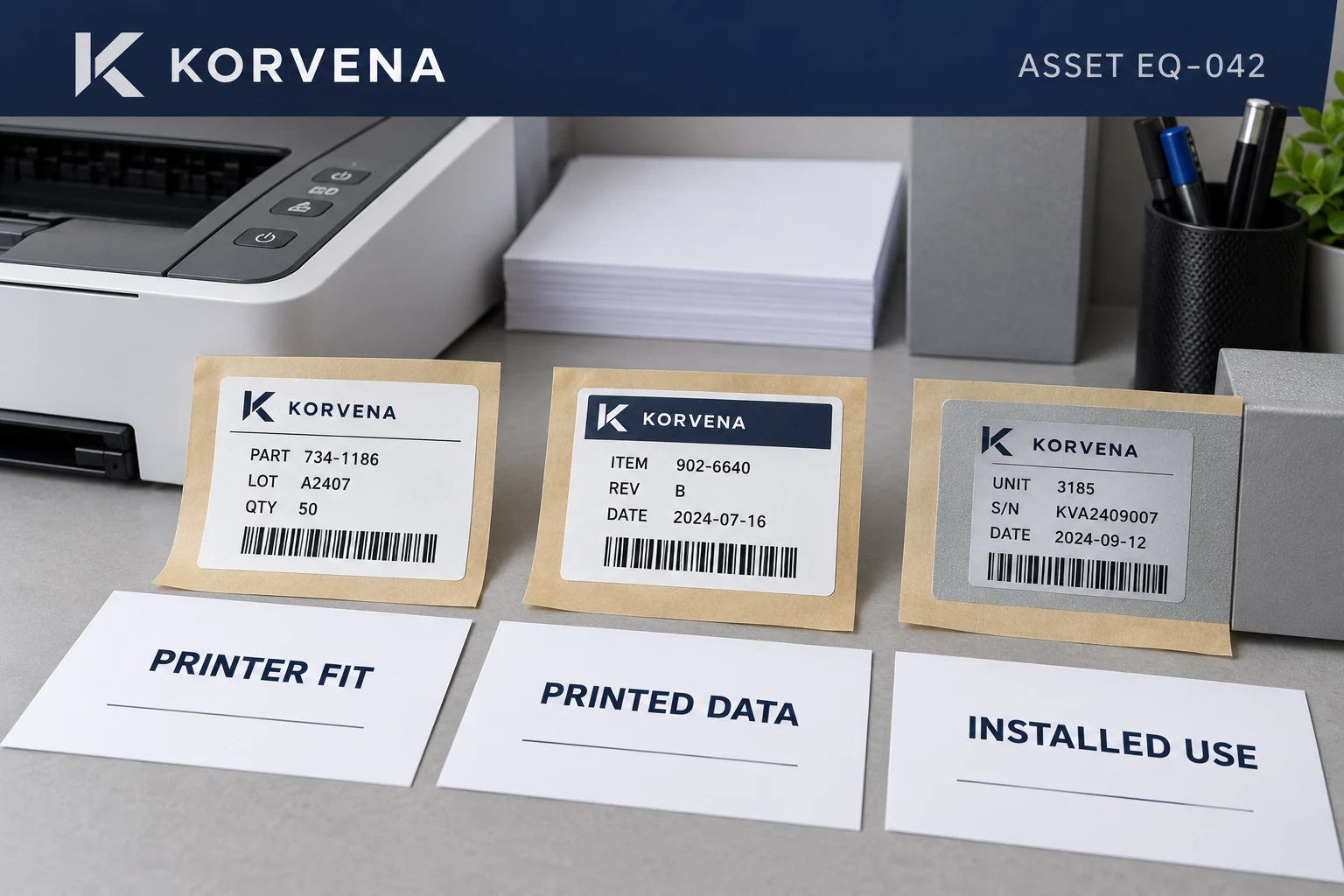
Review the label under the intended reading conditions. If a code is required, use the actual generated production symbol and the project's agreed scan or verification procedure. The illustration on this page cannot be used as a test pattern. Keep a record of the printer, media item and file revision associated with the observed output.
Then review the relevant handling and exposure requirements for that finished sample. Ask what documentation or agreed evaluation supports the claim being made. Avoid replacing a specific question about the buyer's cleaning agent with a generic statement that the unprinted film is waterproof.
Refeeding is a separate permission
A partially used sheet can look like an easy way to reduce waste. Do not infer that it may be fed again, or that a sheet with labels removed remains acceptable, from an approval for a complete sheet. Consult the exact media and device instructions for the intended condition.
Avery's sheet-label guidance advises against repeat feeding. That is a useful reason to make the question explicit, not a universal specification for every custom construction. If a workflow depends on printing one remaining position at a time, settle that workflow before ordering a large sheet quantity.
The alternative may be complete small sheets, a qualified roll-printing system or preprinted supply with the changing information handled differently. Compare usable output and the approved process. Counting unused rectangles is not enough to determine which route is economical.
When preprinted supply is simpler
If all information is already approved and changes infrequently, externally printed finished labels may remove an unnecessary local qualification step. Where serial values must be assigned at the equipment, a qualified on-demand process may be necessary. Neither arrangement wins simply because a printer is already sitting in the office.
Ask what evidence is available for the proposed route before committing to either. If the supplier cannot support laser-printable stock for the required application, preserve that limitation and evaluate another route. This article is a purchasing review method, not a promise that CYJ supplies a particular laser-compatible material.
For equipment and machinery labels, prepare a local-printing brief with the exact printer, intended feed route, proposed sheet construction, fixed and variable artwork, sample data, surface photos, exposure requirements and quantities. Organize the brief on the contact page and share supporting files by email or WhatsApp. Approve what will actually enter the printer before spending time perfecting the design on screen.