GS1 Logistic Label Guideline
Primary guidance for heterogeneous pallets and SSCC-linked contents.
View detailsResource Guide
A pallet carrying three tire sizes is not one tire SKU. Its outer label should identify the shipping unit and direct the receiver to the approved contents record.
Published 2026-09-29
Digital proof before production. Material and adhesive options are discussed according to your application requirements.
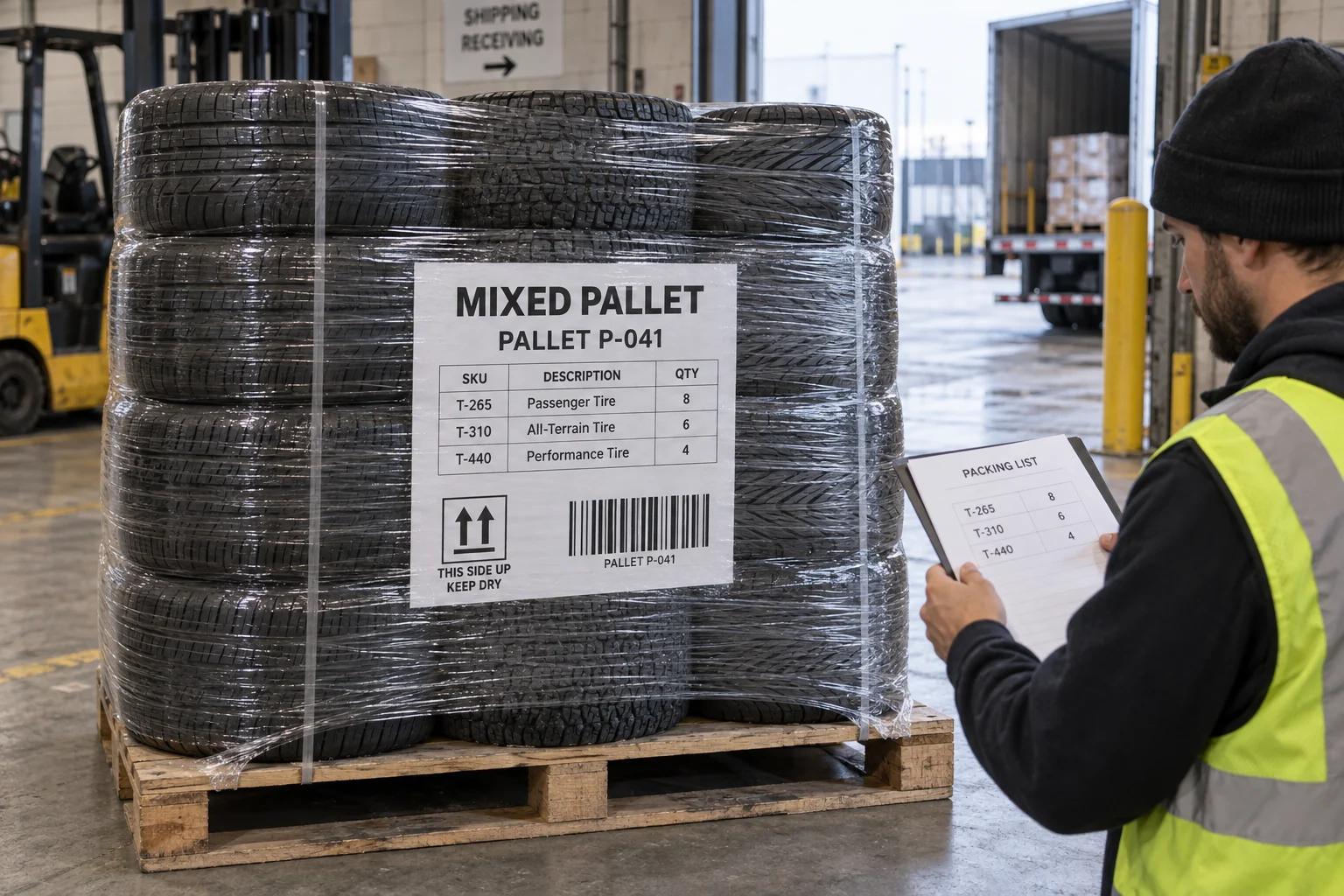
The pallet label and the tire tread labels serve different objects. In a GS1 logistics workflow, the SSCC identifies the logistic unit. The GS1 Logistic Label Guideline explains that a heterogeneous unit should not present one trade item as if it describes the whole load; electronic messages can link the unit ID to its contents. A buyer can still include a readable internal contents summary when useful, but it must not masquerade as a complete standardized data carrier. Check the receiving partner requirement before printing.
Primary guidance for heterogeneous pallets and SSCC-linked contents.
View detailsImagine a pallet with a popular passenger size on top and two less visible sizes beneath the wrap. A hurried picker writes the top SKU on the outer label. At receipt, the receiver expects a full pallet of that size. This is an illustrative process gap, not a reported shipment. More prominent print alone does not solve it. The packing record, outer pallet identifier and physical SKU counts need to agree before the stretch wrap closes the load.
Assign a pallet or dispatch reference, capture each SKU and quantity, and connect that record to the order. If a shipping unit uses GS1 SSCC, the responsible party must assign it under the correct rules; a decorative barcode from a supplier is not an SSCC. State whether the mixed load includes different buyer brands or market versions, and record the approved tire label revision where needed. A physical summary can help a human check the wrap, but electronic data is easier to update if the load composition changes.
Print the outer label only when the pallet contents are confirmed. Apply it where a driver or receiver can reach it without unwrapping, while protecting it from scuffs, folds and strap edges. If stacked pallets become one wrapped shipping unit, identify that grouping according to the actual logistics arrangement; GS1 describes separate unit IDs and an additional group ID in such cases. Ask the receiver which side should face the scanner. Test a wrapped sample at the real distance and angle.
Send the label dimensions, outer-wrap material, required fields, expected handling, printer or applicator setup and number of labels per pallet. Decide whether a preprinted shell with on-demand variable data is more practical than fully preprinted labels. Agree who owns the file that maps pallet ID to tire SKUs. The label supplier can help with stock, print and format, but cannot verify the tire counts unless that checking process is explicitly part of the order.
FAQ
Do not represent a heterogeneous load as one trade item. Follow the buyer and applicable GS1 logistics specification.
Usually not when individual tire identification is needed after the pallet is opened. Define each scan point separately.