GS1 Logistic Label Guideline
Primary distinction between outer-case markings and logistics labels.
View detailsResource Guide
A tire label and a shipping label may carry the same SKU, but they do different jobs. Decide what must be read on the tire, on the outer case and at dispatch before ordering either roll.
Published 2026-09-28
Digital proof before production. Material and adhesive options are discussed according to your application requirements.
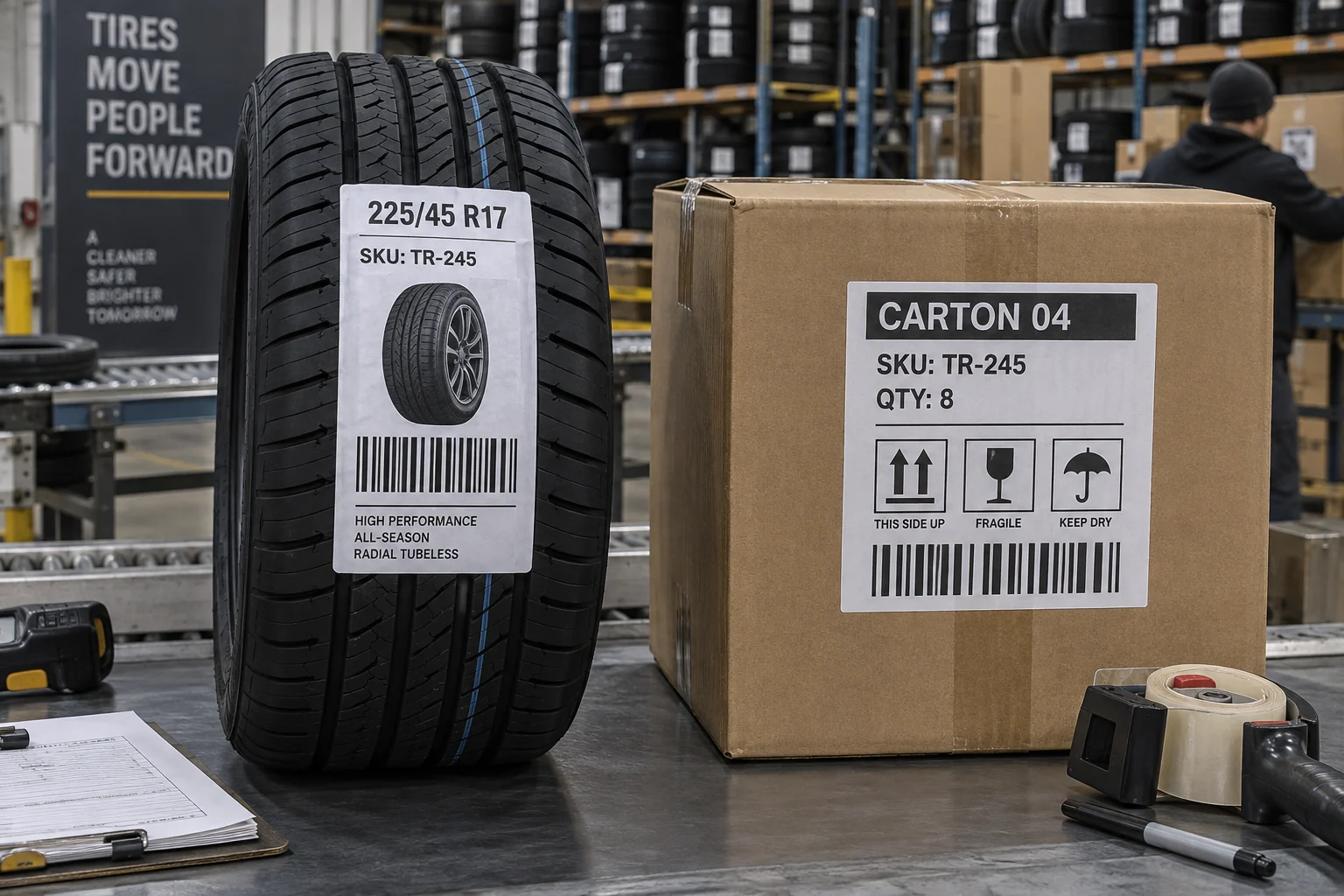
The label on an individual tire helps a person or system identify that tire or tire type at the point of handling. A carton or outer-case label identifies what is in a case. A logistics label identifies a particular shipping unit such as a case or pallet. Do not reuse one barcode everywhere simply because the artwork looks consistent. GS1 distinguishes trade-item markings from a logistics label bearing an SSCC; the right identifiers depend on the actual business process and trading-partner requirements.
Imagine a warehouse packing several tires of one size for a distributor. At the tire rack, the picker needs tire size and buyer SKU immediately. At dispatch, the receiver needs to match the sealed unit to the shipping record. This is a composite example, not a reported customer case. If the tread label is the only identifier, opening a wrapped case may be the only way to check contents. If only the case is labeled, an unpacked tire may lose its visible picking reference.
Make three rows: tire, case and pallet or other shipping unit. For each row, name the party that owns the identifier, the scan location, human-readable fallback and whether quantity is fixed or mixed. Keep tire size and product SKU aligned, but do not silently treat a case ID as an individual tire serial. If the buyer uses GS1 identifiers, obtain the assigned data and format from the responsible company; a label printer should not invent an SSCC or GTIN.
A tread label is applied to a curved, textured rubber surface; a carton label is usually applied to paperboard or film. A shared design does not mean a shared adhesive construction. Ask for samples on the actual tire and packaging, then review removal, handling and scan access. For cases, avoid a barcode across a fold, seam or closure. For tires, check whether the label can be seen and removed in the intended workflow. These are project checks, not a promise of universal adhesion.
Provide photographs of both application surfaces, the label size range, SKU count, data file owner, quantity per case, scan equipment and whether labels are applied by hand or by machine. Include the buyer specification if one exists. Ask the supplier to quote each construction and roll format separately. A low unit price for the wrong scan point costs more attention on the warehouse floor than a clearly mapped label system.
FAQ
Only when the data meaning and buyer workflow genuinely match. Do not use a carton or logistics identifier as an individual tire identifier without an approved scheme.
Under GS1 guidance, the party creating the logistics unit normally assigns it using its own GS1 Company Prefix. Confirm the trading-partner process.