Resource Guide
Wheel and Tire Assembly Labels: Set IDs
The tire has a size and stock record. The wheel has another. Once they are mounted, the warehouse handles one unit. That unit needs a set identity that does not erase either component.
Published 2026-10-04
Digital proof before production. Material and adhesive options are discussed according to your application requirements.
Quick Answer: Three Records, Not One Overloaded Sticker
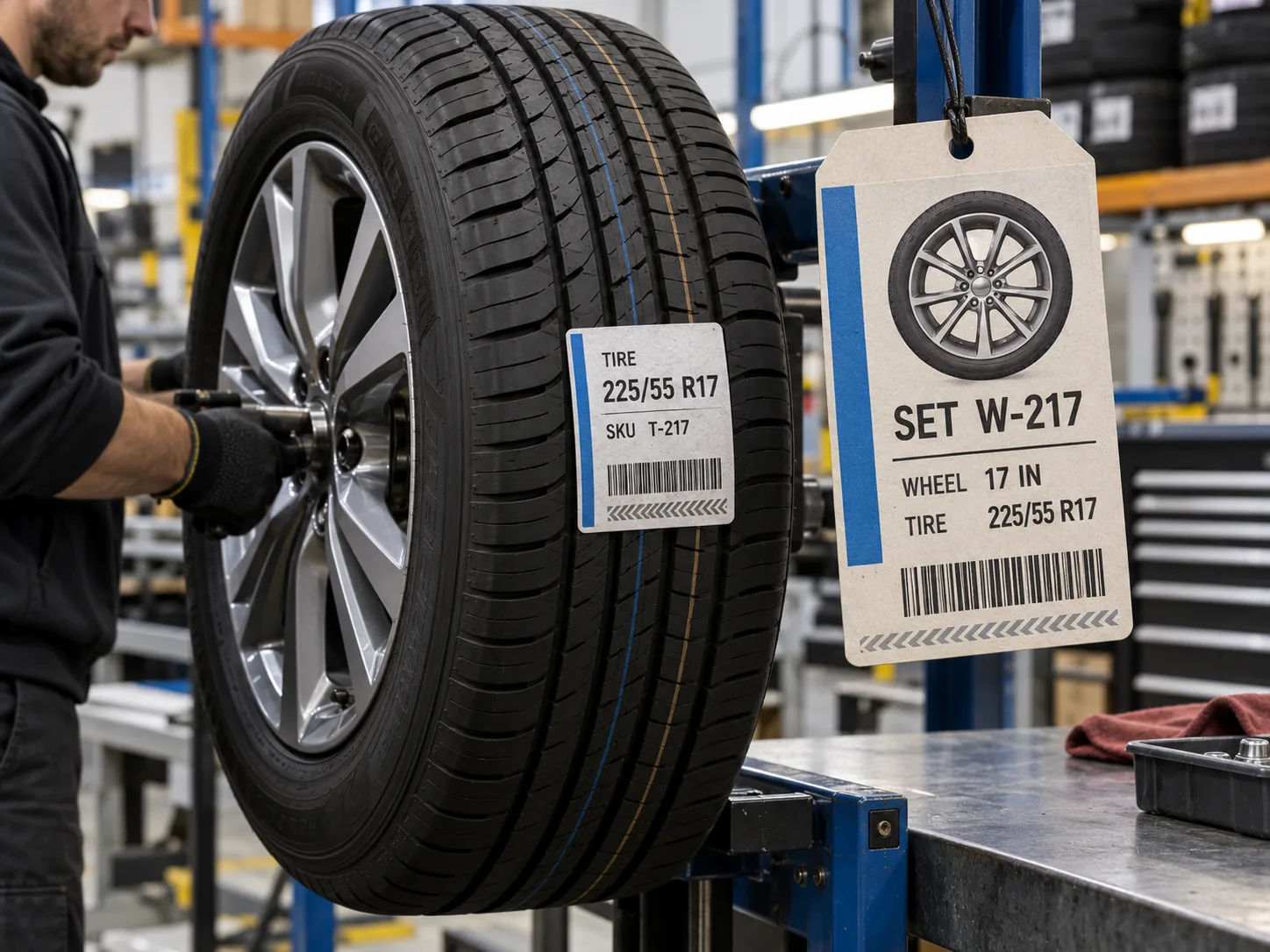
Keep the tire record, wheel record and mounted-assembly record distinct in the buyer system. The outer set label can carry the assembly ID, approved configuration and scan code; the tire tread sticker does not need to become a complete bill of materials. A code should resolve to the exact approved set and its component records. Nothing on a label establishes mechanical fitment or torque approval: those remain with the responsible assembly process.
An Illustrative Packing Decision
Imagine two mounted sets with the same tire size but different wheel finishes awaiting dispatch. This is a composite scenario, not a production case. A tire-size-only label invites the picker to treat them as interchangeable. A set ID tied to the wheel variant gives receiving a single value to compare with the order. If the tire sticker remains visible, it still serves the tire information job; the outer assembly tag serves the packed unit and should not contradict it.
Where the Set Label Goes
Agree whether the set ID appears on a swing tag, protective wrap, carton or another buyer-approved surface. Avoid placing a new adhesive over tire markings, wheel finishes, valve components or required product labels. A removable outer tag may be better than a permanent wheel sticker if the customer will discard the packaging. Photograph the packed unit from the direction a dock worker will scan it. The chosen placement should survive normal handling without pretending to be a permanent part marking.
Proof the Data Relationship
Send the printer an approved table with one row per set: assembly ID, tire SKU, wheel SKU, variant, quantity and any destination-specific text. Print a sample and scan the set code into the actual order record. Check that the human-readable tire size and wheel designation agree with the data row. A visually attractive set label cannot repair a wrong component mapping.
- SET: unique assembly or kit identifier.
- TIRE: approved tire part and size.
- WHEEL: approved wheel part or finish variant.
- PACKAGE: outer placement and scan face.
- CONTROL: revision owner and first-article check.
A Quote Brief for the Label Supplier
Provide images of the mounted and packed product, proposed attachment method, approximate label size, data fields, number of variants, print quantities and sample scans. Say whether the label is preprinted or receives variable data at assembly. Ask for a finished-size proof with representative fictional data before production. The quote should distinguish tire-level stock labels from set-level tags so the wrong construction is not ordered for both jobs.
FAQ
Questions Buyers Ask
Can a tire tread label also be the assembly ID?
Only if the buyer data model and physical scan path support it. Usually the assembly is a separate record, especially when wheel variants share a tire size.
Does the label prove the wheel and tire fit together?
No. Fitment and assembly approval belong to the responsible buyer process; the label reproduces its approved identification data.