GS1 Implementation Guideline: Components
Official distinction between components and trade-item hierarchy.
View detailsResource Guide
A maintenance kit has its own pick and issue task, while the bolts, seals and bearings inside may have separate part numbers. Make the outside label useful without turning a kit number into a substitute for each component.
Published 2026-10-01
Digital proof before production. Material and adhesive options are discussed according to your application requirements.
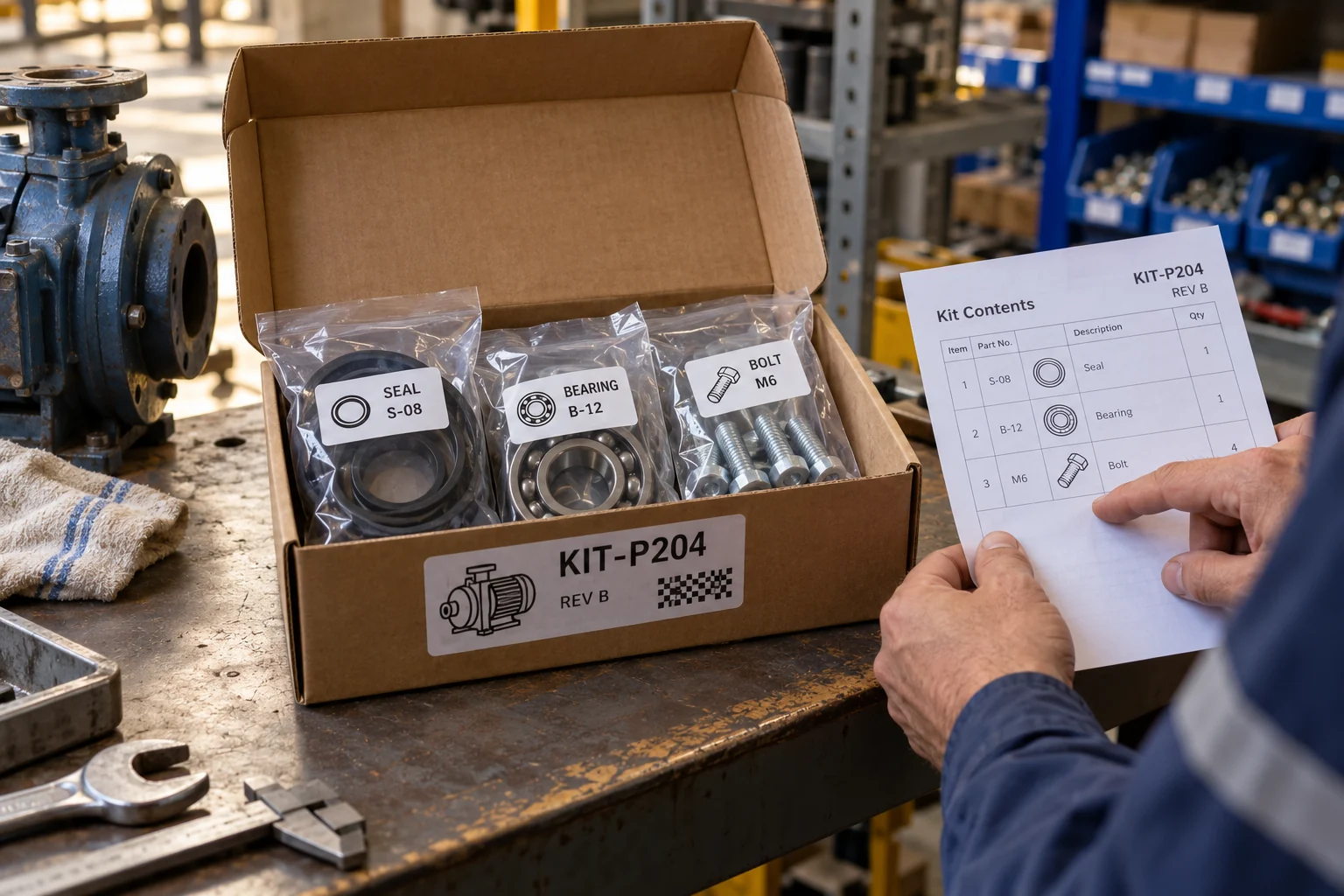
The outer kit label should identify the kit as the warehouse issues it. Each component needs its own approved part or lot identity when the receiving, replenishment or repair process requires it. GS1 distinguishes a trade-item hierarchy from components within a larger item; a kit can be represented according to how it is traded and identified. That does not require every internal maintenance kit to use a GS1 GTIN. Use the ERP or trading-partner scheme assigned by the item owner, and never create a standards identifier simply to fill a barcode.
Official distinction between components and trade-item hierarchy.
View detailsImagine a technician collecting a pump service kit from the store. The box says KIT-P204, but the seal inside has been substituted and the inventory system still lists the earlier component. This is a composite buying example, not a documented customer problem. A polished outer label cannot correct an unapproved bill of materials. Make the kit revision and contents record visible to the picker, and give each traceable component a separate label or supplier marking as required by the maintenance program.
Agree who owns the kit bill of materials, who approves substitutions and when a change triggers a new kit revision or identifier. A shipping carton label may change for every order, while the kit product identity remains stable until its definition changes. Some tiny loose parts cannot reasonably carry a sticker; an inner bag or compartment label may be the practical carrier. Consider whether the technician needs the exact part number at the machine or only the kit ID at issue. The answer changes the print hierarchy.
Put finished-size labels on the real carton and inner bags. Verify that the outer ID remains visible after tape and shipment markings, and that inner labels do not fall into the wrong compartment. Scan at the receiving shelf and again where the technician opens the kit. Small print may look fine on a PDF but become unreadable on a clear bag over a metal part. If a serialized component is required, validate the variable-data file against the parts record rather than assuming the kit code covers it.
Send kit artwork, approved bill of materials fields, number of kit variants, inner packaging, label locations, shelf and field scan devices, expected quantity and whether labels are preprinted or produced at pack-out. Separate the purchase quantities for outer and inner labels. Ask for one complete mock pack, not just a strip of loose sample stickers. The printer can make the label system legible; the buyer must govern the kit identity and contents.
FAQ
Not automatically. The receiving, inventory and service workflow determines which parts need separate identifiers and where a label can be applied.
The item owner should assign and approve the kit identifier and bill of materials. The printer reproduces approved data.