Resource Guide
Warehouse Bin Labels vs Part Labels: Keep Place and Product Separate
The bin stays in place while parts move. A location label tells staff where to go; a part label tells them what they have. Printing the same code on both creates quiet inventory errors.
Published 2026-09-30
Digital proof before production. Material and adhesive options are discussed according to your application requirements.
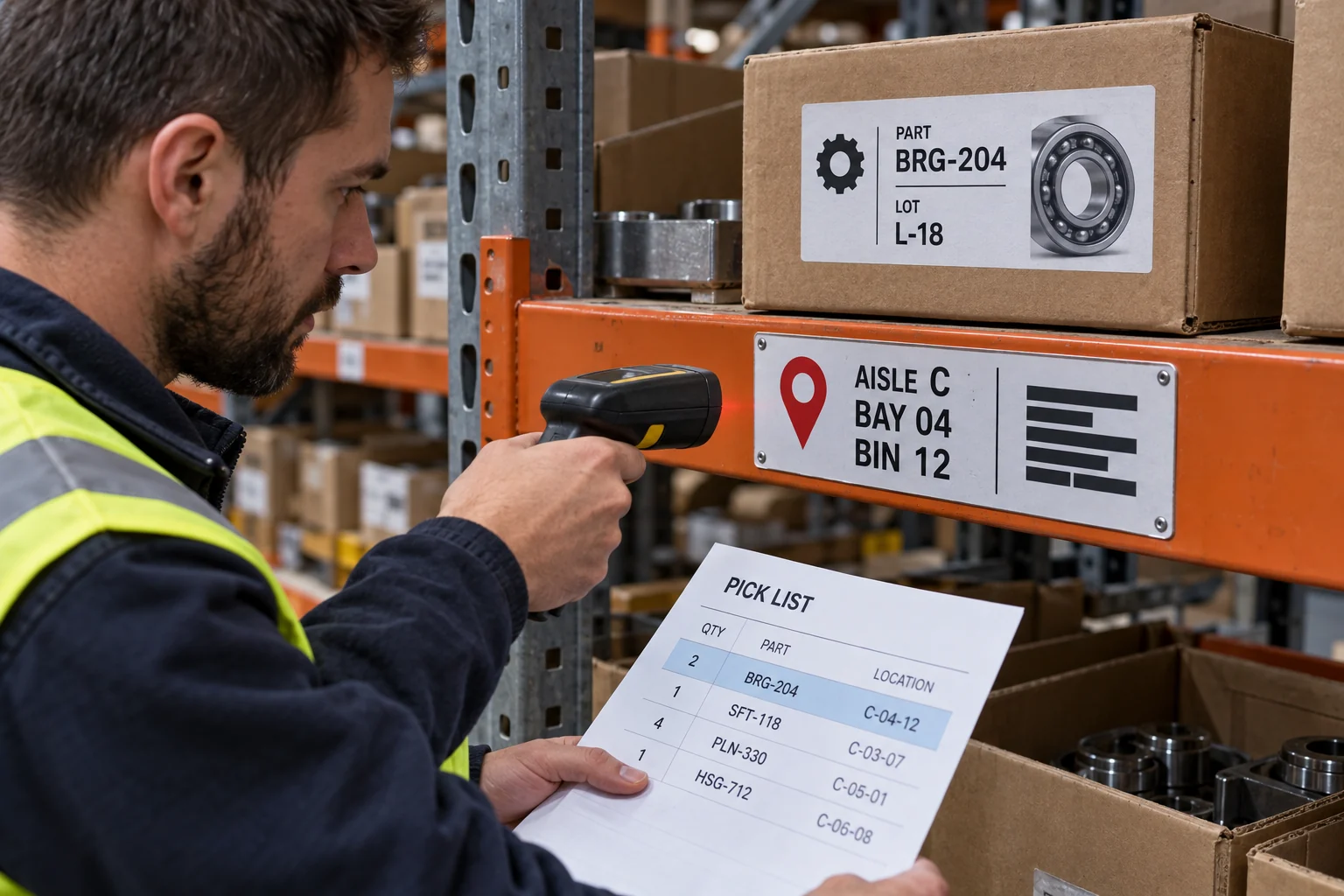
Quick Answer: Give Each Identifier One Owner
A rack or bin label should encode the physical location assigned by the warehouse system. A part label should carry the approved product or lot identifier, according to the receiving workflow. GS1 explains that a physical location can be identified by a Global Location Number, and its AI (414) can represent that location in a GS1 barcode. This does not mean every internal bin requires a GLN: use the identifier scheme mandated by the system owner. Do not invent a GS1 key on artwork.
An Illustrative Put-Away Error
Imagine shelf C-04-12 carrying a large barcode. A box of bearings arrives with a nearly identical-looking label. A worker scans the shelf, then the box, but the mobile screen does not show which value belongs to which field. This is an illustrative scene, not an incident claim. Make the location sign visibly different from the product label, and configure the workflow to ask for location and item in a deliberate order. The graphic design supports the software rule; it cannot replace it.
Design for the Reader and the Distance
A rack identifier must be visible from the aisle where scanning occurs. Choose height, contrast, mounting surface and code size for the actual scanner and reach distance. A part label may be smaller because it is read in hand, but it may also need lot, serial or handling information. Keep human-readable text beneath or beside the code for recovery. Verify that labels do not wrap around uprights, disappear behind stock or get covered by temporary shipment stickers. A scanner test at desk distance is not the same as a scan from an occupied aisle.
- LOCATION: aisle, bay, level and bin scheme owned by the WMS.
- PART: SKU, lot or serial fields approved by the product master.
- SCAN: device, distance, angle and expected workflow prompt.
- SURFACE: rack coating, tote plastic or carton material.
- CHANGE: who updates location signs when a layout changes?
Avoid Relabeling the Wrong Thing
When stock moves, its part identity should move with it; the bin sign remains. When shelving is rearranged, update the location map and physical signs together before new put-away starts. A temporary pick label can supplement the stable location marker but should not cover it. Control old-label removal, especially where staff can scan either an outdated code or a new one. If the same part occupies several bins, the part ID stays the same while each location ID differs.
A Better Quote Pack
Supply the location hierarchy, sample data records, rack dimensions, mounting photos, scanner model, viewing distance, label quantities and replacement process. Separate durable rack markers from removable carton or item labels on the purchase order. Request a full-size mock-up on a representative rack and test it during an actual pick and put-away sequence. The label supplier can propose material and print layout; the warehouse owner must approve the data and process.
FAQ
Questions Buyers Ask
Can a part number identify a bin?
Not reliably. Parts move and one SKU may occupy several bins. Use a location identifier owned by the warehouse system.
Must every bin use a GS1 GLN?
No. Use a GLN when the applicable trading or system specification requires it; an approved internal location code can suit an internal workflow.