ISO/IAF Auditing Practices: Service Organizations
Primary quality-auditing guidance on control and identification of nonconforming outputs; not certification of this website or buyer.
View detailsResource Guide
The carton is still part V-204, lot L-18. Its status has changed to HOLD FOR REVIEW. One identifier tells staff what it is; the other tells them what they may not do yet.
Published 2026-10-07
Digital proof before production. Material and adhesive options are discussed according to your application requirements.
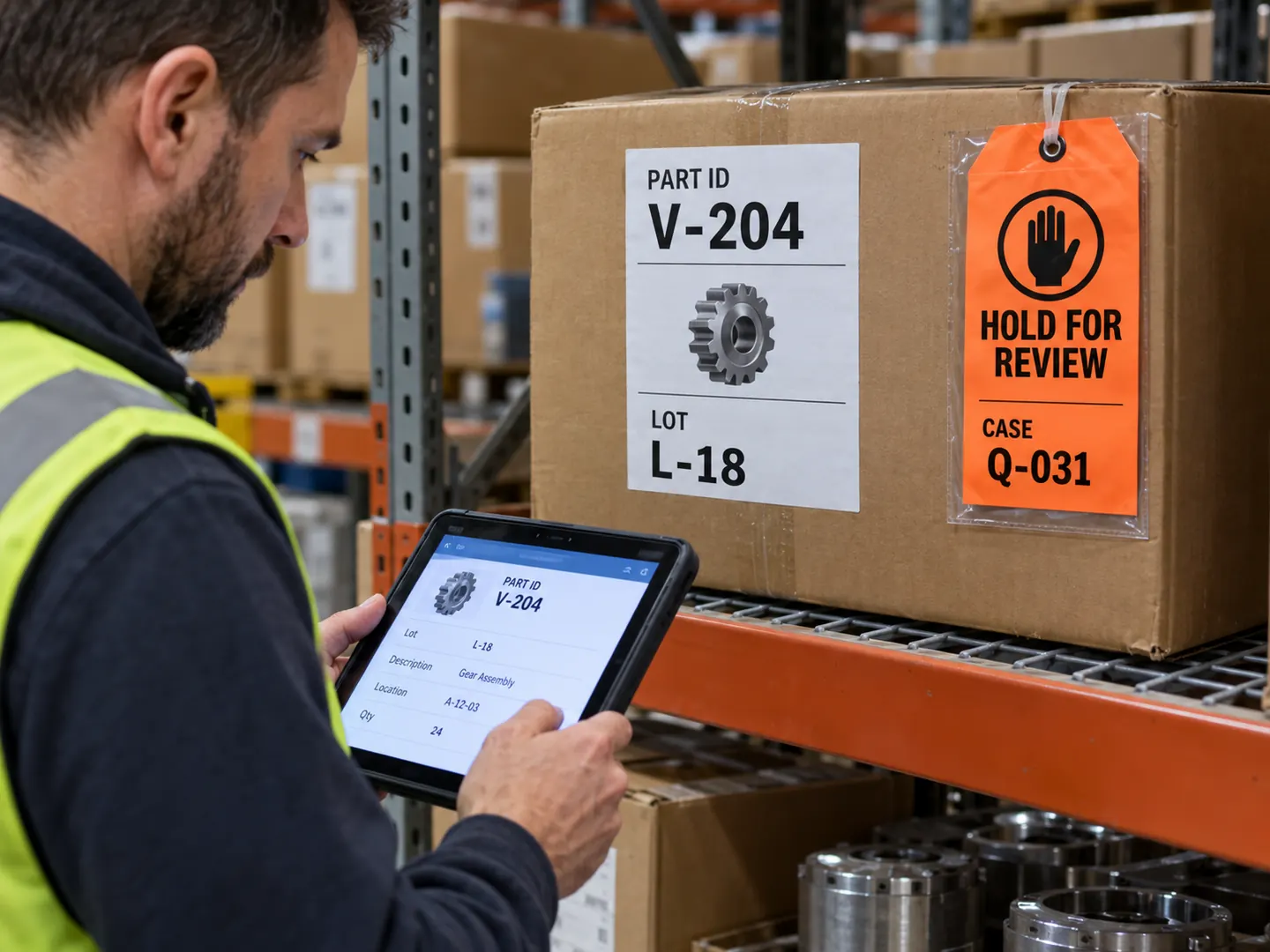
Keep the approved item, lot and quantity record intact. Add a conspicuous temporary status label or tag with a case ID that links to the buyer quality workflow. It should indicate a hold, not a final disposition. Only the authorized quality process can approve release, rework, return or scrap. ISO and IAF auditing guidance discusses identification and control of nonconforming outputs, but a colored tag alone cannot show that a site process meets a standard.
Primary quality-auditing guidance on control and identification of nonconforming outputs; not certification of this website or buyer.
View detailsImagine a picker scanning a carton of gears after a quality clerk has opened a review case. This is a composite scenario, not a documented shipment. The carton still has its item label and location record; a separate orange hold tag sits beside it. If a worker removes the item label to make space for the hold note, the review team may later struggle to identify the exact lot. If the hold tag is missing in the system, another shift may still pick the carton. Physical and digital status must agree.
State who applies the hold tag, how the case ID is assigned, where held goods physically go, who may change status and what happens to the tag after disposition. A QR or barcode is optional; if used, the owner must control its payload and test the actual scanner. Use plain status words in addition to color so a faded print or low-light warehouse does not become a guessing game. Avoid preprinted RELEASED stickers in a general hold-label pack.
Place the status tag next to, not over, the approved item and lot identification. If cartons are stretch-wrapped or moved to a cage, decide whether a second outer status mark is needed at the real pick face. Ask for a finished-size proof showing item label, lot and temporary status together. A small elegant label is no help if a forklift driver cannot see the hold from the aisle.
Provide carton or tote photos, existing item-label dimensions, hold words and icon, variable case field, quantity, printer or handwriting method, handling route and expected label removal. State whether the status is used on an individual carton, pallet or entire location. Ask for a sample photographed from normal picker distance and a matching system status check.
FAQ
No. The hold describes a temporary workflow state; the item and lot IDs identify what is being reviewed.
No. Only the buyer controlled quality record and authorized disposition should change the status.