Peel-and-Reveal Industrial Labels: Prove the Reading Sequence First
Published
The extra language fits on the artwork only after the type becomes uncomfortable to read. Someone suggests a peel-and-reveal label: keep the same footprint and put the additional copy underneath. Purchasing now has more printable area, but it has also acquired a new question. Can the intended person actually open, read and close that label on the installed item?
Treat peel-and-reveal as a format feasibility decision, before treating it as a quotation for extra layers. Identify what must remain visible, what may be accessed by opening a panel, and what a representative handling review must establish. Confirm supplier availability and construction suitability rather than assuming that an ordinary label order can simply be made multilayer.
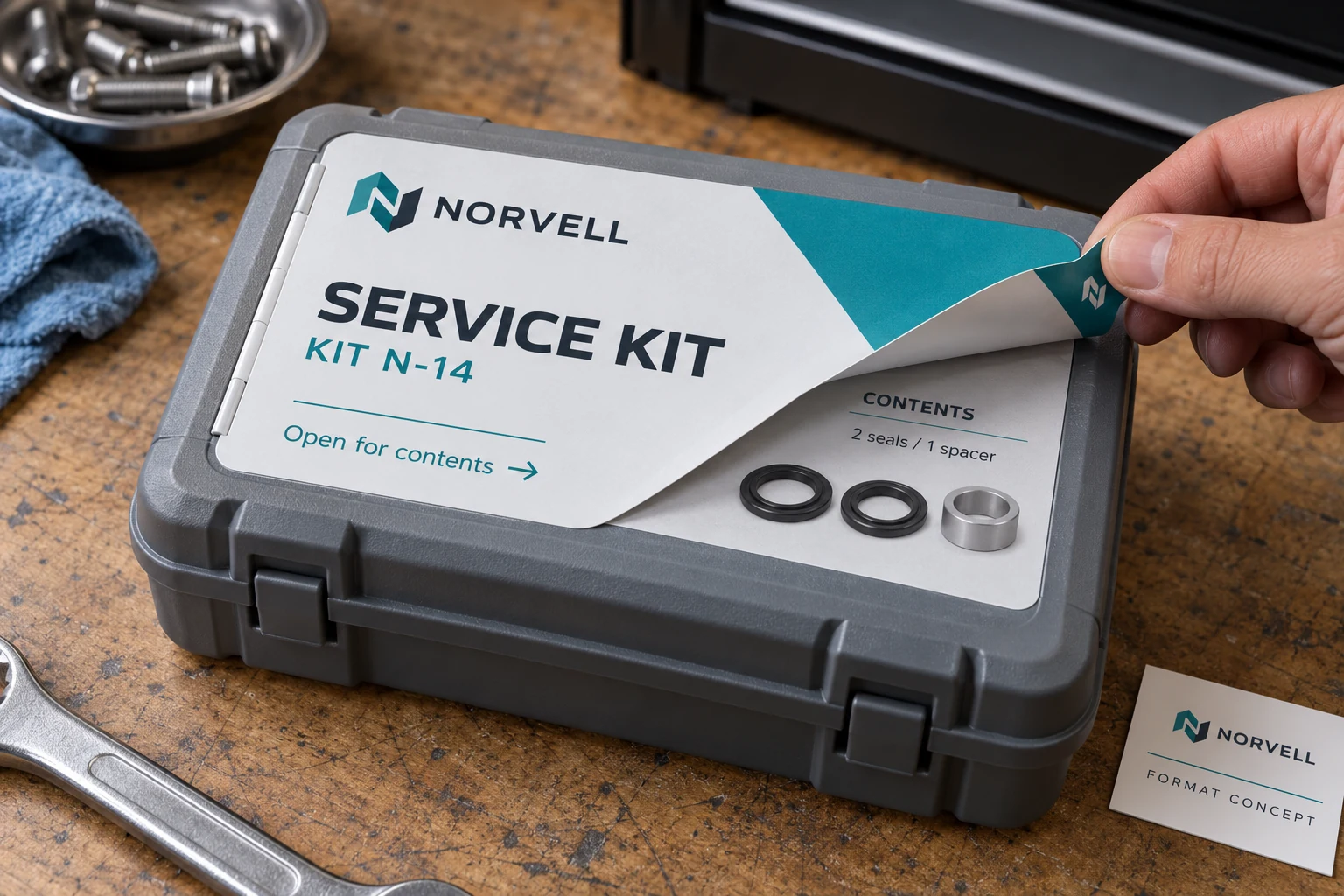
Start with the content that must stay visible
Make a content map before allocating panels. The responsible content or safety reviewer decides which messages must remain immediately visible for the intended use. Do not move required warnings or identification underneath a flap merely because the front looks cleaner. If visibility requirements have not been settled, pause the layout decision and obtain that review.
Secondary content might include an approved service-kit contents list or supporting instructions, depending on the application. That does not mean every instruction is suitable for an opening panel. Consider when the reader needs it, whether the item is already installed, and whether access depends on a removable cover or surrounding packaging.
For the fictional kit illustrated here, the front identifies KIT N-14 and tells the reader where the contents list is. That example is intentionally limited. It does not demonstrate chemical labeling, machine safety compliance or any sector-specific rule.
| Content group | Decision before artwork | Review owner |
|---|---|---|
| Always-visible information | What must be readable without opening? | Responsible content or safety reviewer |
| Secondary panel | What may be accessed after lifting the top panel? | Content owner with intended reader |
| Product identity | What remains identifiable during opening and after closing? | Product or data owner |
| Opening instruction | Can a first-time reader find the correct tab? | User representative and packaging reviewer |
| Changed information | Which panel and version must change together? | Document control or designated release owner |
If the real problem is choosing language versions, use the multilingual safety-label review alongside this map. A second printable surface does not resolve an unapproved translation or a mismatch between panel versions.
Specify the reading sequence, not just the layer count
CCL Healthcare describes a multi-ply construction using a hinge and release arrangement that permits opening and resealing. That is a manufacturer example of the mechanism. Its healthcare applications and claims do not establish industrial suitability or CYJ supply capability.
For procurement, describe the actions instead of specifying only “two layers.” Where does the reader lift? Which edge remains attached? Which surface carries the secondary information? What stays identifiable when the top panel is open? What should closing restore? These questions help distinguish a useful construction from a drawing that simply has more panels.
Include the intended location and surrounding clearance in the brief. A label can be reachable on a loose case but awkward after the case is placed on a shelf. Curvature, adjacent components and the reader's approach may change how easily the tab is found. Review the real arrangement rather than approving access from a flat artwork PDF alone.
Use a real handling review
Ask the supplier what representative format sample can be provided and what it does or does not represent. A paper mockup may help locate the opening edge and sequence. It cannot by itself establish the behavior of the proposed adhesive, hinge, print surface or reseal system.
Have the intended reader try the sequence under agreed conditions. If gloves are part of the task, include the relevant gloves. Record difficulty finding the tab, unintended lifting of the whole label, an obscured panel, or a closure that no longer sits as intended. Those are observations to investigate, not grounds for inventing a universal opening-force limit.
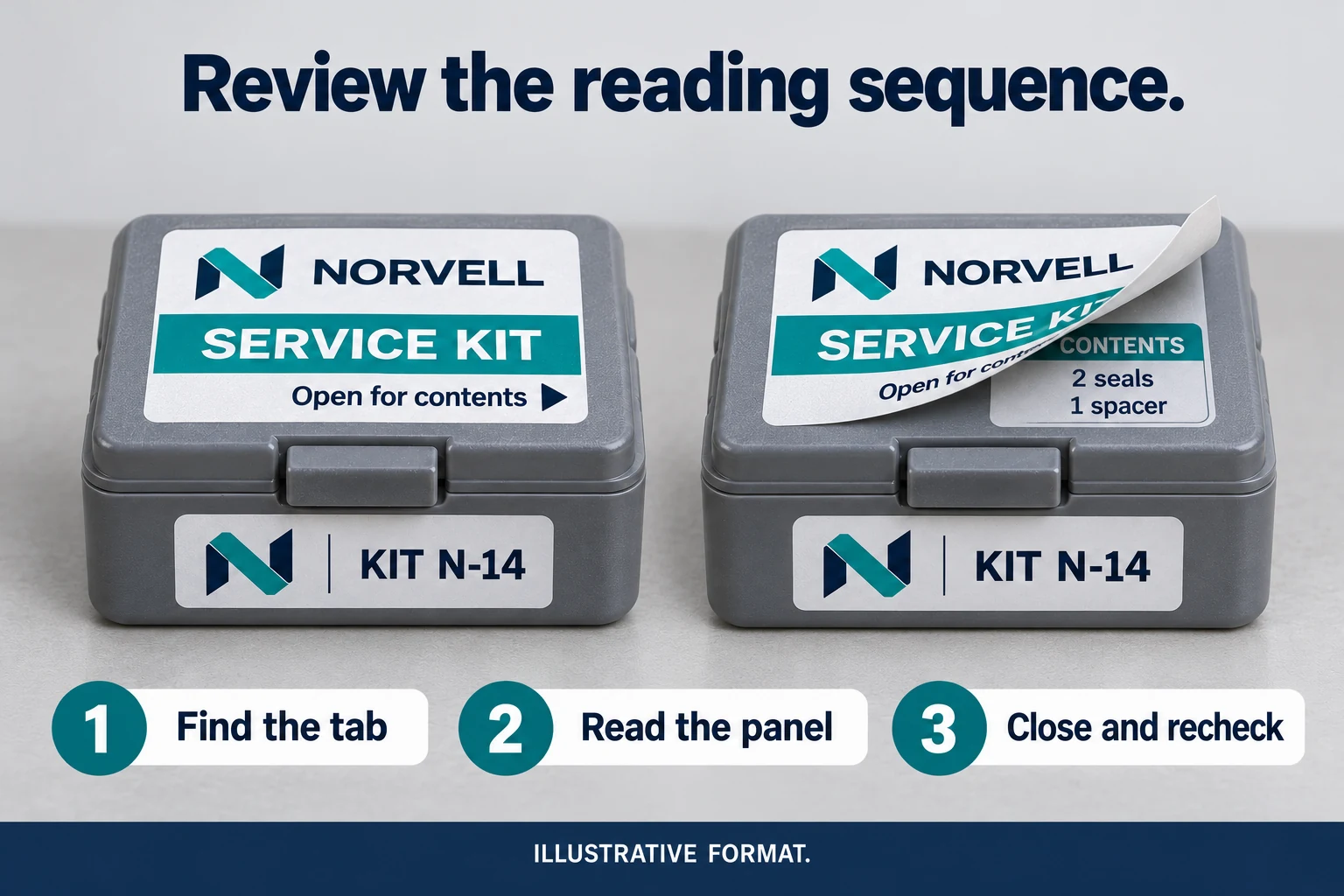
Review the closed state again after the agreed handling. Confirm that the important front information remains readable and that the label has not become confused with a tamper indicator or another status device. If repeated access is required, agree an appropriate review with the supplier; this guide supplies no generic cycle count or service-life guarantee.
Keep the observations tied to a sample reference and the actual surface. A successful handling check on one configuration should not silently approve a different panel shape or a different mounting location.
Compare the simpler flat-label option
A second flat panel can win when there is usable adjacent space and the information needs frequent, immediate access. It may make the reading task easier and remove the opening step. The buyer still needs to approve location, version matching and construction, but the added mechanism may be unnecessary.
A separate insert can also be appropriate for supporting information that genuinely belongs with packaging rather than on the item. It can be a poor choice where it will be discarded before the information is needed. Decide from the reader's task, rather than assuming that more printable area automatically improves the result.
Peel-and-reveal remains worth investigating when the footprint is constrained, secondary content belongs with the item, and the physical sequence can be made workable. If opening is impractical in use, choose another arrangement before paying to reproduce an unsuitable one.
Ask for feasibility before assuming supply
The enquiry should separate required outcomes from a preferred format. Provide the content map, closed footprint, proposed panels, actual surface and location photographs, expected handling, and quantity per version. Ask which construction, sample and review steps are feasible. Do not describe a concept drawing as a confirmed available product.
Use the broader sample approval checklist to retain the resulting construction and artwork decisions. Here the additional approval is specific: the intended reader can access the right information in the right sequence under the reviewed conditions.
For a custom industrial label feasibility discussion, prepare those panel files and application details, then use Prepare My Requirements on the contact page and its email or WhatsApp path. Ask whether a suitable format can be offered before releasing an order that depends on it.