Resource Guide
Preprinted vs On-Demand Serial Labels: Which Workflow Fits Your Line?
The choice between supplied preprinted serial labels and printing at the line affects data ownership, printer setup, inventory and rework. Begin with when the final serial number becomes known.
Published 2026-09-27
Digital proof before production. Material and adhesive options are discussed according to your application requirements.
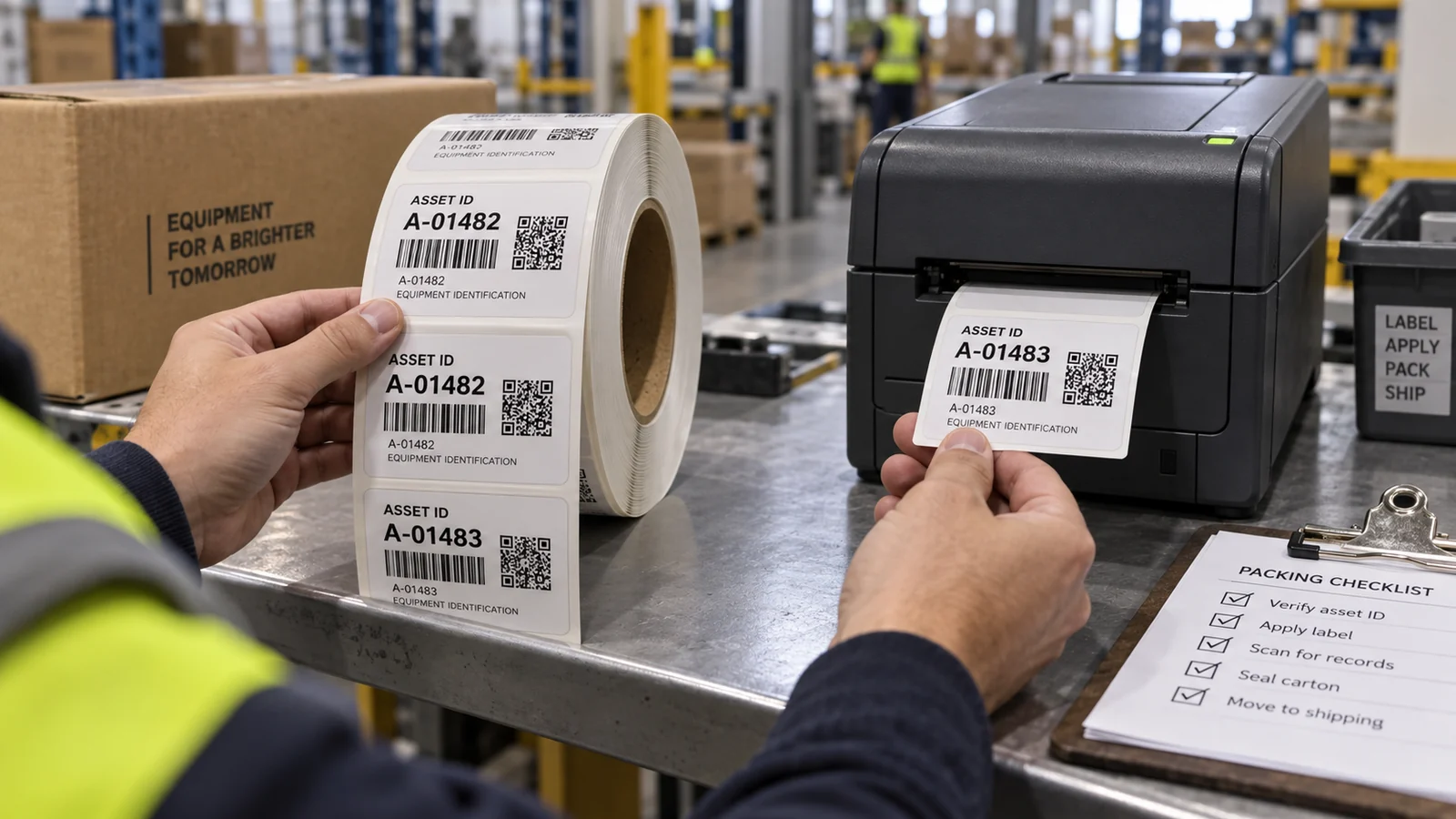
When Does the Number Become Final?
If serials are approved before production and the sequence is stable, a finished printed roll can arrive ready for application. If the number is assigned after testing or assembly, on-demand printing may match the process better. Some teams use a hybrid: fixed color, icons and regulatory artwork are preprinted, while an in-house printer adds a changing serial field. The right answer depends on who owns the data at the moment the label is applied.
A Composite Packing Shift: The Next Serial Changed After the Labels Arrived
In a composite equipment line, purchasing orders a full serialized roll based on a planned production sequence. A unit is held for rework, then a replacement takes its place. The printed order and the physical units no longer line up. The labels themselves are legible. The problem is that the sequence was treated as fixed before the line made it final. A simple exception rule for skipped numbers, reprints and unused labels would have mattered more than another proof of the font.
Compare the Whole Workflow, Not Only Label Price
A buyer should price the work around data changes, verification and line handling. Preprinted labels can reduce printing steps at the station. On-demand labels give the line control over late data, but require a printer, approved media, maintained templates and a check that text and code represent the same record.
- Point in the process when each serial or asset ID becomes final
- Fixed design fields versus variable text, barcode or QR data
- Who generates, checks and archives the source data file
- Printer, ribbon or media setup if printing at the line
- Rules for reprints, skipped serials, damaged labels and surplus rolls
Use a Proof That Shows an Exception
Review the shortest and longest example values and compare the human-readable number with its encoded field. Then walk through a rejected unit: who prints the replacement label, and how is the old label accounted for? This small rehearsal turns a seemingly simple format choice into a controllable handoff. An attractive sample roll cannot answer it by itself.
Technical Reference
Zebra describes both preprinted and on-demand barcode workflows, including variable fields and hybrid use. The manufacturer guidance provides context; the buyer still needs to define its own data controls.
Zebra: Which Barcode Label Printing Method Is Right for Me?
Manufacturer comparison of preprinted and on-demand label workflows.
View detailsFAQ
Questions Buyers Ask
When should I order preprinted serial labels?
Consider them when the approved sequence is known before printing and the team has a clear rule for exceptions, unused labels and reprints.
Can a preprinted label be finished with variable data on site?
Some workflows preprint fixed artwork and add changing fields later. Check media and printer compatibility and define which team controls the final data.
What information should I send for a quote?
Send sample records, label size, fixed and variable fields, quantity, print point, code format and the rule for skipped or reprinted serials.