OSHA Hazard Communication Standard
Primary US text on container labeling and retention of incoming chemical labels; not an approval of this sample artwork.
View detailsResource Guide
The drum can keep the same asset number through many trips. Its contents, inspection and cleaning status can change each time. An ID sticker and a temporary hold tag should never be mistaken for the required contents and hazard communication.
Published 2026-10-07
Digital proof before production. Material and adhesive options are discussed according to your application requirements.
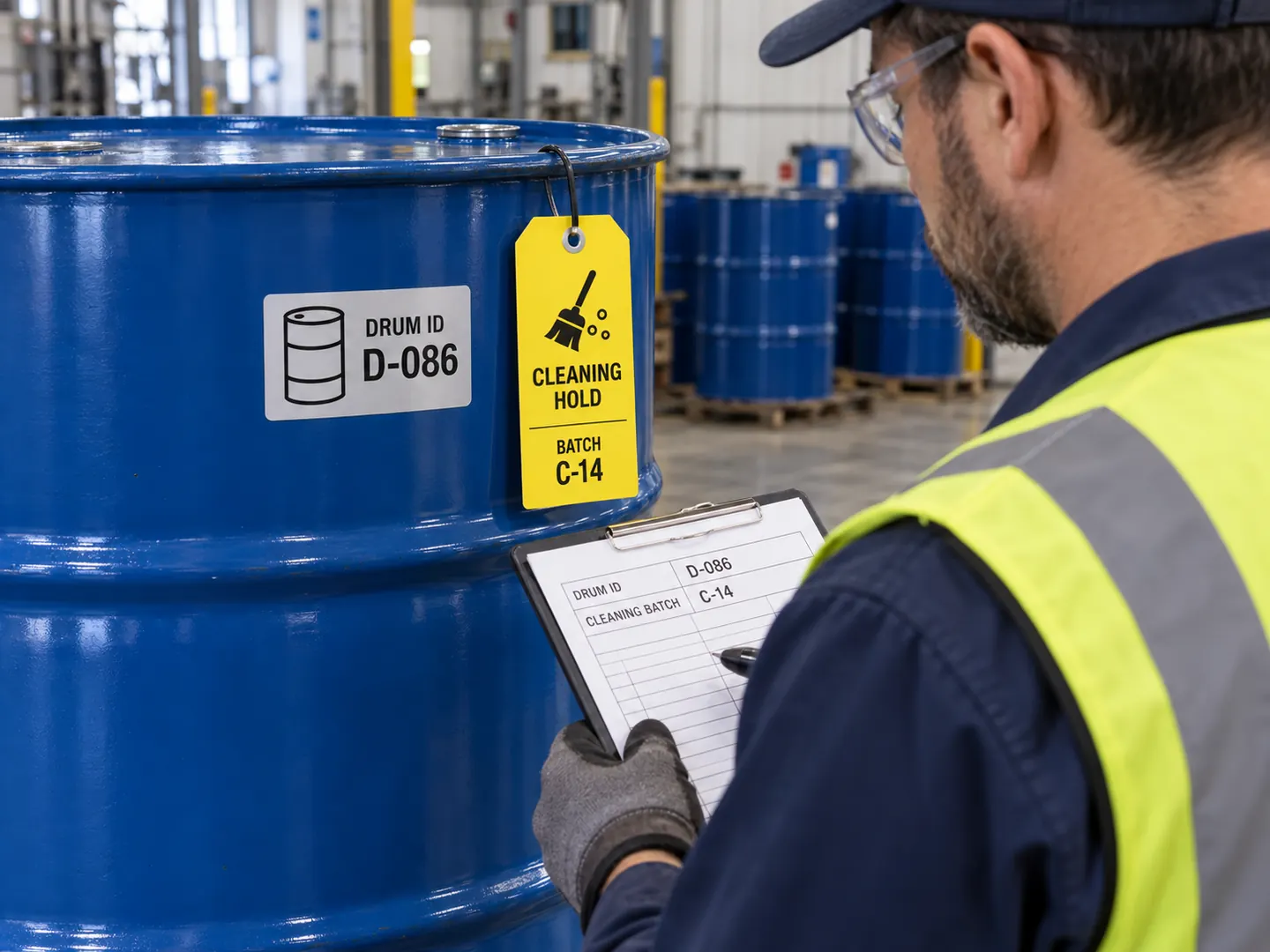
Use a stable internal drum ID to locate the container record, a controlled temporary tag for the current cleaning or inspection stage, and the correct contents and hazard markings for the actual use. A CLEANING HOLD tag means the container is not released; it does not say what is inside or that the container is safe to handle. In US workplaces, OSHA 29 CFR 1910.1200 includes rules against removing or defacing incoming hazardous-chemical container labels without proper replacement. The responsible operator must determine the applicable labeling and handling requirements for each container.
Primary US text on container labeling and retention of incoming chemical labels; not an approval of this sample artwork.
View detailsImagine three visually identical steel drums returning to a service area. One is awaiting cleaning, one is awaiting inspection and one has an approved next use. This is a composite scene, not a reported plant record. If all three carry only a permanent D-086-style number, staff can find history but not the current hold state. If the temporary tag covers the old contents label, staff lose critical information. Keep identity, process status and required hazard information in distinct visible places.
The temporary tag can carry a case or batch ID, stage wording, date field and responsible owner. Leave completion and release fields unmarked until the authorized process reaches that step. Define exactly who removes a hold tag and how the system records disposition. Do not use a green READY sticker as a shortcut for inspection or cleaning evidence. A printed color is a workflow cue, not a safety test.
Send photos of the coating, curvature, handles and seam. Decide whether a permanent asset ID belongs on the shell and a temporary status tag on a handle or sleeve. State exposure to washing, abrasion, outdoor storage and any contact with contents, then test a representative construction. The print supplier should not assume a general chemical-resistant film is appropriate for every drum or substance.
Provide the drum type, surface and existing markings, asset-ID format, temporary status stages, responsible approvers, quantity, application and removal method, cleaning exposure and storage photos. Request a mock-up showing all three information layers on a real drum. If the request concerns regulated chemical or transport labels, supply the approved content from the responsible compliance team as a separate scope.
FAQ
No. It only reports a workflow stage. The responsible operator must preserve or provide the required contents and hazard information.
Normally the reusable asset ID stays with the physical drum while the cycle record and temporary status change.