Michelin: Finding the Right Tire Size
Manufacturer guidance on staggered fitment and confirming vehicle specifications.
View detailsResource Guide
Two tires can belong to one sale and still need two different product labels. For a staggered fitment, the buyer has to keep front and rear sizes, SKUs and carton counts straight before the print file reaches a roll.
Published 2026-10-08
Digital proof before production. Material and adhesive options are discussed according to your application requirements.
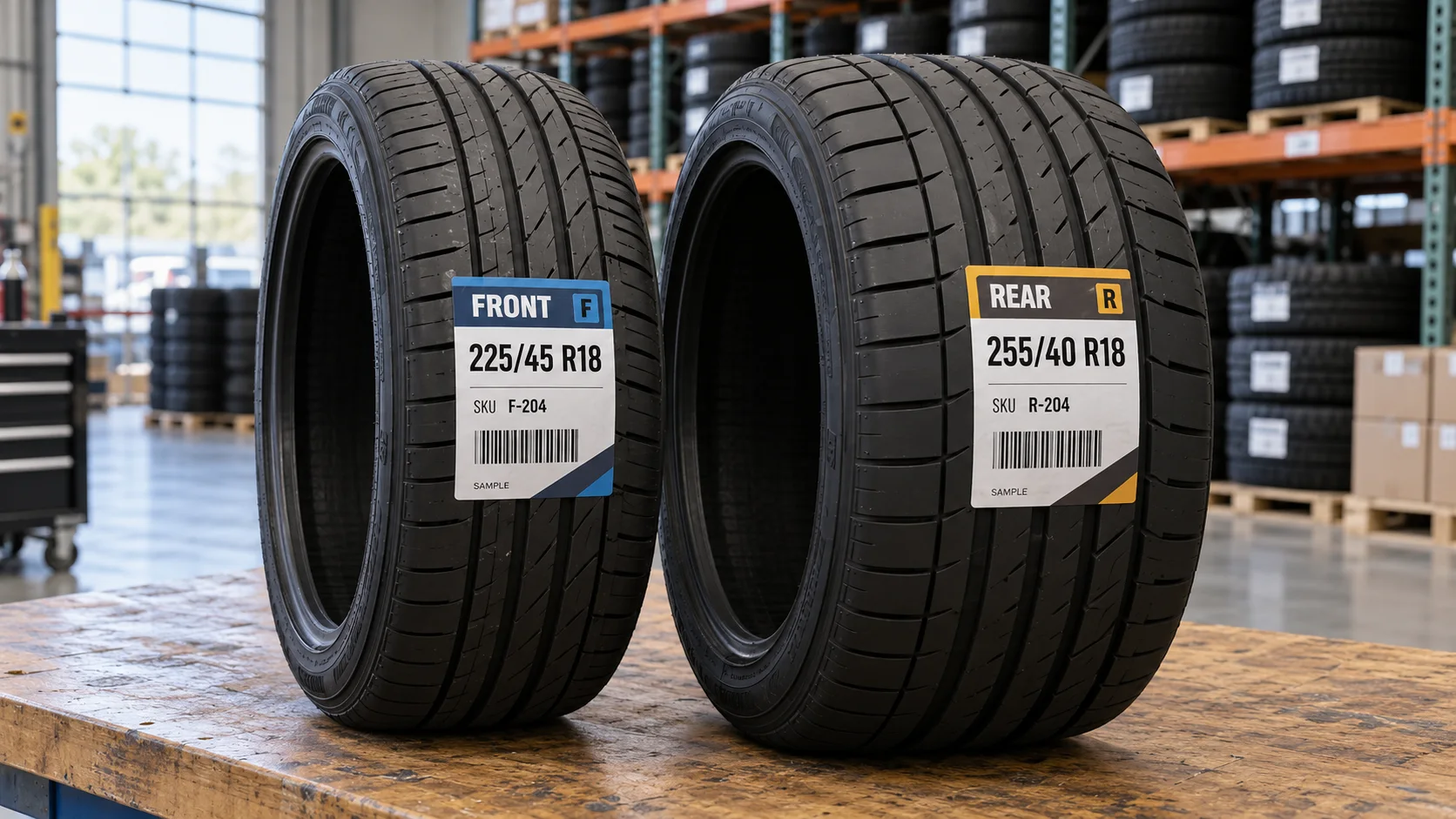
Treat the front and rear tires as separate product records even when they ship as one set. Give each approved tire size its own SKU, human-readable size and encoded value if a barcode is required. A set-level packing label can describe the combination, but it should not replace the individual tread labels. Michelin explains that some vehicle fitments intentionally use different front and rear tire sizes; the vehicle maker specification determines the actual fitment, not a color on a warehouse sticker.
Manufacturer guidance on staggered fitment and confirming vehicle specifications.
View detailsConsider a fictional order with front SKU F-204 at 225/45 R18 and rear SKU R-204 at 255/40 R18. These values are only an artwork example, not a fitment recommendation. Both labels might use the same design and brand color. If the print supplier receives one shared barcode or the warehouse picks from an unmarked mixed roll, a beautiful proof can still become a wrong-size shipment. The cost is not the ink; it is the disputed handoff between the SKU file, the roll and the physical tire.
Put the approved size and SKU in the primary reading area. A small FRONT or REAR cue and restrained color band can help warehouse staff, but never make color the only identifier. Ask for separate proof files or a controlled variable-data file that shows the exact row-to-size mapping. The receiving team should be able to compare the label against the molded tire marking and order line without guessing from tread appearance. Any claim about suitable vehicle position belongs to the buyer-approved fitment information.
Tell the printer whether front and rear labels arrive on separate rolls, on clearly identified sheets, or in a controlled alternating sequence. Separate rolls are simpler for two application stations; a combined sequence may suit a paired kitting process only if the applicator and reconciliation can maintain order. Specify first and last labels per roll, quantity by SKU, carton identification and what happens to a partial roll. A one-to-one set ratio must not be assumed when spare quantities or replacements are ordered.
Apply finished-size samples to representative front and rear tires, then compare label text, encoded value and pick record to the approved SKU list. Check that the label remains legible at the actual scan point and that the set-level packing document lists the right quantities. A printed FRONT cue does not authorize mounting; it is a fulfillment aid. Keep the buyer technical approval, tire marking and vehicle fitment decision separate from this print check.
Send the two or more approved SKU rows, exact tire-size strings, label size, sample tire photos, artwork revision, encoded data, quantity for each SKU, roll or sheet preference and the set-level packing rule. Ask for a distinct proof per data variant and a receiving method that makes front and rear rolls obvious. If the same artwork will later serve another market or fitment, name that version now rather than overwriting an old file.
FAQ
Only if the buyer data system deliberately assigns the same encoded value to the intended record. If sizes or SKUs differ, confirm the mapping before printing rather than assuming a shared code.
No. It is a picking cue for a buyer-approved set. Vehicle fitment must follow the manufacturer and buyer technical specification.