Red Brand Colours on Tire Labels: Keep Barcode Approval Separate
Published
The tire label's red header matches the approved brand reference. The designer carries that colour into the barcode bars to make the whole label consistent. On screen, the bars are obvious against white. Purchasing is about to approve the artwork, although nobody has asked how the intended reader responds to that colour.
Keep the barcode colour decision separate from the brand colour decision. For a conventional GS1 barcode, black bars on a white background are the straightforward reference combination. A decorative colour that is easy for a person to distinguish does not automatically provide the response the scanning system needs. Resolve the code requirement before treating the brand-colour proof as release approval.
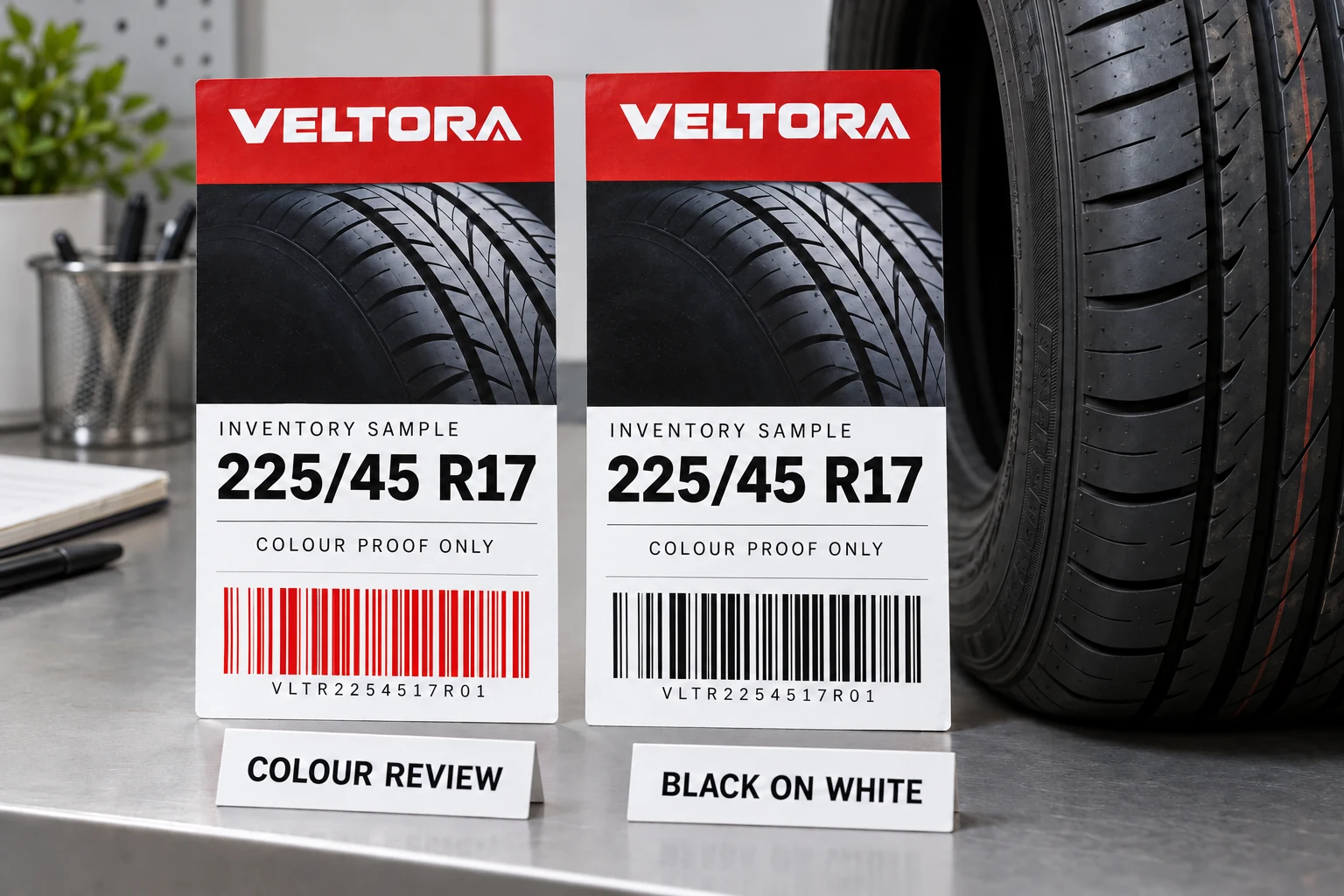
Human contrast and scanner response are different questions
GS1 US colour guidance recommends black bars on white and warns against red or reddish bars because of the red light used by scanning lasers. It also distinguishes bar colours from background colours. The useful point is that a colour's role matters; the label should not be approved from visual contrast alone.
That guidance concerns GS1 barcodes. It does not establish that every internal tire code uses a particular symbology or reader. Identify the actual code requirement and equipment with the responsible technical owner. A phone demonstration does not override an applicable trading-partner requirement or establish compatibility with a different reader at receiving.
Avoid turning the explanation into a rule that every part of a tire label must be black and white. A brand header can retain its approved colour while the code uses a separately controlled data panel. The buyer is defining different jobs within one piece of artwork.
Assign a purpose to each colour zone
Mark the logo and decorative areas separately from barcode bars, spaces and surrounding clear area. Identify which text needs brand matching and which information needs practical readability at the tire rack. The tire label-size guide handles the physical allocation of these fields. Colour approval adds another requirement; it does not replace that allocation.
Provide an explicit instruction such as a red brand header with a black barcode on an opaque white panel, where that arrangement fits the approved job. Do not let a general instruction to match all black artwork to brand red silently change the code. Identify the actual output file and revision so prepress knows which elements are protected from a global colour substitution.
A white background must also be understood as a physical part of the finished construction. If the label is transparent or a graphic sits underneath, the screen's white artboard may not represent the final spaces between bars. Describe the required background construction and review the finished sample on the actual tire or approved application surface.
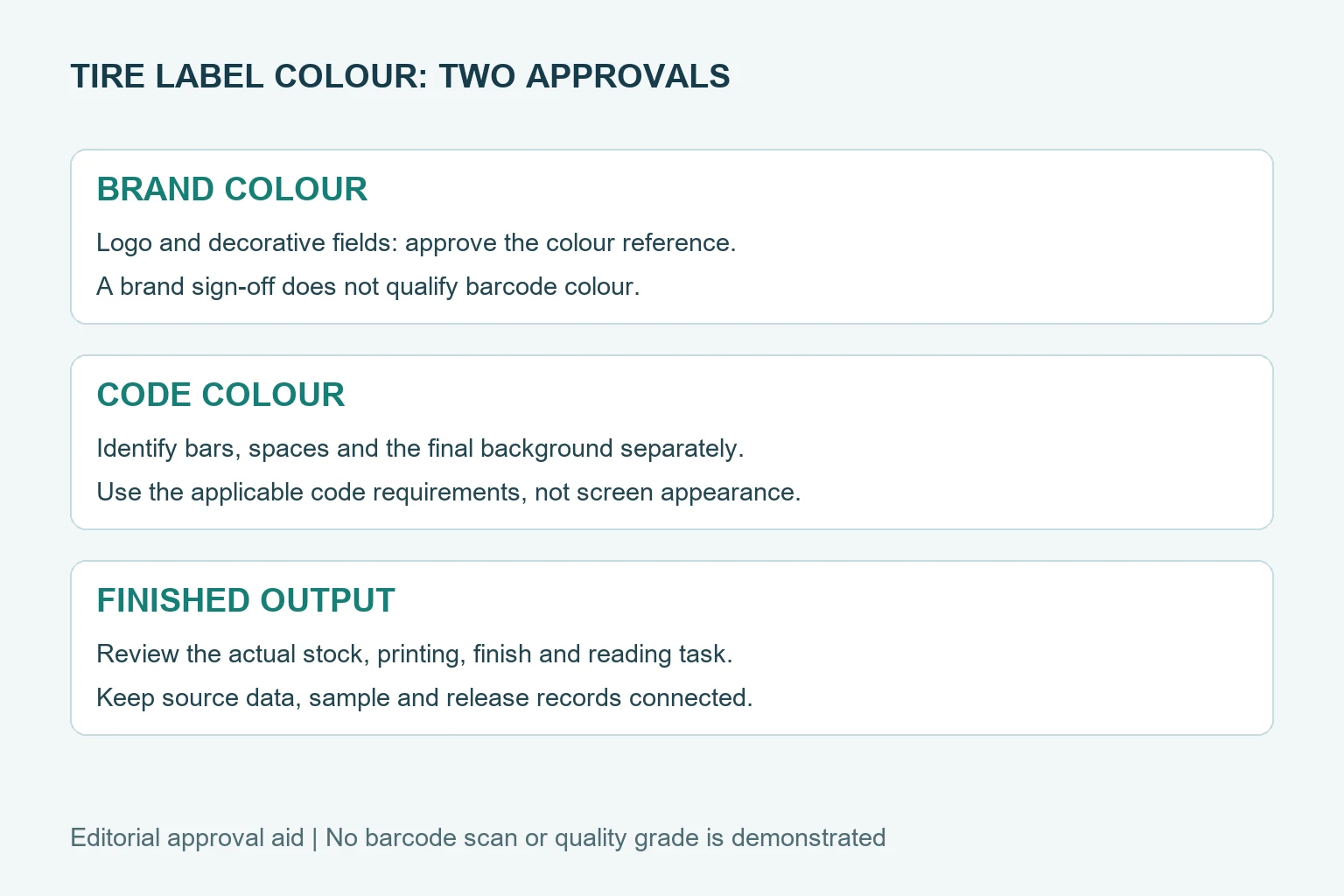
Make the colour-role record reviewable
Use a record like this alongside the artwork. Entries are proposed review prompts, not a universal printing specification.
| Area | Requirement to identify | Responsible review |
|---|---|---|
| Brand header and logo | Approved colour reference and material/finish | Brand or artwork owner |
| Barcode bars | Code requirement and permitted colour approach | Data or barcode-quality owner |
| Spaces and quiet area | Required clear/light background on final stock | Prepress and responsible technical reviewer |
| Tire size and SKU text | Readability at finished size and viewing position | Warehouse or operating owner |
| Printed sample | Exact stock, print and finish revision | Named release approver |
The record should say what remains unresolved. If an alternative bar colour is requested, obtain an applicable basis and agree how the finished result will be assessed. A colour name, a hexadecimal value or a small screenshot is not a complete scan requirement.
Match the proof to the finished construction
Review the code generated from the approved data at the intended dimensions. Check that the output colour separation has not changed its assigned ink or background. GS1 US also cautions against using a multicolour process for bars. Keep the applicable production requirements with the job rather than assuming an attractive composite preview establishes the final result.
The label's material and protective finish remain relevant. A colour approved on one stock may look different on another, while the optical behaviour of the finished surface may also change. Use the exact proposed printed and finished construction for the required review. Do not borrow a measured result from an unrelated stock or another label size.
At the scan station, record the reader, conditions and observed decoded value. Compare that value with the approved tire record. If formal barcode verification is required, have the responsible owner define its method and acceptance criteria separately. A successful scan and a formal quality assessment answer different questions.
Retaining black bars can preserve the brand design
Consider an illustrative tire-label layout with a red logo band, a prominent approved tire size and a white data panel. The barcode can remain black while the decorative portions carry the brand identity. That division may avoid a special colour qualification without requiring a complete redesign.
If the available area becomes crowded, simplify decorative content or revisit the label dimensions with the layout owner. Do not reduce the barcode's required clear area to compensate for a new coloured frame. The quiet-zone guide explains why that space has a functional purpose.
An alternative colour may be legitimate in an appropriately specified system, but it needs its own applicable review. Keep that decision scoped to the actual carrier, output and reading workflow. It should not become permission to recolour every barcode in the company's artwork library.
Preserve two approvals in the reorder record
Retain the approved brand reference and the approved code construction as separate, connected records. Include the artwork revision, stock and finish, code source and any required sample or verification reference. A later logo refresh should reopen the relevant colour review without silently altering an otherwise approved data panel.
For a tire barcode-label enquiry, prepare the brand artwork, proposed colour zones, approved code data and carrier, reader details, tire placement photo, finished dimensions, quantity by version and roll requirements. Organize the brief through the contact requirements page and send supporting files through its email or WhatsApp route for a tire barcode-label discussion. Make the colour boundary explicit before it becomes an expensive print boundary.