NHTSA Electronic Tire Identification Study
Primary US report discussing bead barcode visibility before and after a tire is mounted.
View detailsResource Guide
A buyer can ask for a tire barcode and mean two very different things. The small code near the bead follows a manufacturing or inspection process; the larger tread label carries information people see while the tire is unmounted. The mounting step changes what can be read.
Published 2026-10-07
Digital proof before production. Material and adhesive options are discussed according to your application requirements.
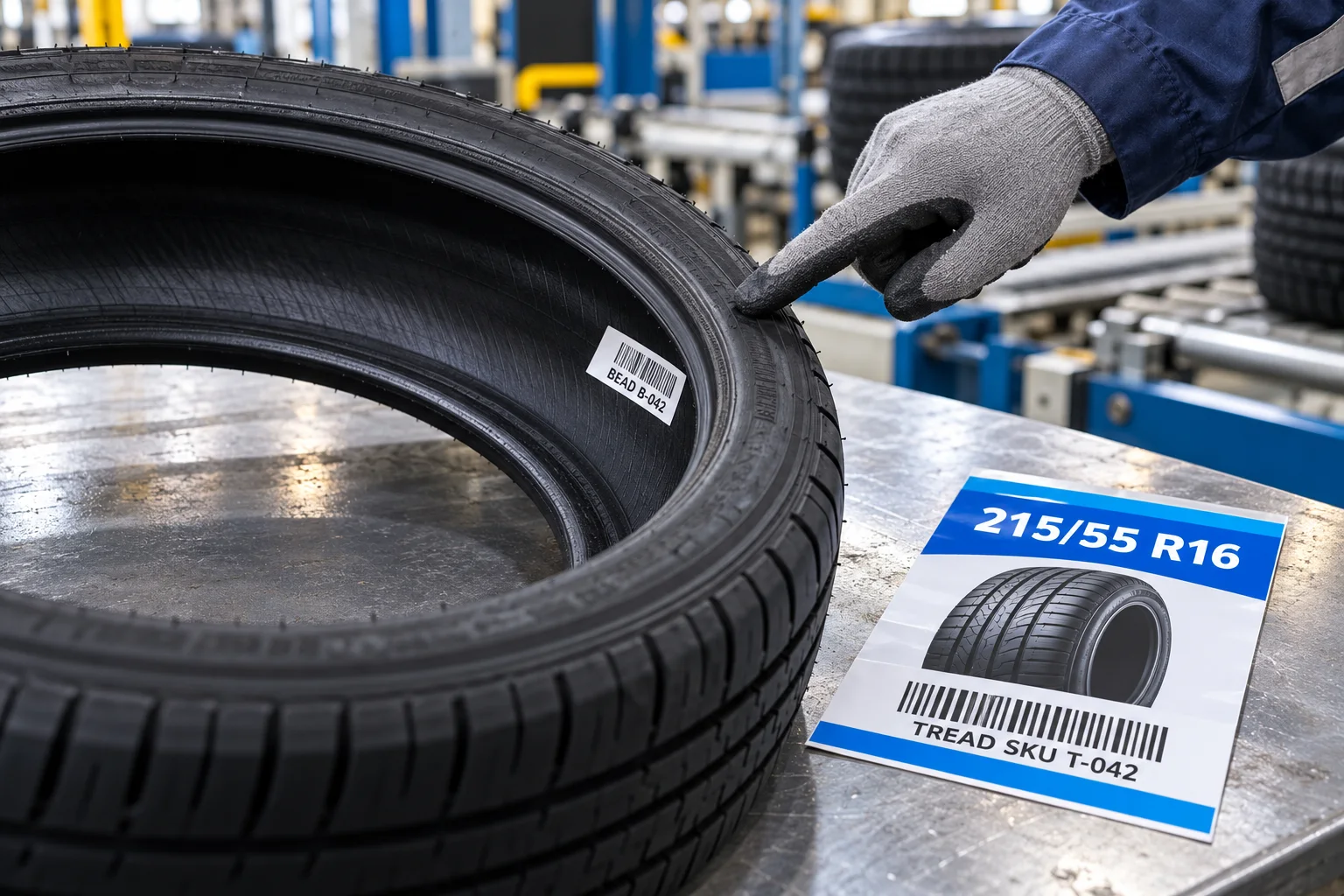
A bead-area identifier and a retail-facing tread label should not be specified as interchangeable stickers. A bead code may be read during tire production and before mounting; once a wheel covers the bead, its location is no longer useful for routine visual scanning. A tread label can display size, product data and a warehouse code while that label remains attached, but it is not a substitute for a permanent tire identification marking. NHTSA describes this visibility limit for one-dimensional bead barcodes in its electronic tire identification study.
Primary US report discussing bead barcode visibility before and after a tire is mounted.
View detailsImagine a green tire entering a factory line with one unique process ID. At final inspection, a worker reads that ID to retrieve the production record. Later, a distribution worker needs a larger product label showing a tire size and stock code. This is a composite example, not a CYJ customer project. Printing the same bars on both positions may look tidy, but the buyer must decide whether they identify one tire instance, a product SKU or a shipment. Those are different records.
Some specialized bead labels are designed for use before curing. Nitto describes a tire-manufacturing barcode label that bonds through vulcanization; that is a specific product construction, not a general property of adhesive tire labels. This website does not claim that its regular tread products have been qualified for a green-tire or vulcanization process. If your request is for a pre-cure bead label, send the cure stage, rubber surface, print method, data and required validation plan, and ask for explicit supplier confirmation before treating any sample as suitable.
Manufacturer description of a specialized pre-cure construction; not a performance claim for this site.
View detailsDraw a short map from print to application, curing if relevant, final inspection, storage and wheel mounting. At each read point, record who scans, which device is used and what the decoded value should open. Keep a human-readable sample ID on the proof so the buyer can catch a wrong row even when the code graphic looks plausible. If the bead code and tread code are meant to link, state the approved mapping and who owns it; a print supplier cannot infer that relationship from the artwork.
State bead or tread placement, pre-cure or post-cure application, tire type, code format, unique-data count, available print area, scanner setup and expected read stages. Supply photos of the real tire and a finished-size reference. For a tread-only project, focus on surface, removable or permanent use, product layout and roll or sheet format. For a bead or cure-stage project, request a separate technical qualification discussion rather than using a tread-label quote as evidence of fitness.
Printed tire barcode and QR product options for identified applications.
View detailsFAQ
A bead-area code can be hidden by the wheel. Specify any post-mount identification need separately rather than assuming bead access.
Do not assume that. Pre-cure bead use requires a construction and process qualification explicitly confirmed for the intended rubber and cure conditions.