Resource Guide
Tire Sidewall vs Tread Barcode Labels: Choose the Scan Surface
The same SKU can look perfectly readable on a proof and disappear once the tire is stacked. Choose sidewall or tread only after watching where a worker actually sees, applies and scans the label.
Published 2026-10-02
Digital proof before production. Material and adhesive options are discussed according to your application requirements.
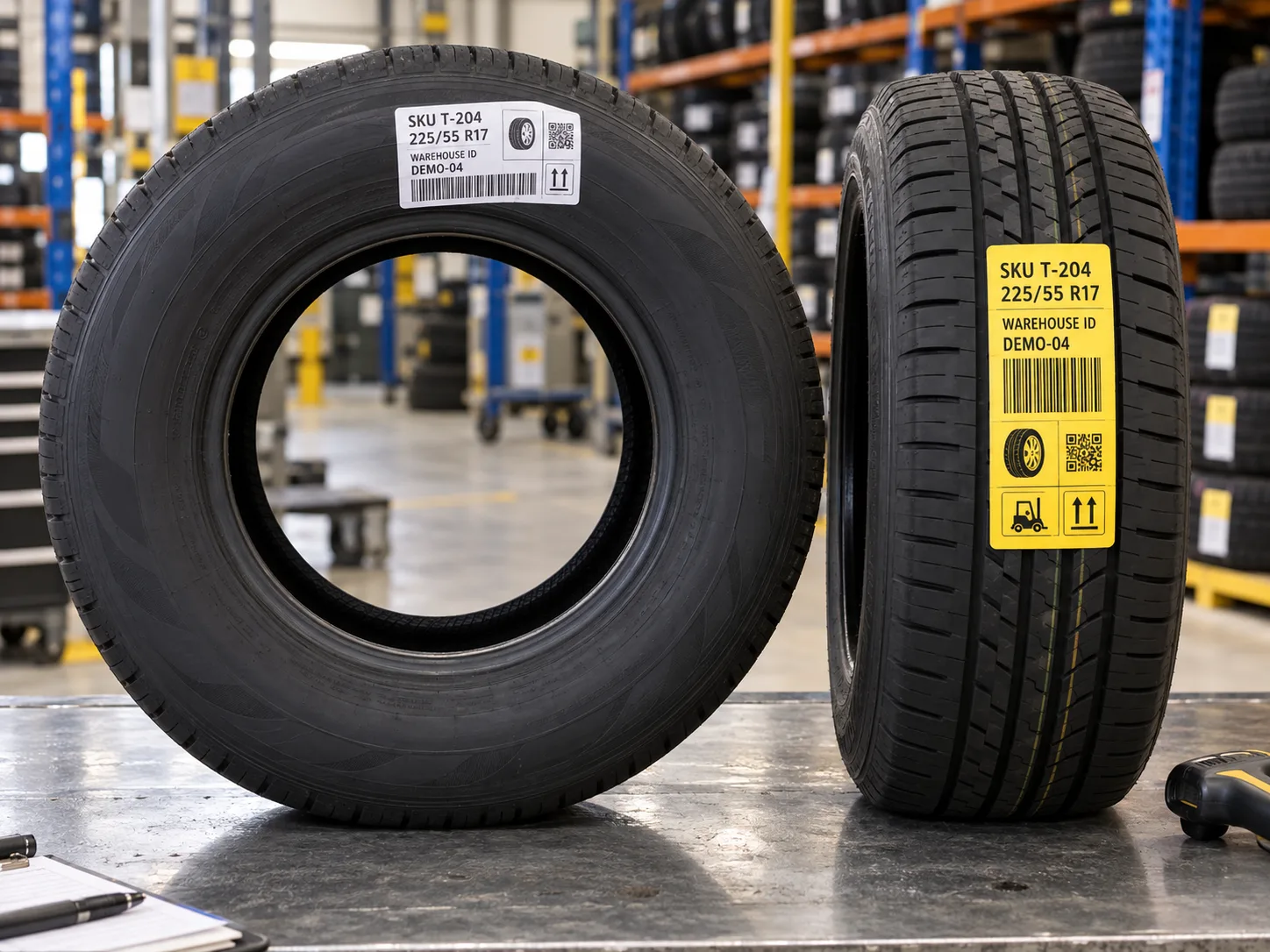
Quick Answer: Start at the Scan Point
A tread label often presents a broad viewing face when a tire is upright, while a sidewall label may be easier to see on a tire stored with its side facing the worker. Neither surface is automatically the better adhesive or scanning choice. The tire construction, surface condition, label shape and handling path decide what needs testing. If a trading partner requires a particular label or approved product information, follow that specification first. A warehouse inventory code is not a substitute for any required tire marking.
An Illustrative Receiving Aisle
Imagine a receiver facing a vertical rack of loose tires. The tread faces the aisle, so a barcode on the sidewall is hidden until a tire is pulled out. At another site, tires lie flat in stacks and the sidewall is the only face visible from above. This is a composite scenario, not an observed customer installation. The purchase decision changes with the storage orientation. Walk one tire through receiving, put-away, picking and dispatch, then mark the exact scan point on a photo.
Two Surfaces, Two Sample Questions
A tread sample needs review across the actual tread pattern, any residue, curvature and contact with neighboring tires or conveyors. A sidewall sample needs review against molded lettering, relief, oils and the portion of the sidewall that remains visible in storage. Avoid a barcode that bends into a shoulder or sits across raised features. Place a finished-size sample on the correct tire, use the intended applicator or hand method, and scan with the real device from the normal working angle. A flat print proof alone cannot answer these questions.
- VIEW: which face can the operator see without moving the tire?
- SURFACE: which exact tread or sidewall zone receives the sticker?
- DATA: product SKU, size, lot or shipment ID, and who owns each field.
- HANDLING: how will the label meet a conveyor, pallet, wrap or adjacent tire?
- CHECK: scan at receiving and at the last point where the tire is handled.
Keep the Identifier Owner Separate From the Printer
Decide whether the code represents a product type, a specific tire, an internal warehouse record or a shipment unit. These are not interchangeable merely because all can be printed as bars or squares. GS1 describes a GTIN as identifying a trade item; an internal tire inventory code follows the buyer controlled system unless a trading partner specifies a standard identifier. Give the label supplier the approved payload and human-readable text. Do not ask the supplier to invent a GTIN, official tire rating or serial scheme from a reference photo.
What to Send for a Useful Quote
Send tire type and size, photos of both candidate surfaces, storage orientation, application timing, label dimensions, substrate and adhesive requirements if already approved, artwork, code data, scanner model, quantity and roll format. Ask for an applied comparison sample if both positions remain plausible. The better option is the one that your team can apply consistently, keep legible through the intended handling period and scan without an extra tire-moving step. It is a workflow decision, not a universal rule.
FAQ
Questions Buyers Ask
Is a sidewall sticker always easier to scan?
No. It depends on how the tire is stored and which face is visible at the scan point. Test both orientation and finished-size artwork.
Can a label printer assign our tire barcode number?
The product or inventory record owner should approve the payload and any required standard identifier. The printer should reproduce the approved data.