Country-of-Origin Wording on Tire Labels: Get the Approved Basis First
Published
The brand has a U.S. office, the shipment leaves from another country, and the reference label shows a third location. The designer needs one line for the tire artwork. None of those facts, considered alone, gives the printer authority to decide the country-of-origin wording.
Obtain the exact approved origin statement and its product scope from the responsible business before printing. Keep origin, business address and shipping route as separate fields. The print brief should reproduce an authorized decision rather than ask the designer to infer one from commercial paperwork.
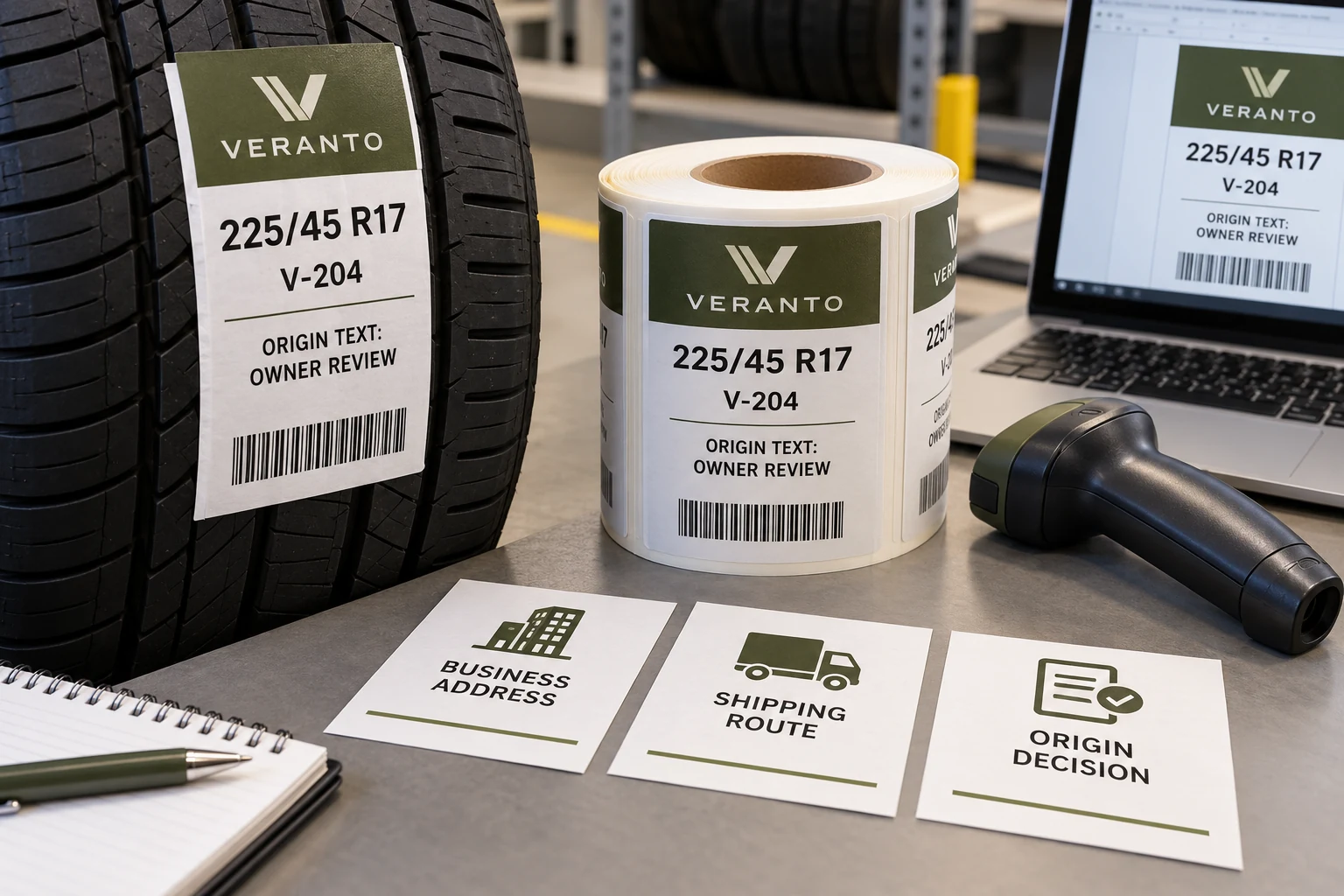
Treat origin as an owner decision
For U.S. imports, 19 U.S.C. 1304 establishes a country-of-origin marking framework with requirements and exceptions. The responsible importer and qualified customs resource should determine how the applicable rules relate to the actual product and marking arrangement.
This guide does not determine a tire's origin, eligibility for an exception or acceptable marking method. Those decisions depend on facts and requirements outside a label artwork file. The procurement task is to obtain and preserve the approved instruction so the print process does not invent the conclusion.
If a product has multiple manufacturing or processing locations, provide the relevant facts to the qualified owner. Do not resolve the issue by selecting the country that best fits the brand design or the country shown on the freight booking.
Keep addresses from answering the wrong question
A company address can identify a business contact. A shipping port can identify a logistics event. A country-of-origin statement concerns a different determination. These fields may appear together on the same label without having the same meaning.
Ask the artwork reviewer to identify every location reference in the proposed design, including text embedded in a logo or brand panel. The responsible owner should review the complete presentation, not only the line labeled origin. Do not assume nearby geographic wording is irrelevant to the intended marking review.
For an illustrative private-label order, the distributor's office address can remain part of approved business information while the origin wording follows the separately approved product determination. That example supplies no actual origin value and should not be treated as legal approval of a particular layout.
Create a traceable wording handoff
| Field | What purchasing obtains | What should not substitute |
|---|---|---|
| Product scope | Exact tire or SKU references | A generic brand family |
| Approved statement | Exact wording authorized for print | Text copied from a similar product |
| Responsible owner | Importer or appropriate authorized function | The designer's assumption |
| Basis reference | Controlled decision or supporting record | Shipping port alone |
| Placement instruction | Approved complete marking arrangement | An isolated text crop |
| Effective version | Applicable artwork and change reference | An undated email fragment |

Keep sensitive supporting records under the buyer's normal access controls. The printer needs the authorized instruction and sufficient scope to reproduce it correctly; it does not need unrelated confidential commercial information in every artwork packet.
Review mixed-source orders row by row
A label order may cover visually similar tires that do not share the same approved origin statement. Make the version mapping explicit. The market-version guide provides the broader discipline for separating destination and artwork variants.
Do not assume a single country line belongs on every SKU because the buyer wants one common template. A template can hold a controlled variable field, but each populated record still needs the appropriate source and approval. Separate complete files may be easier where the workflow cannot reliably control the variation.
At proofing, compare the exact statement and its placement against the released instruction for each relevant version. Check that roll and carton identification allow the intended version to be selected at the packing station. A correct statement on the wrong tire is still a mismatch.
A source change is not merely a logo revision
When the supply chain changes, ask the responsible owner whether the existing origin instruction remains valid. The answer should precede artwork release and any decision about printed stock. Do not let a purchase-order revision silently authorize a new origin statement.
Preserve the earlier approved version and its product scope for history. The owner should decide how existing labels, work in process and future supply are handled. A printer should not independently relabel products or cover existing markings to make an order look consistent.
If the origin determination is unresolved for one product group, isolate that group. Other fully approved versions may be able to proceed under their own release scope. The uncertainty does not need to become either an invented answer or a blanket hold on unrelated work.
Keep the existing wording when the owner confirms it
Not every shipping or distributor change requires a new product-origin statement. If the responsible business confirms that the approved wording and marking arrangement remain suitable, retain them. That can avoid unnecessary artwork variants and obsolete stock.
Conversely, an unchanged brand logo does not prove the old statement is still correct. The useful trigger is a change in the facts or requirements relevant to the determination, as assessed by the owner. Keep that review separate from routine aesthetic edits.
For tire identification labels, prepare an origin-wording brief with the exact authorized statement, product-to-version mapping, complete artwork, approved placement, dimensions and quantities. Organize the requirements on the contact page and send supporting files through email or WhatsApp. The printer should receive a decision it can reproduce, not three locations it must choose between.