European Commission: Tyres
Official information on EU tyre labels and supplier responsibilities.
View detailsResource Guide
A tire size may be the same across shipments while the approved label version is not. Control market, SKU and artwork revision together before printing and packing.
Published 2026-09-27
Digital proof before production. Material and adhesive options are discussed according to your application requirements.
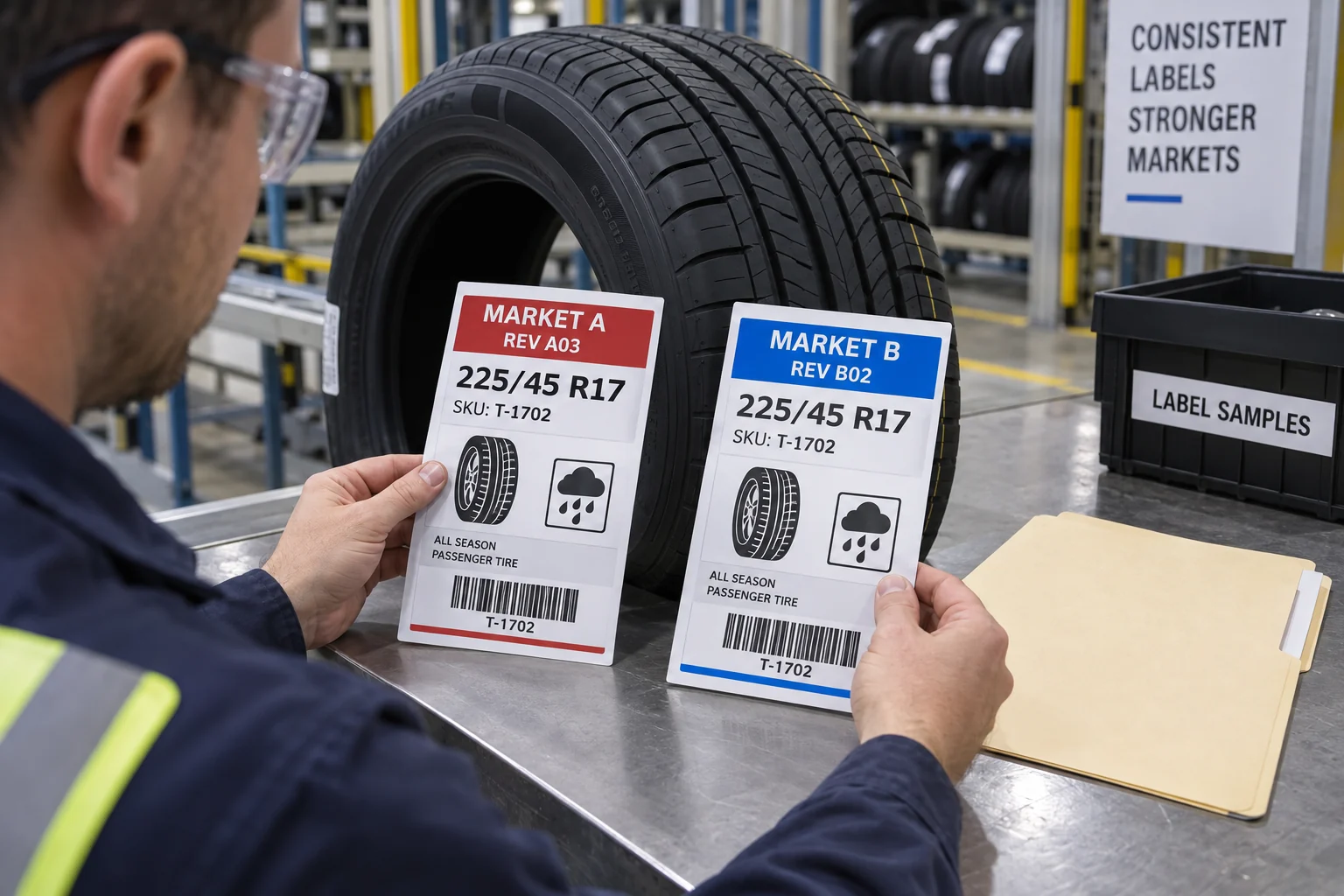
Keep a controlled record for each combination of tire type, destination market and approved label revision. Link that row to its source artwork, owner approval, printed quantity and dispatch identifier. Do not assume that changing a color band turns one market label into another. Requirements differ by market and may change. The buyer or responsible tire supplier must confirm which official label or information is required; a printer should reproduce only the authorized, current files.
Imagine two pallets of the same 225/45 R17 tire leaving for different buyers. A warehouse worker sees the same tire size and nearly identical artwork. The market version sits in a tiny file name no one sees at the bench. This is an illustrative workflow, not an actual mislabeling case. The fix is not larger decorative text alone. Give each order row a visible market version and revision, then verify the roll tag, first printed label and purchase instruction at changeover.
For EU-market tyres within the EU labelling regime, the European Commission describes supplier registration in EPREL and the label generated from registered tyre data. That is a primary example of why approved source files matter. This article is not a market-by-market compliance checklist and does not decide whether any particular tyre is in scope. Obtain the correct current official label and product information from the responsible supplier, and have that party approve the final use. A generic performance icon in a sample photograph is not an EPREL label.
A useful matrix separates commercial artwork from regulated or product-performance information. Record the tire type identifier, size, market, language if applicable, barcode payload, buyer or brand version, source file date and approver. Preserve the approved file itself rather than relying on an email screenshot. If a destination or regulation changes, make a new revision and explicitly retire or quarantine old printed rolls. Never copy a rating or QR from a similar-looking tire and assume it belongs to the current one.
A shared layout system can reduce proofing effort and help product information stay in predictable places. It is useful only if variable fields and any official label modules remain correctly controlled for each market. In some workflows, separate complete files may be safer than a clever template with hidden switches. Choose the handoff that warehouse and production teams can verify reliably. Before bulk supply, review one physical label from each version against the buyer-approved record, including decoded codes and readable tire size.
Cover image is AI-generated generic Market A/B sample artwork, not an official EU tyre label or verified performance declaration.
FAQ
Do not assume so. Product and market requirements must be verified by the responsible tire supplier and buyer for the specific tire type.
No. Use the responsible supplier authorized, current product-specific label and data. A reference photo is not an authoritative source.
Identify and segregate them when a revision changes, then follow the owner approved disposition decision rather than mixing them with current stock.