Tire Label Roll Splices: Agree What Counts Before Delivery
Published
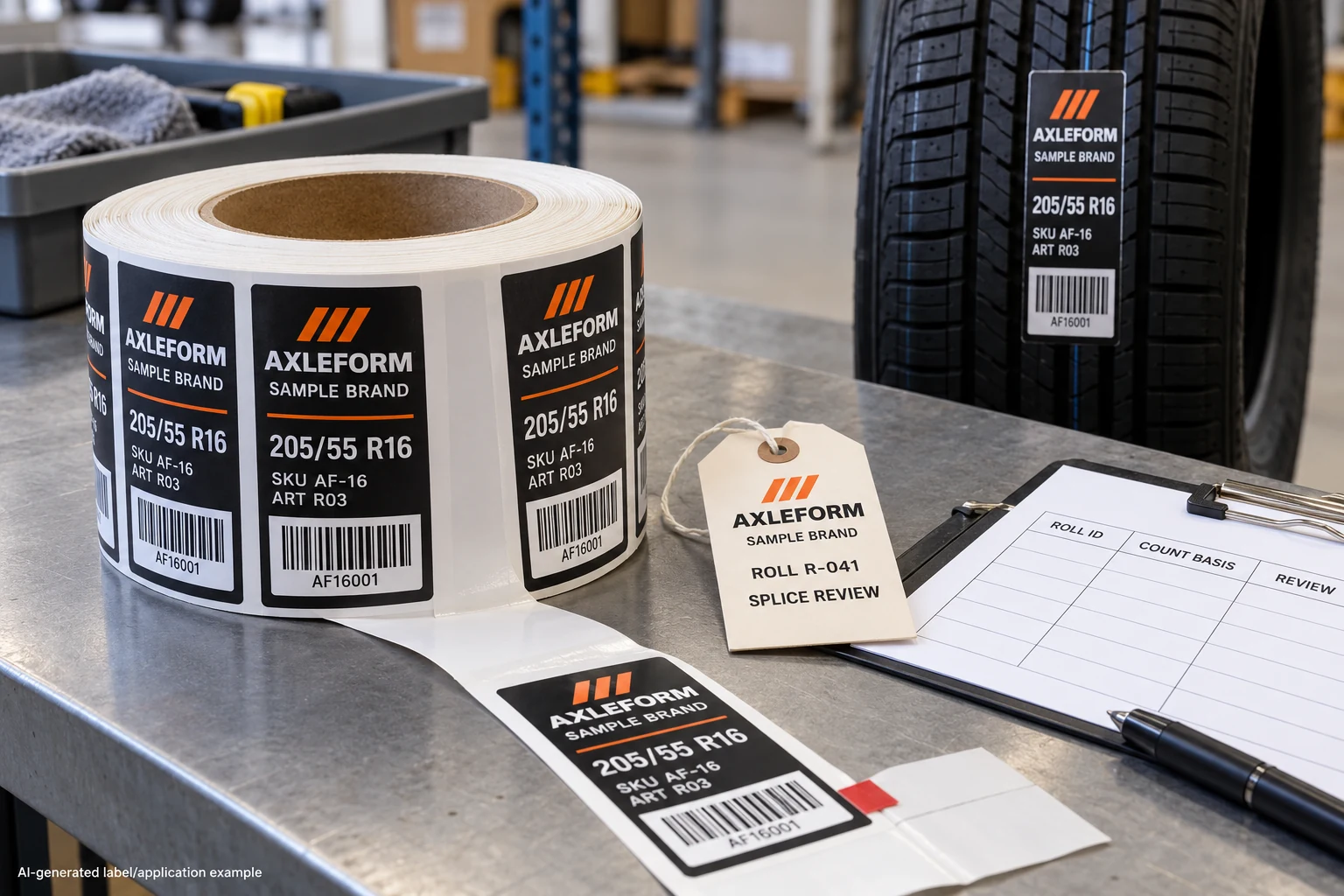
The carton says 1,000 labels. The packing plan needs 1,000 labelled tires. Those numbers look comfortably aligned until someone asks whether the count includes labels the operator must discard around a roll splice.
This is an illustrative purchasing situation, not a shipment report. The buyer wants the order quantity covered. The converter wants to deliver useful stock without discarding long lengths of material. The line supervisor wants to know where the interruption is before the roll reaches the applicator. A single quantity on a purchase order does not settle all three concerns.
For tire label roll splices, agree two things together: whether the supplied join is acceptable for the intended process, and how excluded labels affect the usable delivery quantity. A permitted splice is not permission to leave the count ambiguous.
Separate the joint from the quantity beside it
A splice joins lengths of the web carrying the labels. Its presence raises questions about the supplied construction, the way it is identified and what the application process does when it arrives.
Do not assume that a material supplier's splice policy is your finished-label acceptance rule. Mactac's published splice specification, dated November 2017, distinguishes product groups and sets its own joining and identification provisions. It illustrates supplier-specific terms, not a current universal allowance for finished tire-label rolls.
Ask the converter to describe the finished roll being quoted. Does the proposal allow joins? Which construction is proposed? How is each affected roll identified before loading? What becomes unusable under the approved operating method? A phrase such as standard roll supply needs a written explanation.
Keep the machine drawing and general dimensions in the existing automatic tire label roll specification brief. Here, the additional decision is how the join and its quantity consequences are accepted.
Decide who can handle the splice before choosing the price
A small hand-application station may be able to stop at an agreed marker, set aside excluded material and continue. That arrangement still needs a controlled count and enough usable labels for the job. Manual handling does not make a concealed join acceptable.
A machine-fed station may require a different arrangement. Ask its equipment owner to assess the proposed joint, any marker and the required operating procedure. Do not prescribe tape, overlap, flag position or a restart method from an internet photo.
cab's guidance on automated label quality explains why the liner's passage around the peel plate and the selected release behavior matter. It does not validate a particular splice on a tire applicator. The relevant equipment instructions and a representative approved trial must answer that question.
If the line cannot accept an internal join, request splice-free finished rolls and ask how that affects roll lengths, partial rolls, cost and availability. If the process accepts a defined, marked join, compare that proposal on the same basis. Neither option wins merely because its unit price looks simpler.
Also distinguish a join inside a delivered roll from a connection made between rolls by line equipment. A plant's automatic roll-change arrangement does not automatically approve every converter-made joint arriving in the carton.
Put usable quantity on the receiving record
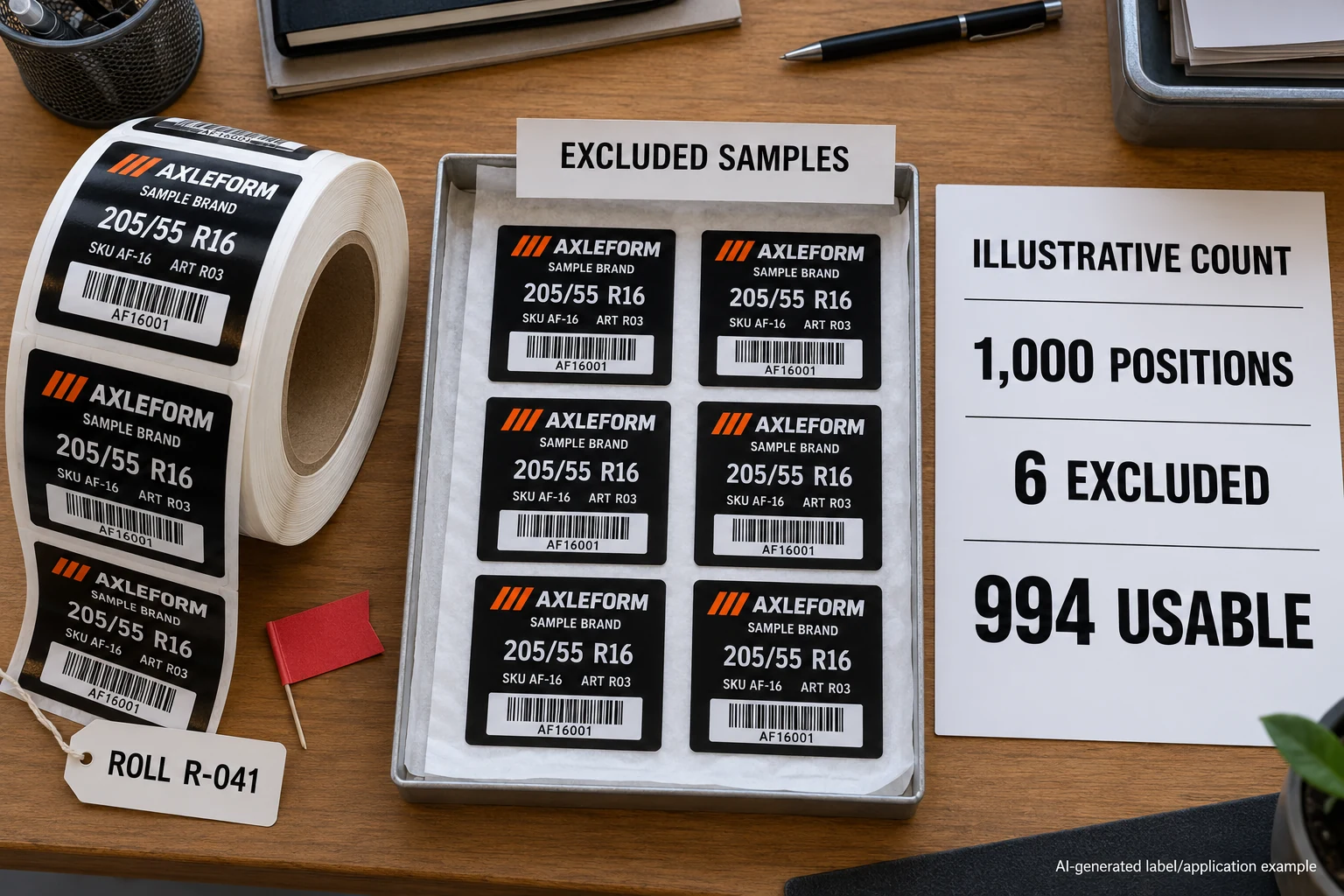
Consider a deliberately simplified count: 1,000 nominal label positions, with six printed labels excluded under the agreed review. That leaves 994 usable labels before any separately agreed application allowance. Six is an example, not a recommended exclusion zone or industry tolerance.
If the buyer ordered 1,000 usable labels, this roll alone does not fulfill that requirement. If the contract instead specifies a nominal count with defined exclusions, record that basis plainly. The commercial agreement determines the obligation; the arithmetic should not change between purchasing and receiving.
| Quantity field | Question to settle before the order |
|---|---|
| Ordered basis | Usable finished labels, nominal printed labels or another explicitly defined measure? |
| Excluded quantity | Which labels are excluded, for what reason and by which agreed counting method? |
| Declared usable quantity | What remains after exclusions, by roll and by SKU? |
| Operating allowance | Is an agreed setup or application allowance additional, and how is it identified? |
| Balance resolution | If usable supply falls short, who authorizes replacement, credit or another agreed remedy? |
Avoid double deductions. If the declared usable count already excludes the affected labels, do not subtract them again on receipt. Conversely, a nominal counter reading does not become a usable count just because it appears on a tidy roll tag.
Keep any replacement tied to the original SKU
An extra six labels of another tire size do not close the shortfall. Reconcile the usable balance against the approved SKU and artwork revision, including how a small replacement quantity will be packed and identified.
For repeated product codes, many labels may legitimately carry the same SKU barcode. For serialized labels, replacement requires a separate decision about authorized identifiers and the status of damaged or excluded copies. Do not infer a serial-number gap from a product-code barcode, or let a supplier invent replacement values to make the count look complete.
The tire barcode labels brief can carry the approved code, readable tire information and data sample. Keep the roll ID, artwork revision and agreed quantity basis attached to the supply record. A roll identifier describes the supplied roll; it should not silently replace the tire's product identity.
Receive the declaration before discovering the join
Ask for a roll-level record linking each supplied roll to its SKU, revision, declared splice information, count basis and usable quantity where specified. Agree how a partial roll or replacement pack carries the same references.
At receipt, compare that declaration with the order and the agreed inspection evidence. Opening the carton and reading the first label cannot establish the condition or count of the entire roll. Define what will be sampled, what supplier counting evidence is available and what happens if an undeclared join is later found.
Do not unroll every delivery merely to manufacture reassurance, and do not turn a supplier declaration into proof of successful application. Those are different checks. Record an exception against the specific roll, preserve its identification and resolve it through the agreed process.
I would put the usable-count field beside the price on the comparison sheet. It is much easier to negotiate that definition before printing than while the last tires wait for labels.
Preparing a tire-label roll order? Send a roll acceptance brief with the application method or machine model, proposed splice restrictions, label and liner dimensions, roll direction, approved SKU/artwork sample, quantities and intended counting basis. Use the contact page to prepare the requirements, then attach supporting files through your chosen email or WhatsApp conversation.