Tire Label SKU Cross-References: Keep Supplier and Distributor Codes Apart
Published
The purchase order says D-184. The tire label says AX-72. Both teams may be talking about the same tire, but the receiving clerk cannot release stock on that assumption. Asking the printer to replace one code with the other can hide the mismatch rather than settle it.
Approve the relationship between the codes before changing the artwork. Keep the issuer attached to each identifier, connect both to the approved tire record, and decide which value each receiving or picking task expects. A supplier SKU and a distributor SKU can coexist without becoming interchangeable.

The tire size cannot settle the mapping
Consider an illustrative distributor that buys two products in 225/45 R17. A size match narrows the search, but it does not prove the products share a pattern, approved specification or commercial identity. Nor does a familiar brand color establish that two records refer to the same item.
Start with the buyer's controlled product record. The product-data owner should confirm which attributes distinguish one item from another in that business. Purchasing can collect the supplier reference; the receiving-system owner can confirm the expected local code. The printer should receive the approved relationship after those owners resolve it.
Do not create a universal composite number by joining the two strings unless the system owners explicitly require that format. An improvised AX-72/D-184 value may be readable to a person while being unknown to both receiving systems. Labels are where the relationship becomes visible; they should not be where an unapproved identity scheme begins.
Make an alias table with an owner for every column
The useful deliverable is a cross-reference table, not a folder containing two screenshots. Keep one relationship per row and preserve the original characters. If leading zeros, spaces or letter case matter to either system, state the rule instead of normalizing them by eye.
| Field | Illustrative entry | Approval question |
|---|---|---|
| Supplier and code issuer | Fictional supplier, AX-72 | Who owns this code? |
| Distributor and code issuer | Fictional distributor, D-184 | Which account or system uses it? |
| Controlled tire record | Approved product record reference | Have the differentiating attributes been checked? |
| Effective relationship | Mapping revision M03 | When does this relationship apply? |
| Label use | Both readable; agreed code encoded | Which scan task is authorized? |
| Exception | Unmatched or conflicting row on hold | Who resolves the discrepancy? |
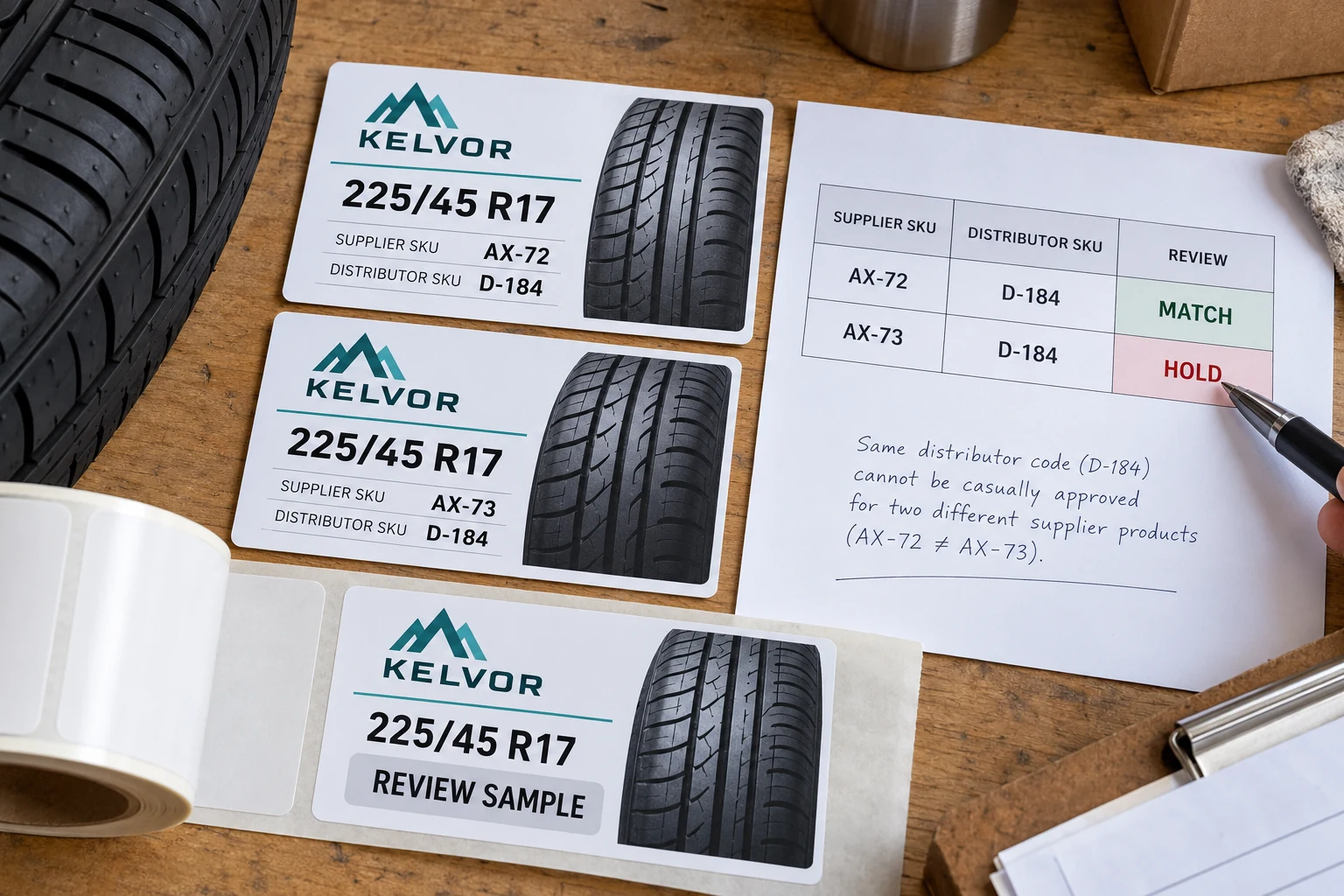
These entries are examples, not an actual customer file. In production, attach the approved record or its controlled reference. A copied description alone can become stale while the code remains unchanged.
Also define the relationship's scope. One supplier code may have different aliases for separate distributor accounts. That does not authorize printing every alias on every tire. Confirm the destination account before selecting its label variant, and keep the shared tire identity separate from the account-specific ordering language.
Decide what needs to appear on the tire
If staff must compare both references at receiving, separate headings such as Supplier SKU and Distributor SKU make the distinction explicit. Place the code used most often where that task can find it. Keep the tire size and other approved product information readable rather than squeezing everything into the barcode caption.
If the warehouse already resolves the supplier code reliably to its local item, a second printed alias may add little value. Retaining the existing tire label and maintaining a controlled system mapping can be the better choice. Confirm that the relevant trading partner accepts this workflow and that staff have a workable exception route.
The tire data handoff guide covers ownership of the source data. This cross-reference review is narrower: it establishes how two authorized naming systems point to the same approved product without silently merging their meanings.
Test the awkward rows, not just the obvious one
Build a small witness set from the actual order. Include a straightforward match, a same-size different-product pair, an account-specific alias, and any retired or unresolved relationship. Keep unresolved data out of released artwork; it can remain clearly marked in the review pack.
For each released row, compare the readable fields on the proof with the approved table. Then capture the intended code using the receiving workflow and check which product record opens. A correct beep does not answer that second question. Preserve the observed value and returned record so the approver can see the relationship that was tested.
Have receiving review a deliberate mismatch in a controlled test environment. The purpose is to establish that a conflicting relationship is stopped or routed for review, not silently accepted because the tire size looks plausible. The system owner should define the test and its disposition; this guide does not prescribe a software configuration.
Keep mapping changes out of casual reprint requests
A request to change D-184 to D-185 may be an alias correction, a new account convention or a different product. Ask the data owner which it is. The answer controls whether existing labels remain usable and which downstream records need attention.
Retain the old mapping with its history rather than overwriting it without context. Tie the new relationship to the appropriate artwork revision and unprinted order rows. If printed stock exists, purchasing needs an explicit decision about that stock; the printer should not assume all old labels are obsolete or all are still acceptable.
For tire barcode labels, the purchase becomes concrete once the buyer can identify the product, the two code issuers and the intended capture task. Until then, a polished layout is still an unresolved data conversation.
Prepare one cross-reference brief
Prepare your label requirements with the approved alias table, destination account, tire record references, readable and encoded field choices, label dimensions, marked tire photo, quantity by version and supply format. Use the contact page to organize those requirements, then send the supporting files through its email or WhatsApp path. That gives the next discussion a mapping to review rather than two codes to guess between.