UTQG Tire Label Copy: Separate Grades From Mileage Claims
Published
The approved tire record contains a treadwear grade. The proposed label headline turns it into a promised number of road miles. The digits may have been copied accurately while the meaning of the claim has changed.
Review the sales wording separately from the grade field. Keep a comparative grade, a mileage warranty and a broader performance statement connected to their own approved evidence and conditions. A label proof should not let one become shorthand for another.
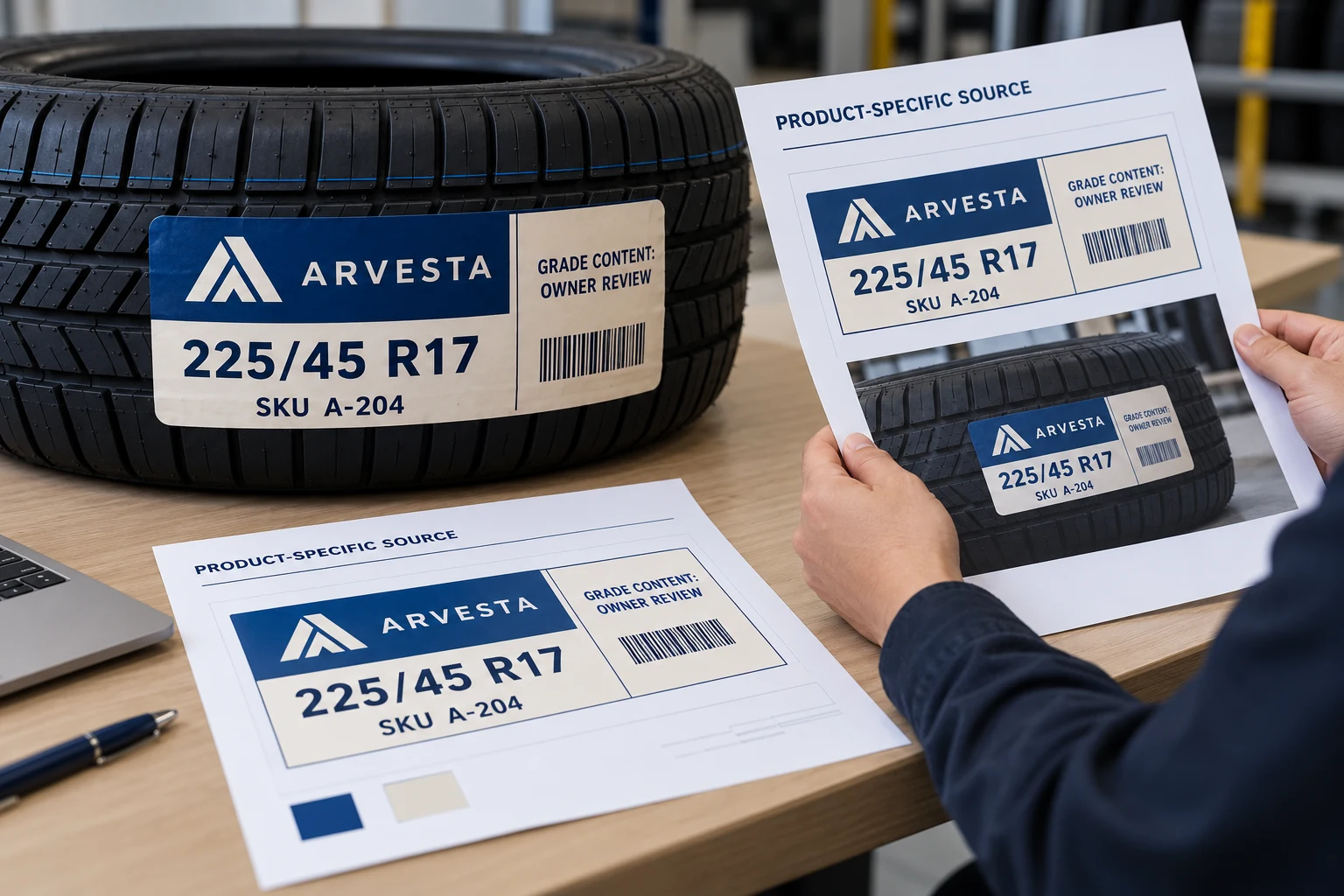
Identify the jump from data to promise
Ask the product owner for the exact grade information and ask the marketing owner for the exact proposed claim. Put the two beside each other. The review question is whether the source supports the words that the buyer will actually read, not merely whether the grade appears somewhere on the design.
An illustrative draft might replace a relative treadwear comparison with a specific mileage headline. Do not calculate such a headline by multiplying the grade by an assumed mileage factor. If the business offers a mileage warranty, obtain its separate approved wording, product coverage and conditions.
The existing load-and-speed proof guide addresses faithful reproduction of product fields. This review starts after that check: can the proposed surrounding copy claim more than the approved field establishes?
Keep the three grading categories within their scope
The explanations in 49 CFR 575.104 describe treadwear as a controlled-course comparison and note that actual use can produce different results. Its traction explanation concerns specified wet-surface braking tests and excludes several other traction characteristics. Its temperature explanation concerns a defined heat-resistance test context.
Those distinctions matter when reviewing words such as mileage, all-weather grip or speed capability. Do not infer a broad promise from a category that answers a narrower test question. The responsible product and compliance owners should approve any interpretation used in sales copy.
This article does not determine a tire's grades or regulatory applicability. Obtain the product-specific source and qualified review before reproducing the information. The narrower editorial task is preventing an unsupported expansion of meaning during design.
Build a claim-boundary table
| Proposed label content | Evidence the reviewer needs | What should remain separate |
|---|---|---|
| Approved grade field | Product-specific authorized grade information | Additional sales interpretation |
| Specific mileage promise | Separately approved substantiation and wording | Grade arithmetic alone |
| Mileage warranty reference | Actual applicable warranty and conditions | An unconditional life prediction |
| Broad grip statement | Evidence covering the exact stated performance | A narrower grade category |
| Temperature or speed language | Appropriate product-specific approval | Treating distinct rating systems as interchangeable |
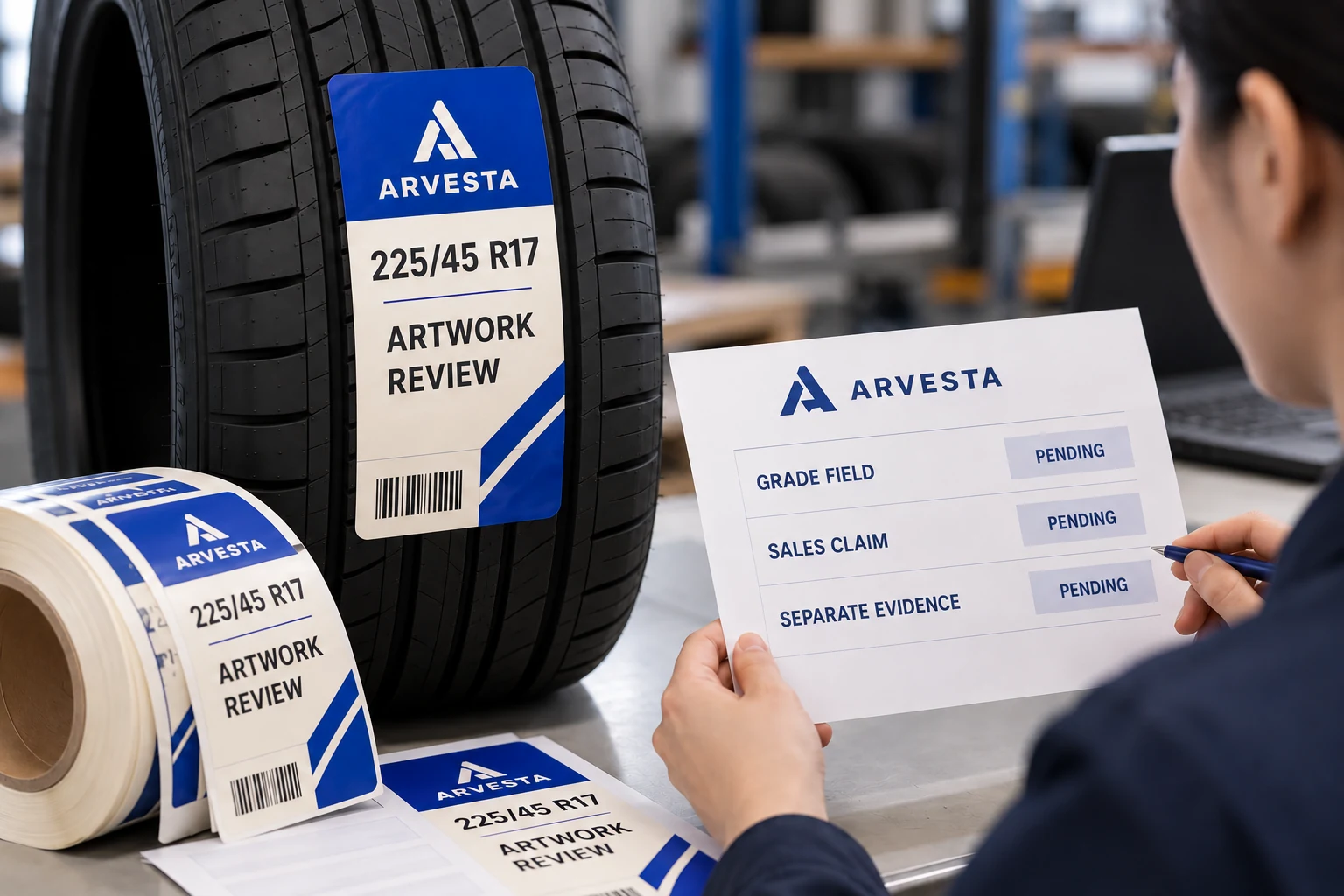
Use the buyer's actual proposed words in the working table. Do not substitute a softer paraphrase that hides the claim under review. If the evidence is unavailable, mark the affected wording unresolved and keep it out of production release.
Review headings and graphics as part of the claim
A large headline can communicate a stronger promise than a small qualification beneath it. Review the complete design, including captions, icons and numerical callouts. Do not approve the grade text in isolation while leaving the overall impression unexamined.
If the buyer supplies a warranty reference, the responsible owner should decide how its conditions are communicated and whether the proposed presentation is appropriate. The printer should reproduce the approved result, not compress conditions until they fit a decorative corner.
Images deserve the same discipline. A product rendering should not invent grade values, award badges or a mileage guarantee to make a sample look finished. A clearly identified artwork-review example can illustrate the process without claiming that an actual tire achieved a result.
Keep product scope attached to the wording
An approved claim may apply to a specific product set or stated conditions. Connect that scope to the label versions in the order. Do not spread the wording across every size or model merely because the artwork uses a common template.
For mixed versions, retain the approved source and claim decision per relevant group. If a product falls outside the approved scope, use the appropriate alternative wording or hold that version for review. The design team should not select a similar claim from another product to avoid an empty panel.
Preserve the distinction between required information and optional promotional copy. Removing an unsupported optional headline does not authorize removing information that the responsible owner determines must remain. Return both questions to the appropriate reviewers where the layout depends on them.
A smaller claim can be the better design
If the grade field is approved but the proposed headline lacks a separate basis, retaining the factual field and removing the unsupported expansion can avoid an unnecessary print hold. Have the owner approve the revised complete proof and confirm the remaining content is suitable.
If a separately substantiated warranty or performance statement is important to the product offer, allocate the space and review it properly. The answer is not to avoid every useful claim. It is to preserve the conditions and evidence that make the particular claim supportable.
Where the existing approved label already communicates the required information clearly, it may need no change. A request for stronger marketing language should have its own review rather than inheriting approval from the previous artwork.
Save the wording decision with the proof
Record the exact released text, its supporting reference, product scope and responsible approval. Keep rejected or revised claims identifiable so they are not pasted back into a reorder from an old presentation. A corrected grade field does not automatically update every promotional file that refers to it.
For tire identification labels, prepare a grade-and-claim brief with the authorized grade source, exact proposed copy, separate warranty or claim basis where applicable, complete artwork, dimensions and quantities. Organize the requirements on the contact page and send supporting files through email or WhatsApp. Approve what the words promise, as well as the numbers they reproduce.