NHTSA Tire Safety Guide
Primary consumer guidance explaining tire size, load index and speed rating markings.
View detailsResource Guide
A buyer can notice the tire size is wrong and still miss two small characters beside it. Load index and speed symbol need a deliberate check against the approved product record, not a visual nod at a familiar-looking tire label.
Published 2026-10-08
Digital proof before production. Material and adhesive options are discussed according to your application requirements.
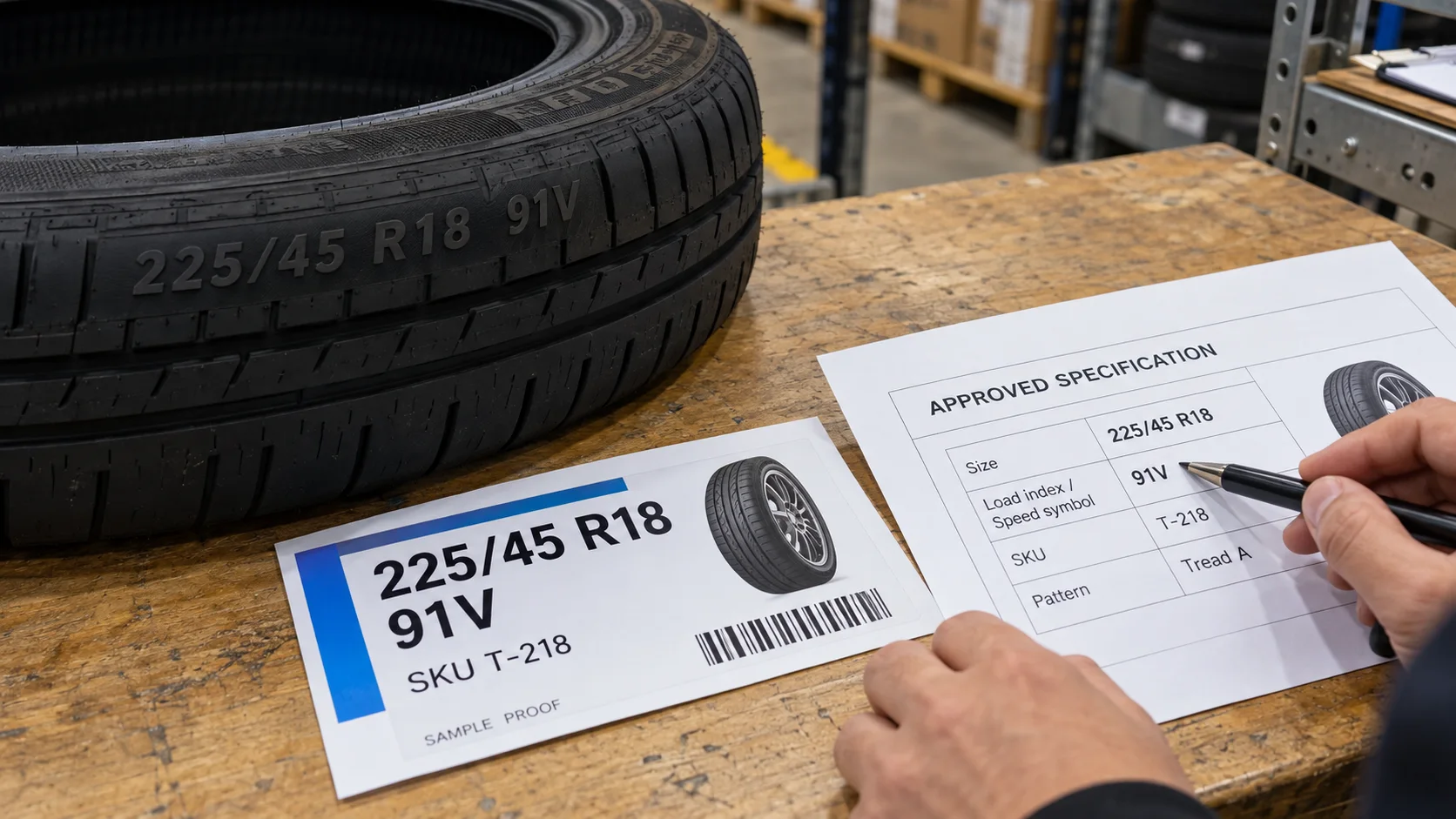
Start with the exact buyer-approved tire specification for each SKU. Then compare the tire size, load index and speed symbol as a single string across the source record, artwork proof, printed sample and physical tire marking where applicable. NHTSA consumer material explains these as separate elements of tire marking. A removable tread sticker is not a substitute for required sidewall markings, and a printer should not choose or infer a rating from a similar-looking size.
Primary consumer guidance explaining tire size, load index and speed rating markings.
View detailsImagine a fictional product file approved as 225/45 R18 91V. A designer starts from an older label whose last two characters read 94W. The new size is updated, but the load and speed field is not. This is a composite example, not a reported recall or customer project. A generic sign-off saying “size checked” may miss it. Mark the entire approved string in the proof and have the data owner sign the specific variant, not just the visual template.
Use one row per SKU. Include buyer SKU, size string, load index, speed symbol, market or language version, human-readable text and any encoded value. Ask the print supplier to show which source column fills each artwork field. For variable labels, inspect the first, middle and last examples plus each distinct data rule. If a code points to a digital record, scan the proof and compare the returned SKU rather than assuming the bars match the visible text.
A proof can confirm placement, spelling, size, legibility and faithful reproduction of buyer-approved data. It cannot establish that the tire itself meets a claimed load or speed capability, that a vehicle can use it, or that a legal market label requirement is satisfied. Those responsibilities sit with the product owner and relevant technical or regulatory reviewer. The illustrated 91V values in this article and image are fictional proof fields, not a product recommendation.
Compare the printed label on a representative tire, not only on a white PDF page. Check whether the data remains readable across tread curvature, whether the code is in the intended scan position and whether similar adjacent SKUs are visibly distinguishable. Photograph the approved applied sample with its SKU and artwork revision. If the tire marking and order record do not agree, stop the print release and return the question to the product owner.
Provide the approved master SKU table, exact size and service-description text, artwork version, tire photos, label dimensions, code specification if any, order quantities by variant and the responsible sign-off contact. Ask how changed data will be proofed and how obsolete artwork will be held. The useful result is not merely a quote; it is a print file that can be traced back to one approved product row.
FAQ
No. The product owner must supply and approve the exact rating for each tire. The printer can reproduce and proof the supplied data.
No. Treat removable product and warehouse labels separately from mandatory tire markings and applicable regulatory requirements.