Brady: Washdown-Resistant Labels
Example of manufacturer-specific washdown constructions.
View detailsResource Guide
A label that survives a damp room may still fail under repeated spray, heat or cleaner contact. Specify how the equipment is cleaned, not just that it gets wet.
Published 2026-09-29
Digital proof before production. Material and adhesive options are discussed according to your application requirements.
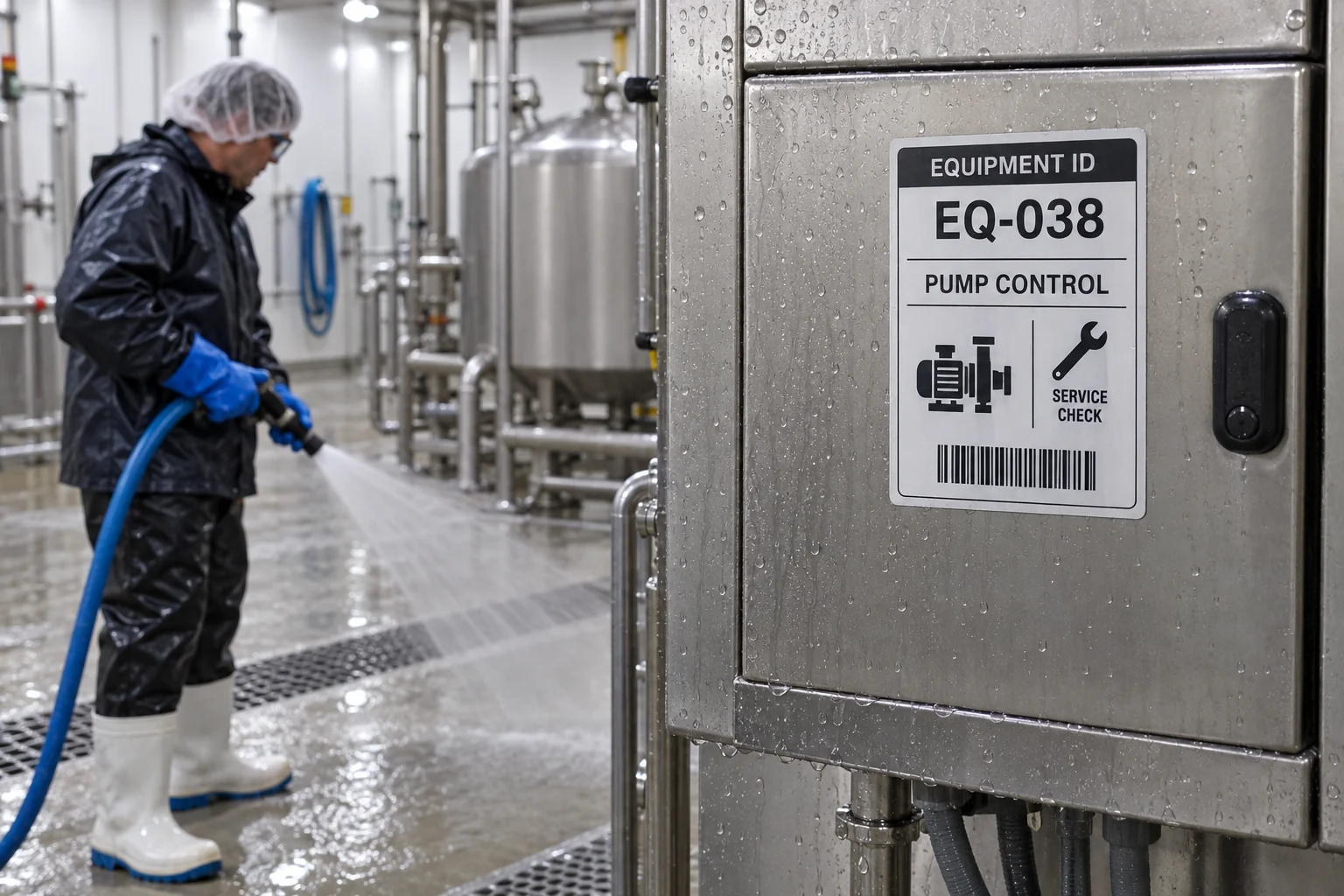
List water temperature, spray pressure and angle, nozzle distance, cleaner type, dwell time, frequency and whether the label is hit directly. Add the temperature and condition of the equipment surface when the label is applied. Brady markets particular washdown-resistant materials for demanding cleaning, while 3M warns that excessive pressure can push water under graphic edges. Those are construction-specific manufacturer statements, not a guarantee for this website or an unspecified material. Ask for data on the exact proposed stock and test it in the actual process.
Example of manufacturer-specific washdown constructions.
View detailsManufacturer guidance that spray conditions can damage graphic edges.
View detailsImagine a stainless cabinet whose ID sticker sits beside a door seam. The operator cleans the enclosure every shift. Water tracks along the seam and under the label edge; a replacement sticker is then applied to a wet panel. This is a composite example, not a field test. A better brief might move the marker to a flatter protected area and specify a dry application step. A thicker film alone does not solve a poor placement or unapproved application method.
Even when the label stays attached, printed IDs can fade, scuff or become hidden by residue. Review the face material, printing method and any protective construction as a system. Put the asset ID in large human-readable text; include a code only if the scanner can reach it after guards and hoses are installed. Avoid placing a sticker over an existing rating plate, drain, fastener or access panel. If food-contact or contamination rules apply, have the responsible facility expert select approved constructions and verify documentation.
Apply a finished-size sample to the actual cabinet after following the material makers surface preparation instructions. Record when it was applied and allow the specified dwell before normal cleaning. Inspect the edges, text and code after representative cycles, then document whether the result meets the site acceptance rule. Do not report a material as certified or tested by this website because a supplier catalog lists a different material. A failed sample should lead to a revised construction or placement, not an unqualified durability promise.
Supply cabinet photos, available flat area, existing nameplate locations, required copy, cleaning procedure, label quantity and whether variable equipment IDs are needed. If different machines have different cleaning programs, list them separately. Discuss label and print construction with the supplier, and ask which performance evidence belongs to the exact item quoted. The aim is an ID that maintenance staff can still read, not merely a glossy label that looks good before washdown.
FAQ
No. Pressure, heat, angle, cleaning chemistry and edge placement can differ. Evaluate the exact construction in the actual cycle.
Follow the specific material application instructions and test the real process. Do not assume wet application is allowed.