GS1: Why Use a Digital Link URI?
Primary explanation of stable encoded addresses and changeable destinations.
View detailsResource Guide
A QR code can be printed once while its maintenance system changes. Decide who controls the encoded link, redirects and fallback ID before the label goes on equipment.
Published 2026-09-27
Digital proof before production. Material and adhesive options are discussed according to your application requirements.
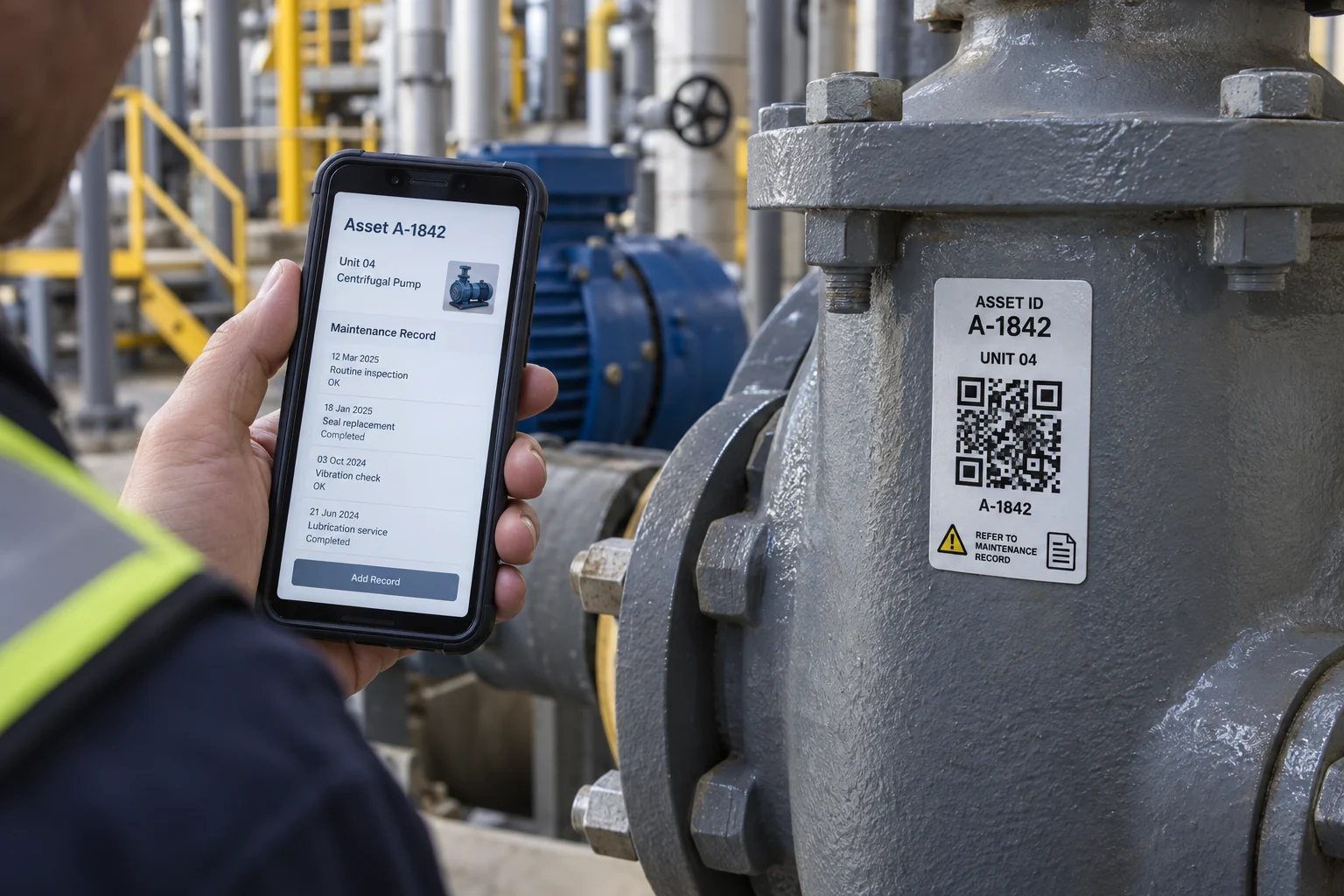
For a long-lived asset label, give each item a stable human-readable ID and decide what the QR code encodes. If the code contains a web link, establish who owns that domain and how a moved record will redirect. A maintenance platform subscription, site redesign or contractor change should not silently turn permanent labels into broken links. The label buyer and the record owner both belong in the approval conversation.
A technician scans a pump label, but the page that once held the maintenance history has moved. The printed code still looks flawless. The failure is now digital, not adhesive. This is an illustrative scenario, not a reported breakdown. Replacing every label would be expensive and disruptive; maintaining a redirect from an organization-controlled address may be much simpler. GS1 explains this general principle for persistent identifiers and updatable destinations. A private asset scheme does not become a GS1 Digital Link merely by copying the idea.
A QR code can hold a fixed asset number, a direct URL or an identifier resolved by an internal system. Each option changes who must maintain data and what happens when systems change. Define whether one QR belongs to the physical unit or to a replaceable part. Keep the same readable ID on the label and in the record so staff can search manually when a scan fails, a phone is unavailable or a printed code is damaged.
If technicians already use a dedicated handheld scanner connected to an internal database, a compact 1D asset barcode may be cheaper and easier than a web QR workflow. If the goal is mobile access to instructions or service history, QR may be more convenient. Neither symbol fixes poor data ownership. The print supplier can check the supplied payload and label layout, but should not invent an asset system or promise that a third-party URL will be maintained indefinitely.
Before bulk production, test a sample on the actual surface with the intended phones or scanners. Check the decoded payload, correct asset record, human-readable ID, permissions and behavior after a controlled redirect. Record the approved URL pattern or identifier format without publishing sensitive credentials. Confirm material and adhesive separately for cleaning, handling and service duration. A QR label can be physically durable while its data route remains fragile, so both sides need owners.
Cover image is an AI-generated maintenance illustration. The QR pattern, phone screen and service history are fictional, not a real customer system or scannable production code.
FAQ
The printed payload cannot be changed without replacing the label. A redirect controlled by the owner can change the destination behind a stable URL.
No. GS1 Digital Link is a specific standard approach. An internal asset system may use another identifier or URL scheme, provided ownership and long-term maintenance are planned.
A readable fallback ID is useful when scanning fails or a digital system is temporarily unavailable.