GS1: Serialisation and Unique Identification
Official explanation of serial values and their relationship to unique item identification.
View detailsResource Guide
A quote for 5,000 numbered asset tags is not complete when it states only the quantity. Someone must decide the starting ID, the last ID, which ranges are already reserved and what happens when a tag is damaged before it ever reaches a machine.
Published 2026-10-07
Digital proof before production. Material and adhesive options are discussed according to your application requirements.
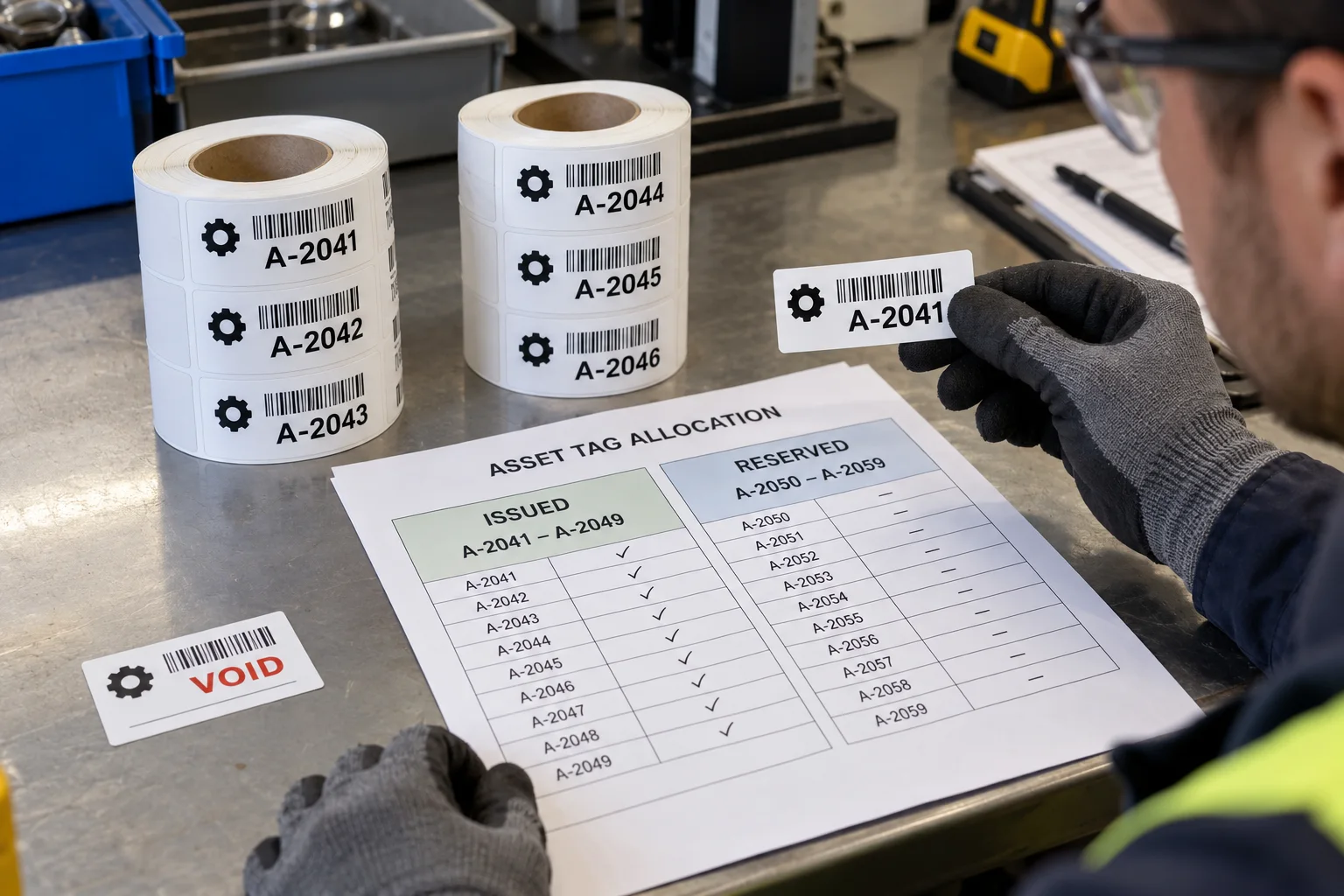
Assign one owner to the approved range and document the prefix, width, starting value, ending value and any check-character rule. Record ranges already issued, held for another site or deliberately voided. A serial number is assigned to an individual item; GS1 notes that serials may be sequential or random and represented in human- or machine-readable form. Use a GS1 identifier only when the buyer scheme actually requires it. Printing tidy consecutive numbers does not by itself make the equipment register accurate.
Official explanation of serial values and their relationship to unique item identification.
View detailsImagine Plant A orders A-2041 through A-2049 and Plant B separately reserves A-2050 through A-2059. This is a fictional planning example, not a company record. If a buyer sends a second supplier a file starting at A-2045, both print runs can look correct while five physical assets receive duplicate IDs. The fix is not a nicer barcode; it is one approved allocation register and a release step before any print file is handed off.
Issued means labels have been allocated to a print run or asset. Reserved means a range must not be used for another job even if no roll has shipped. Void means a number is deliberately retired after a misprint, damage or controlled cancellation. Agree whether a void number may ever be reissued; for long-lived asset tracking, reuse can make historical records ambiguous. Keep the reason and authorizing person in the buyer register, not only on a loose paper note.
Specify the delivery order: ascending serials on each roll, labels per roll, first and last ID on the core or carton, and how partial rolls are identified. After printing, compare the approved source file with a sample from each roll and reconcile the total number of good labels, rejected labels and voided IDs. Test the intended scanner and read the human text too. A barcode that decodes once does not prove that its value is unique or assigned to the right asset.
Provide the exact range or approved CSV, prefix and leading-zero rules, artwork, barcode format if specified, human-readable fields, tag size, equipment surface, expected environment, roll sequence, copies per ID and receiving-site breakdown. Ask whether the supplier can provide the requested file-to-roll reconciliation; do not assume a process that was not quoted. The equipment owner must still apply tags to the correct physical units.
FAQ
Follow the buyer-controlled exception rule. For long-lived unique asset IDs, document voids and avoid accidental reissue.
No. The buyer still needs an allocation register, assignment record, physical application check and ongoing asset database.