Resource Guide
Equipment Relocation Labels: Keep Asset ID Separate from Bay Location
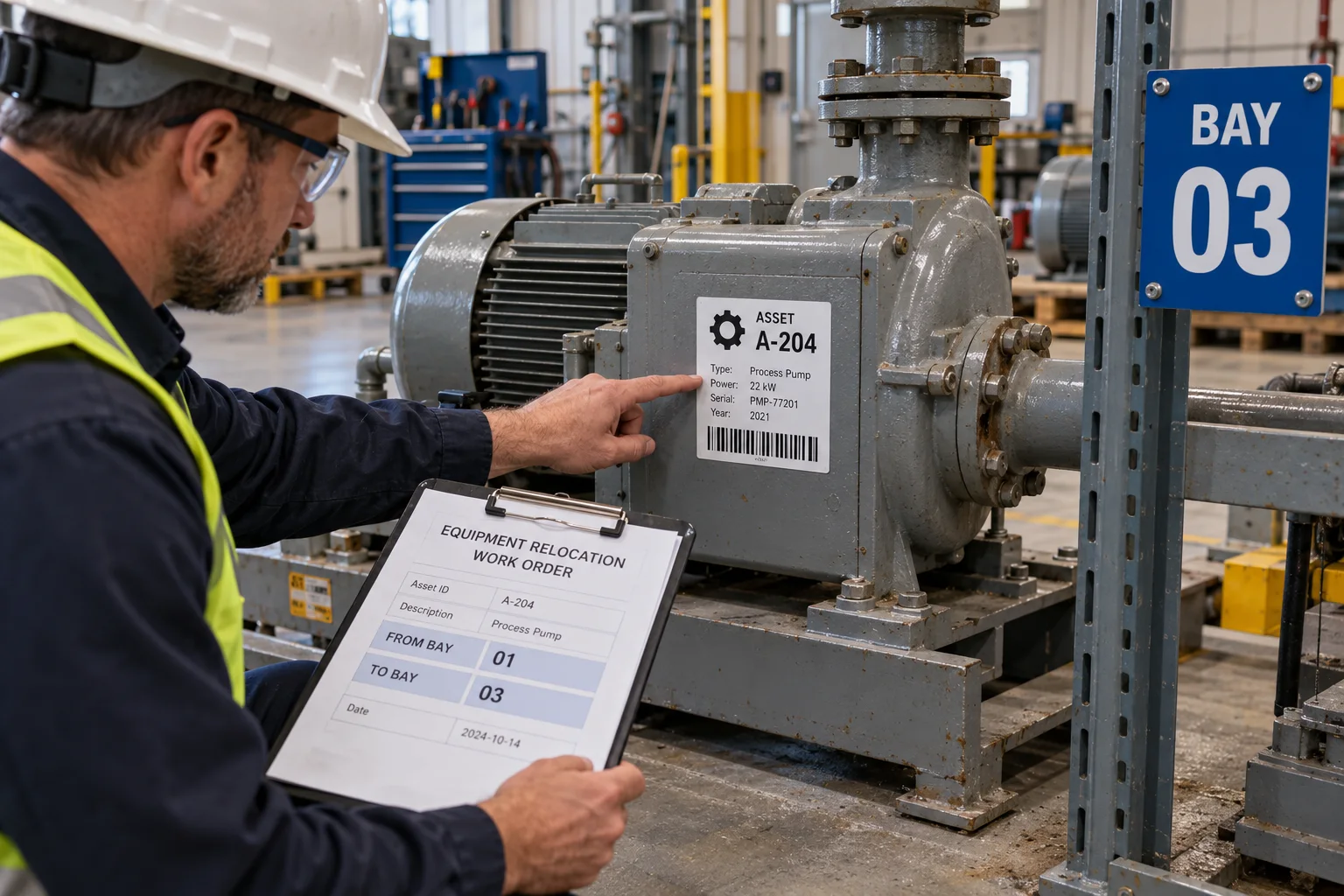
A machine can move from Bay 01 to Bay 03 without becoming a different machine. The plant location changed; the physical asset did not. A label plan that prints the bay number as the only machine ID makes every move a relabeling problem.
Published 2026-10-07
Digital proof before production. Material and adhesive options are discussed according to your application requirements.
Quick Answer: Keep Two Records Distinct
Give the equipment a stable buyer-approved asset ID attached to an appropriate part of the machine. Give the bay or floor position its own location ID on the rack, wall or controlled site map. When the equipment moves, update the asset-to-location relationship in the maintenance or inventory record. Do not move a location placard with the machine or rewrite the manufacturer nameplate. The barcode or QR code is a lookup aid, not proof that the move was authorized.
An Illustrative Move Between Bays
Imagine a process pump marked A-204 leaving Bay 01 for Bay 03. This is a composite scenario, not a customer installation. The technician scans the machine tag, records the move and checks that the new bay sign still identifies Bay 03. If the pump sticker had been printed only as BAY 01, the worker would face a choice between an inaccurate label and a new label every time equipment is relocated. A stable asset ID lets the location field change without breaking the history.
What Stays on the Machine?
The asset tag should remain visible in normal maintenance work and travel with the movable unit. Check placement on the actual frame for heat, cleaning, oil, abrasion, guards and access covers that may be replaced. Keep original rating plates, serial markings and safety warnings uncovered. A separate removable panel or motor may have its own ID when the maintenance record tracks it independently; do not treat every attached component as the same asset by default.
Close the Record Handoff
A relocation order should identify the old and new location, asset ID, responsible person, date and any required commissioning or safety checks. Those checks belong to the site process, not to the printed label. Scan the ID at the old position and the new one, then verify the database returns the intended equipment record. If a network is unavailable, human-readable asset text should still help staff identify the unit. Retire or update obsolete location stickers only under the site labeling rule.
What to Send for a Quote
Share the approved asset IDs, quantity, equipment photos, surface and cleaning conditions, desired size and placement, barcode or QR requirements, scanner details, human-readable text, and whether location signs are also in scope. Ask for a finished-size applied sample at the intended read point. The label printer can make the IDs readable and durable for the specified application; the plant owner must keep asset and location records aligned.
FAQ
Questions Buyers Ask
Does an asset number change when equipment moves?
Normally a stable ID stays with the same physical asset while the approved location field changes. Follow the owner asset-governance rules.
Can the bay number be printed on the machine?
It can be a changeable location cue, but should not replace the stable asset ID when moves need traceable history.