Grundfos: Find a Pump Product Number
Manufacturer guidance on reading the pump nameplate for product identification and replacement-part lookup.
View detailsResource Guide
A pump skid can stay in place when its motor goes to the repair shop. If the only number is on the motor, the pump appears to disappear with it. If the number is only on the frame, the removed motor loses its own history.
Published 2026-10-07
Digital proof before production. Material and adhesive options are discussed according to your application requirements.
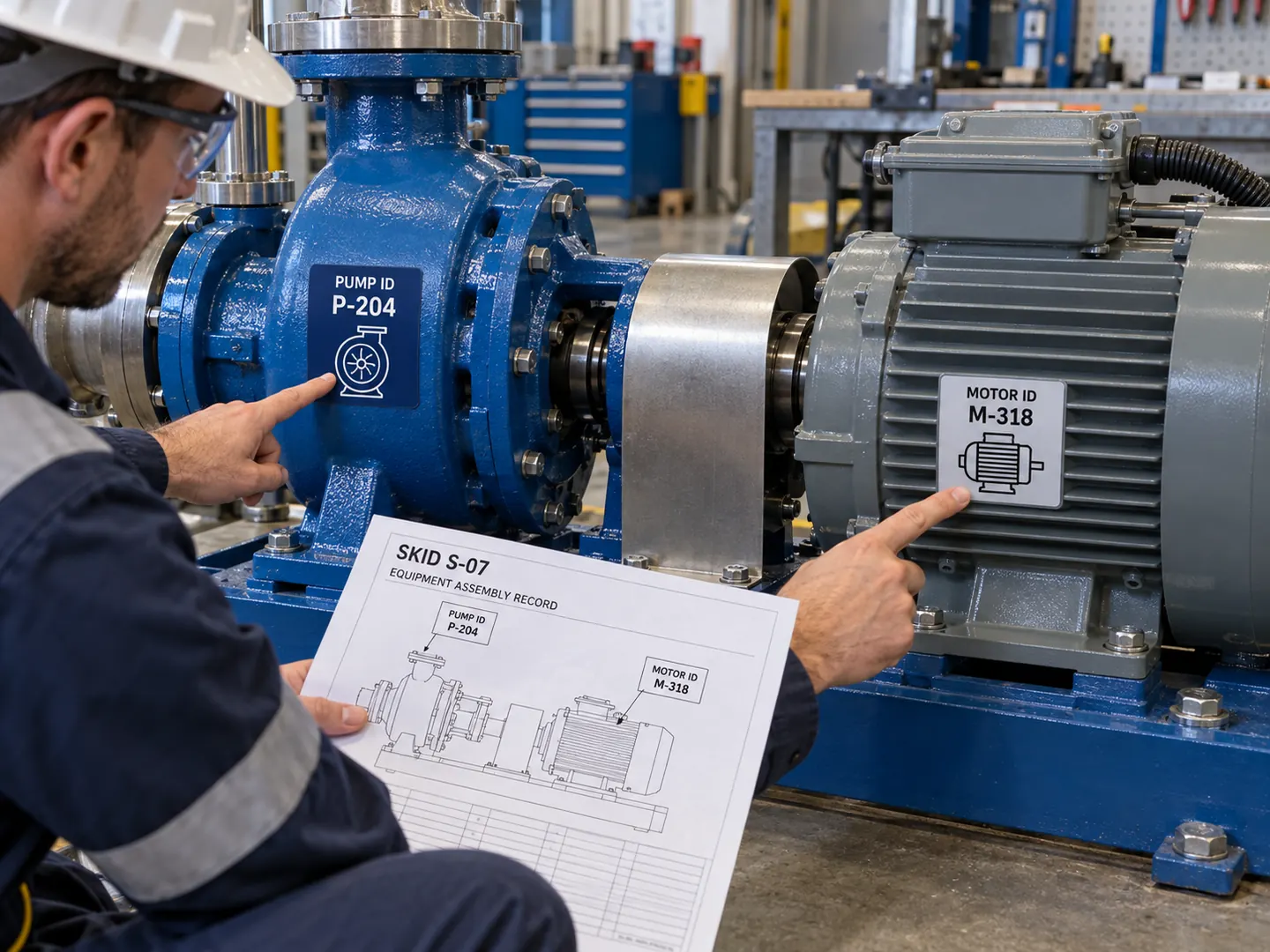
Give the fixed installation or pump its buyer-approved ID and give a removable motor its own component ID when the maintenance system tracks it independently. Keep the relationship between them in the equipment record, not by printing the pump number permanently onto every replacement motor. Manufacturer plates and ratings must remain visible and unchanged. Grundfos provides pump product-number and spare-parts lookup guidance; its examples illustrate why approved equipment identity matters, not a universal label-placement rule.
Manufacturer guidance on reading the pump nameplate for product identification and replacement-part lookup.
View detailsImagine a workshop removes motor M-318 from pump P-204 and installs a spare. This is a composite example, not a maintenance record. A label saying only P-204 on the motor makes the removed unit look like the pump, while a frame plate saying only M-318 becomes wrong as soon as the spare is fitted. Separate IDs let the mechanic record which motor was installed at which pump and when, without changing the fixed pump identity.
The installation or pump ID belongs on a stable visible part approved by the equipment owner. The motor ID belongs on a part that will travel with that motor if it is removed. Keep labels away from cooling openings, rotating parts, hot zones, original nameplates and wiring access. Photograph the installed and removed views before choosing dimensions. Do not use a fictional sample image to approve an electrical or mechanical marking.
A work order should link pump ID, outgoing motor ID, incoming motor ID and the authorized person who performed the exchange. A code on either label is only a lookup key. The buyer should check that the printed text and encoded data resolve to the correct record after a change, including when network access is unavailable. Use a finished-size sample on representative painted or textured metal.
Supply photographs of the pump body, skid and motor housing, approved ID schema, label dimensions, surface finish, expected oil and cleaning exposure, quantity and scan devices. Say which components are likely to be swapped. Request two separate sample labels and an example pairing record with fictional numbers. A print supplier can produce the identifiers; the owner must approve the equipment mapping.
FAQ
Not when each physical motor has its own tracked history. Update the pairing record and keep IDs attached to their respective units.
No. A buyer asset ID is an additional lookup aid and should not cover or rewrite original rating information.