Food Equipment ID Labels: Separate Washdown Resistance From Food-Contact Scope
Published
The proposed equipment label survives the cleaning discussion. It has a readable asset number, a protective finish and a place on a stainless enclosure. Then someone asks whether the same construction can go beside the product opening. The supplier's washdown description does not answer that second question.
Define the label's installed position and intended contact conditions before requesting a food-contact assurance. Cleaning resistance concerns how the finished label performs during cleaning. Food-contact suitability concerns a different use and evidence scope. Neither a waterproof description nor a successful wipe trial establishes that the complete printed label is appropriate for an unspecified contact situation.
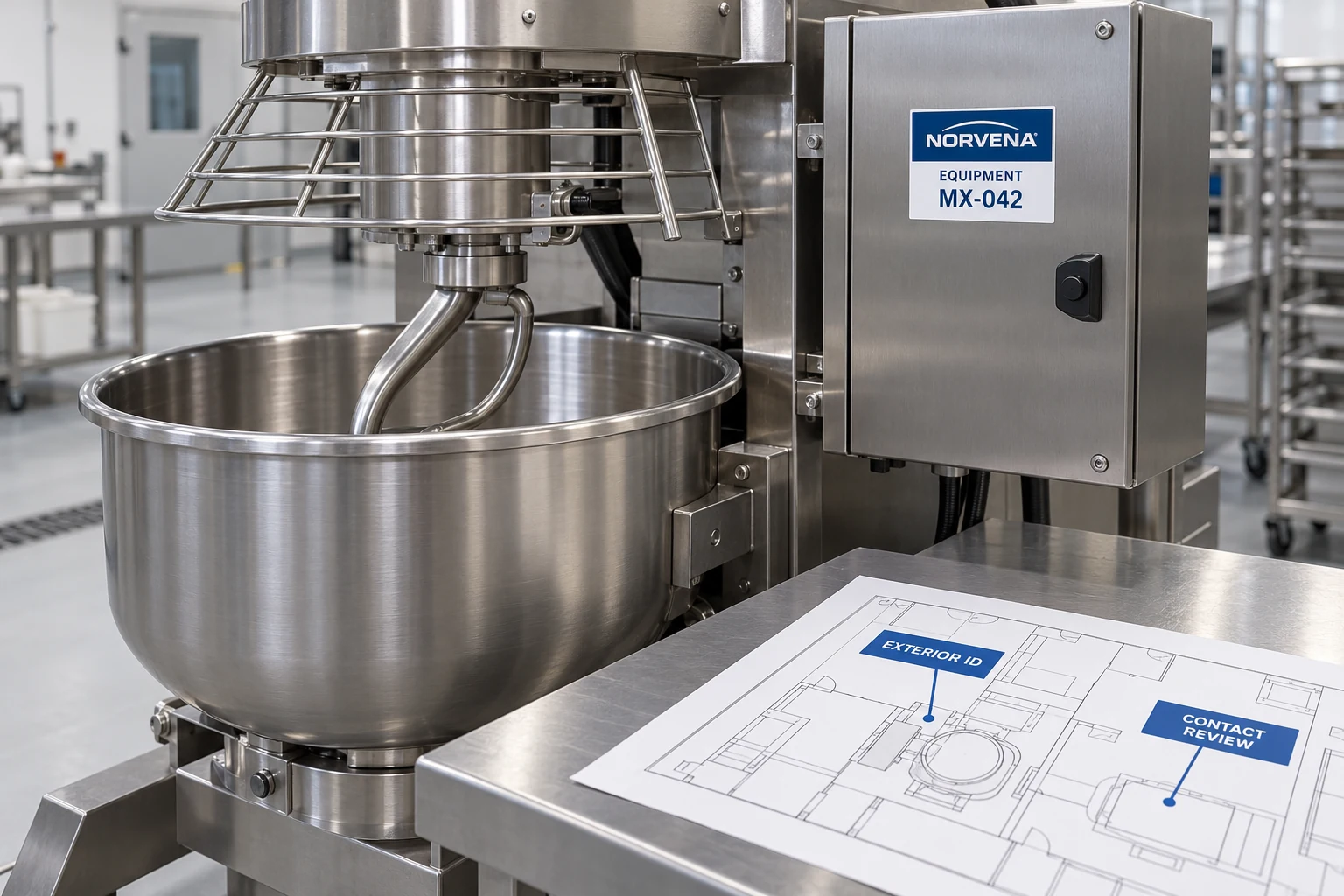
Draw the location before requesting a declaration
Start with a photograph or equipment drawing that shows the intended label and surrounding product path. Include normal operation, loading, unloading and the relevant cleaning sequence. An asset ID on the exterior of a control enclosure and a label on a surface that contacts food should not be described with the same two-word request: food equipment.
The responsible facility reviewer should decide how the proposed position is classified and what assessment is required. Purchasing can make that decision easier by identifying where the label sits and what could reach it. Do not turn a general article into permission to install a label at a particular location.
Record any uncertainty openly. If nobody has established whether an exposed edge, removable panel or handling step introduces a relevant pathway, that is an unresolved requirement. A supplier cannot eliminate it by sending a general statement about a familiar adhesive.
Use the intended application as the evidence boundary
FDA's explanation of food-contact substances includes processing equipment among its examples and discusses adhesives and other components. FDA also explains that its review considers the intended use. This provides a reason to make the application explicit; it is not a determination about a label proposed for your machine.
For a US project, have the responsible reviewer identify the applicable basis and documentation for the actual use. Other markets or customer specifications may introduce different questions. This guide does not select a regulatory route, interpret an authorization for a particular formulation or claim that CYJ supplies a qualified food-contact construction.
Keep that distinction in the purchase record. A quotation for ordinary external identification should not silently become a promise for direct product contact because the same machine appears in both briefs. Conversely, the presence of food somewhere in a facility does not, by itself, classify every exterior label in the same way. The reviewer needs the actual facts.
Identify the complete retained construction
The proposed item contains more than an adhesive name. Record the face material, adhesive, printing system and any protective coating or laminate that remains after installation. If a supporting document covers only one ingredient or one component, mark that scope rather than describing it as approval of the complete label.
Keep a traceable construction reference where proprietary details cannot be shared. The point is not to publish a supplier's formulation. It is to let the authorized reviewer connect the proposed supply with the documents being used to support it.
FDA's inventory description states that listed information concerns specific intended uses and conditions. Finding a similar material name is therefore a starting point for the review, not a substitute for matching scope. Ask the reviewer to assess the source, applicable limitations and relationship to the actual construction.
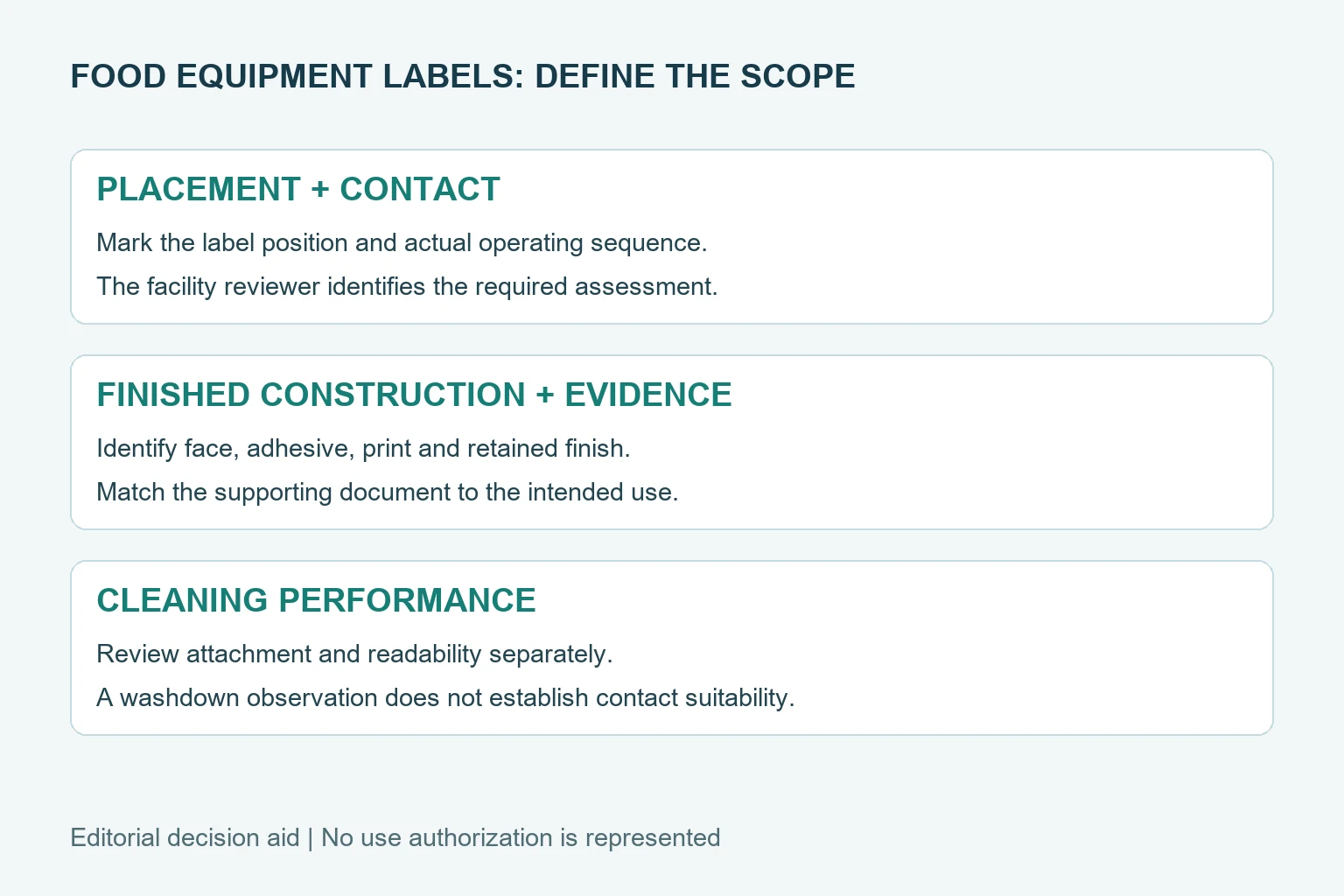
Build a placement-and-evidence matrix
Use a worksheet like this to make the next supplier discussion answerable. It is an editorial procurement aid, not a mandatory regulatory form.
| Item | Information to provide | Question for the responsible reviewer |
|---|---|---|
| Installed position | Marked drawing and equipment identity | What contact assessment applies here? |
| Operating sequence | Normal handling and product route | Which actual conditions must the evidence address? |
| Finished label | Traceable reference for all retained layers | Does the evidence match this construction? |
| Supporting document | Issuer, reference and stated scope | What use does it support, and what does it exclude? |
| Cleaning | Site procedure and relevant exposures | Is a separate durability evaluation needed? |
| Release | Named owner and recorded decision | Which placement and revision were approved? |
Do not fill gaps with assumptions such as all stainless equipment is the same or an exterior-looking position cannot involve contact. Photographs help explain geometry; the facility owner still needs to evaluate the operating facts.
The certificate-of-conformance guide addresses how a supplier statement connects to a particular order. That chain is useful here, but a shipment certificate cannot create a missing use qualification. Specify the question first, then ask what document actually answers it.
Keep cleaning performance in its own record
The washdown equipment-label guide explains why cleaner chemistry, temperature, spray and placement matter to attachment and readability. Continue that work alongside the contact assessment. A construction with relevant contact documentation can still need evaluation against the actual cleaning routine; a label that remains attached after cleaning has not thereby established contact suitability.
Review the printed information as well as the edges. A durable blank material is not the same specimen as the finished item containing ink and a protective layer. Any sample observations should identify the exact construction, procedure and acceptance decision. Do not label an illustrative product photograph as a sanitation test or approval record.
If a sample changes after cleaning, retain the observation and ask the designated owner what follow-up is required. Do not automatically interpret it as a regulatory failure or dismiss it because the asset number is still readable. Those conclusions need the relevant requirements and reviewer.
An approved external position may simplify the purchase
Where the identification task can be performed from an approved external panel, ask whether that position meets the facility's needs. It may avoid introducing a label into a more demanding location. This is a placement option for review, not a universal exemption or permission to move a required marking.
If the information must remain at the originally specified position, keep that requirement and resolve the evidence gap. Removing necessary identification solely to simplify purchasing is not a complete solution. The responsible equipment and facility owners decide what information must be available and where.
Prepare one scoped brief with the equipment identity, marked placement drawing, operating and cleaning conditions, required text, finished dimensions, quantity and the exact documentation question. Use the contact requirements page to organize it, then send supporting records through the listed email or WhatsApp route for a project-specific review. Ask about the proposed construction and its scope before releasing an order for equipment identification labels.