Parker Hose Assembly Training
Manufacturer safety, installation and inspection guidance; not evidence that any pictured label has passed a hose test.
View detailsResource Guide
A hose assembly ID helps a technician find the correct record. An inspection tag says what happened at a particular service event. Combining them carelessly can leave an old approval-looking tag attached after conditions change.
Published 2026-10-06
Digital proof before production. Material and adhesive options are discussed according to your application requirements.
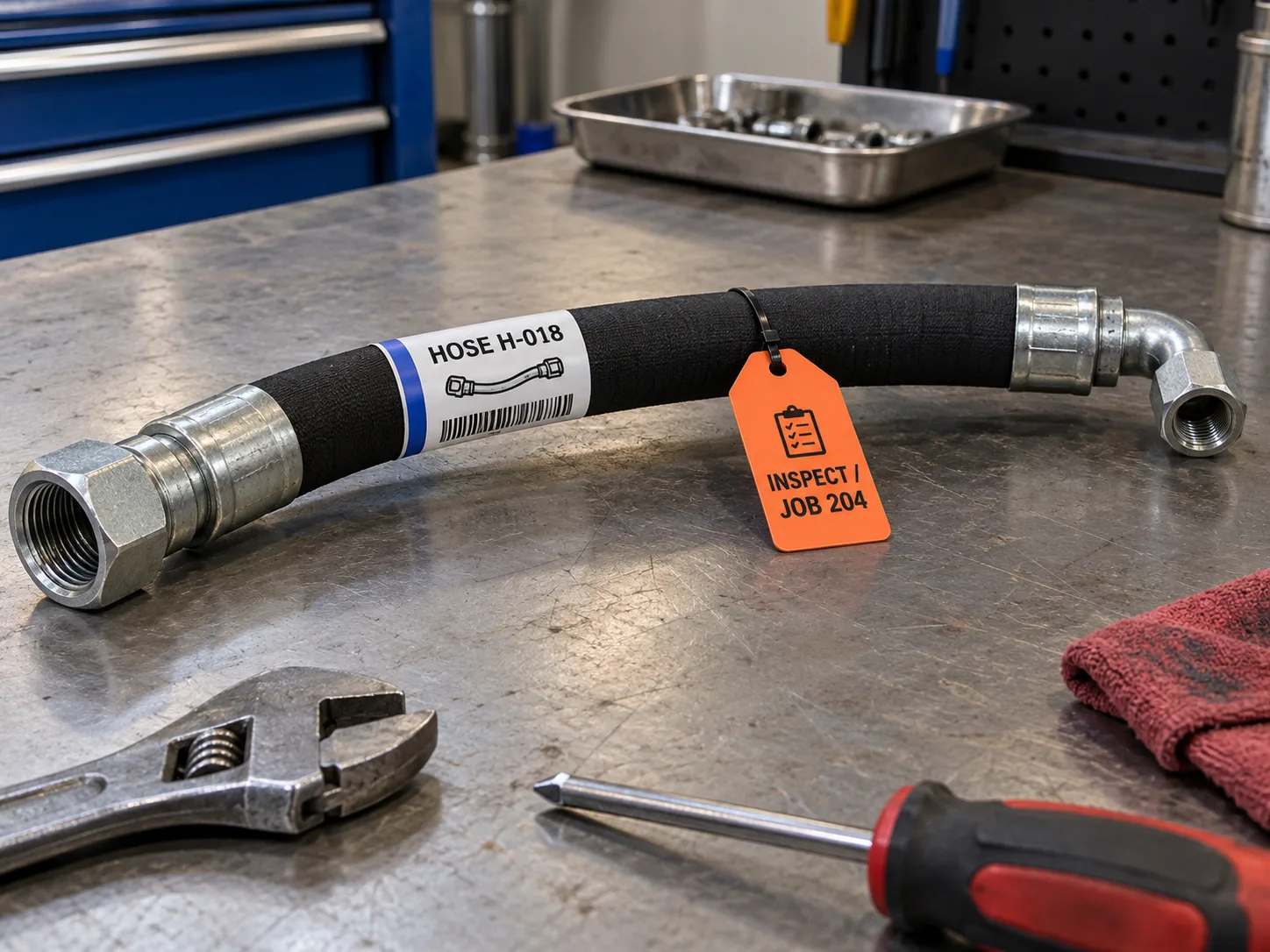
Use a buyer-approved unique assembly ID that links to the proper equipment and hose record. Keep inspection date, result and next action in a controlled service system or a clearly replaceable tag with an owner. A printed ID does not establish pressure rating, suitability or inspection status. Parker training materials discuss hose assembly installation and inspection responsibilities; follow the applicable equipment and hose manufacturer instructions for the actual installation.
Manufacturer safety, installation and inspection guidance; not evidence that any pictured label has passed a hose test.
View detailsImagine two removed hoses placed beside the same repair bench. They have similar lengths, but different equipment records. This is a composite scene, not a customer case. A loose handwritten date tag cannot reliably prove which assembly belongs to which machine. A unique ID that follows the assembly and matches the work order keeps the record connected; the technician still verifies the physical specification through the approved maintenance process.
Discuss the identifier location with the qualified hose or equipment owner. Do not cover manufacturer markings, damage indicators or areas that flex, abrade or need inspection. Some projects may require a separate tag or adjacent equipment marker instead of an adhesive label on the hose. Material, attachment and service exposure must be tested for the chosen surface and operating environment; a generic label photo does not prove suitability.
Keep an approved master for permanent assembly IDs and another for temporary inspection or service events. If a code is printed, the buyer owns the payload and the system lookup. Proof a fictional sample ID against a sample work order, then test the actual scan distance and expected handling. Avoid preprinting a pass result or next inspection date before the responsible inspector has made that decision.
Provide an approved ID format, assembly photographs, permissible marking zones, exposure and handling details, number of variants, desired roll or sheet format, and any scanner requirements. If temporary tags are needed, specify who applies and removes them. Ask for a finished sample on representative material before a production order.
FAQ
No. It is a pointer to buyer-owned technical records. Selection and suitability require the responsible technical process.
Only under a controlled status and replacement process. An old tag should not be treated as a current inspection decision.