Michelin: Storing My Tires
Manufacturer advice to record tire positions and protect tires during storage; follow the applicable tire instructions.
View detailsResource Guide
The pickup desk wants one set number. The fitter wants to know which of four tires was left front. A storage label system has to answer both questions after the tires have been moved, bagged and shelved.
Published 2026-10-07
Digital proof before production. Material and adhesive options are discussed according to your application requirements.
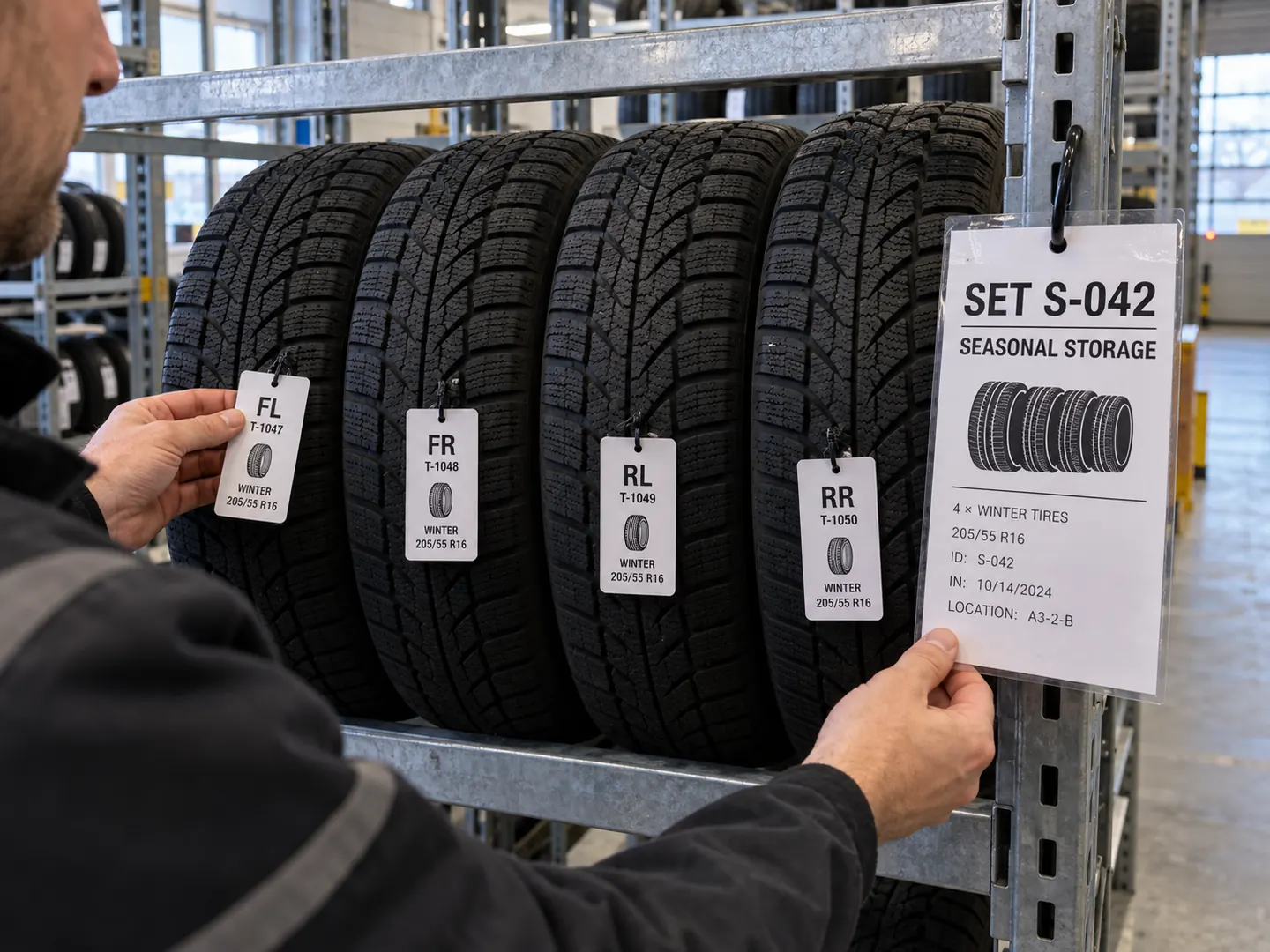
Give the stored group one buyer-controlled set ID and each tire a distinct tire or position identifier. The set ID connects the four items to the customer-owned storage record; the small individual tags tell staff which tire is in hand. A position mark records where a tire came from, not where it must be refitted. The tire professional decides any future rotation, inspection and suitability. Michelin advises noting positions before removing tires for storage, but its storage advice is not a label-material performance claim.
Manufacturer advice to record tire positions and protect tires during storage; follow the applicable tire instructions.
View detailsImagine two customers collect similarly sized winter sets on the same afternoon. This is a composite buying scene, not a reported mix-up. Each rack sleeve has a set card, but one loose tire has rolled into the adjacent bay. A set number only on the shelf will not recover that tire confidently. A tire-level ID matching the set record lets staff check the item before loading it, while the former position stays a separate field.
Decide whether the small ID belongs on a removable tire tag, storage bag, wheel hanger or another approved attachment point. Do not cover tire sidewall markings or treat an adhesive sample as proven on every rubber surface. Photograph the packed set as staff normally store it, then choose a readable set label position on the rack, sleeve or outer pack. A barcode is useful only if the receiving and pickup devices read its approved payload at that location.
The buyer system should own the customer link, tire-level IDs, former positions, intake condition notes and pickup transaction. The printer needs an approved example data file, not access to private customer records. Use fictional proof data. If a tire is replaced during storage, update the set record and issue a new tire-level identifier under the buyer workflow rather than silently reusing the old tag.
Send the set size, tag dimensions, storage bags or rack photos, whether tires have wheels, attachment method, data-field list, seasonal quantity, printer or scanner model and expected handling. Ask for a sample with one set and four different tire IDs. Check that a worker can read each identifier without unpacking the whole rack. Do not accept a quote that assumes every tire will receive the same printed number.
FAQ
Only if the operator can keep every item physically together and still identify a loose tire. A distinct item ID is safer for a workflow that handles tires individually.
No. It records history; inspection and future placement belong to the tire professional.