Serial Label Rolls: Approve the Sequence After Slitting
Published
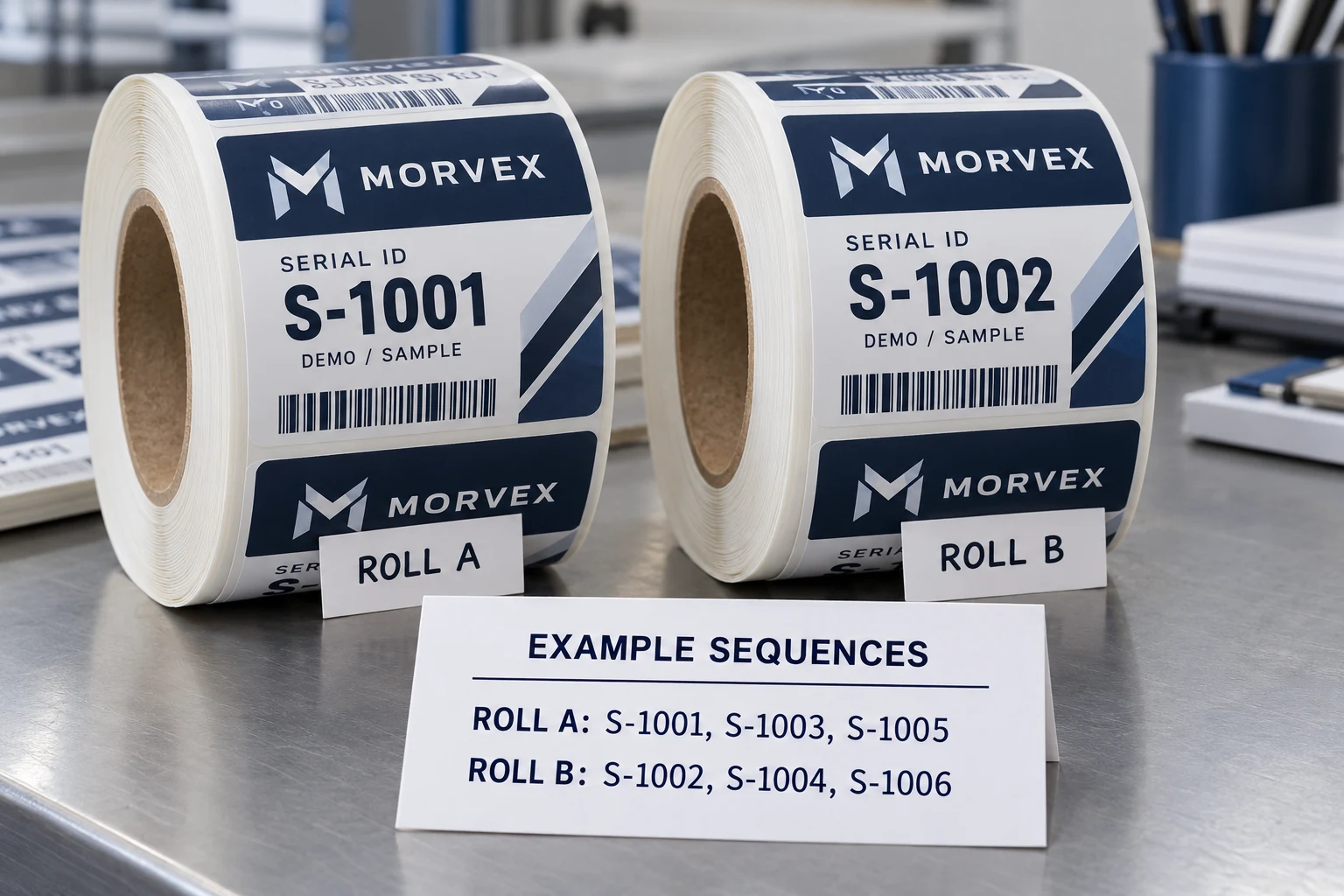
The source file is in ascending order. Every ID appears exactly once. The total quantity is correct. Yet the first finished roll presents S-1001, S-1003 and S-1005, while the next presents S-1002, S-1004 and S-1006.
If the installation team expected consecutive-by-one values on each roll, the delivery still creates a handling problem. The data can be complete without arriving in the order the buyer intended to issue it. That distinction is worth settling before approving a large serialized-label run.
This is a deliberately simplified example, not a shipment report. When a proposed print layout has multiple lanes, ask the supplier to show how records become finished rolls after the agreed converting and packing process. Approve the presented order, not merely the sorted spreadsheet.
Walk the records through a small layout
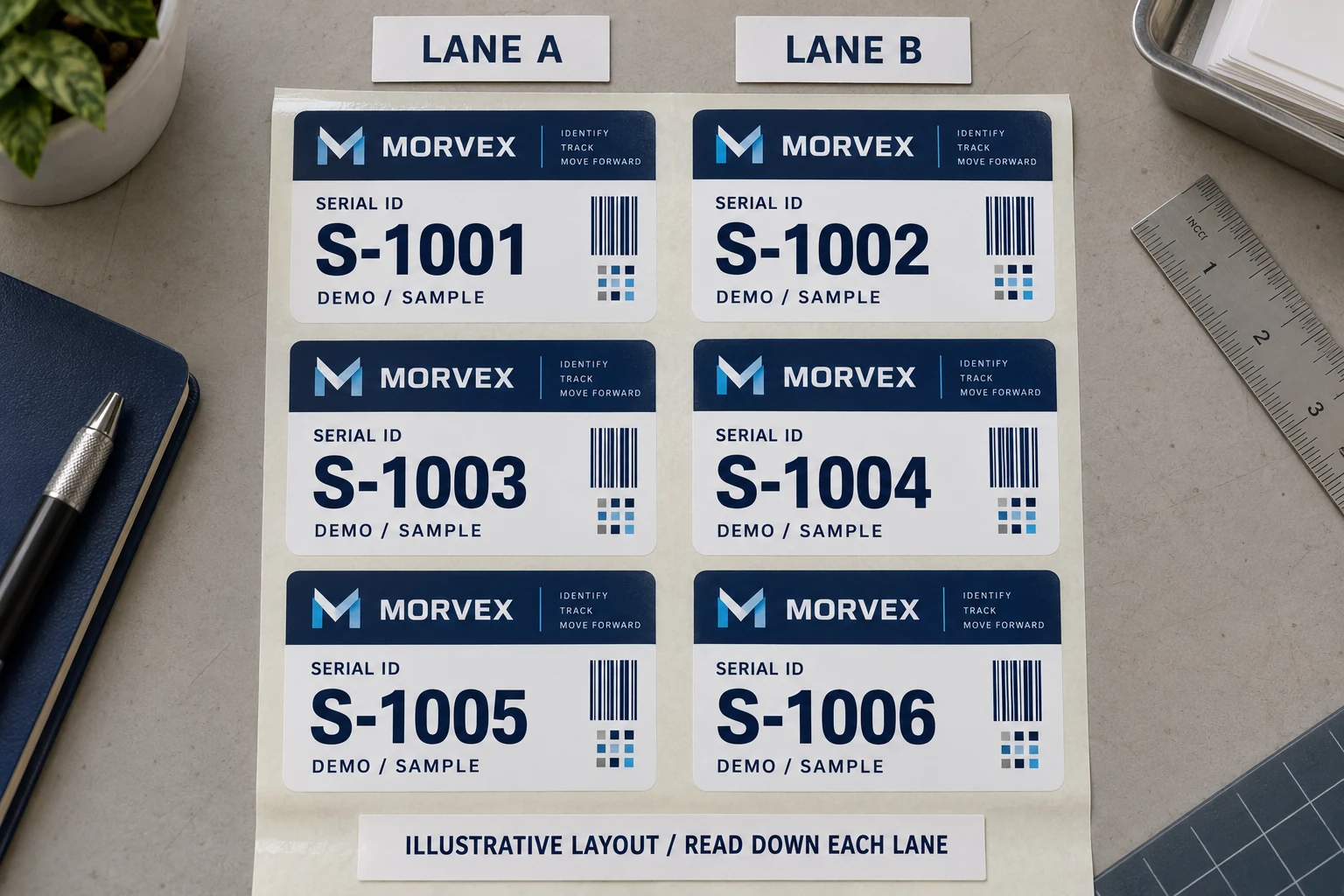
Imagine six approved strings arranged across two lanes, reading each row from left to right. These values illustrate positions only; they do not define a numbering standard.
| Printed row | Lane A | Lane B |
|---|---|---|
| First | S-1001 | S-1002 |
| Second | S-1003 | S-1004 |
| Third | S-1005 | S-1006 |
If each lane becomes a separate finished roll and the stated direction is retained, lane A contains the odd-ending values and lane B the even-ending values. Both contain ascending values, but neither contains a consecutive-by-one run. Saying ascending order alone leaves that difference unresolved.
The NiceLabel Designer user guide, revision 2024-3, documents labels-across and processing-order settings in its layout controls. It is a limited example of how record placement has a direction. It does not establish the supplier's imposition software, slitting process or finished-roll order.
The buyer does not need to prescribe a software setting. The buyer needs to state the required delivery sequence and approve evidence that the supplier's proposed layout and finishing method meet it.
Decide whether roll order matters to the application
Consecutive issue can be useful when a team allocates a defined block to an installation crew or follows a buyer-controlled sequence. In that case, specify what consecutive means, whether gaps are permitted, which value is presented first and how the next roll continues.
Other projects assign an approved ID only when a particular asset is registered. If the system accepts any unused value and the team has a controlled issue process, interleaved roll values might be entirely workable. Reorganizing the labels solely to make the cartons look tidier can add unnecessary work.
Ask the person applying and recording the labels, not only the person reviewing the artwork. A procurement requirement should reflect the downstream task. Do not turn consecutive-by-one order into a universal quality rule for all serialized labels.
For the allocation itself, the existing asset-tag number-range guide covers issued, reserved and void values. This review starts after the approved set is known and asks how those values will be physically presented.
Keep identifier content separate from placement instructions
If the buyer requires a different roll sequence, the answer is not to generate replacement serials to make the columns look neat. Preserve the approved strings and numbering authority. Discuss the record-placement and finishing plan with the supplier.
Maintain a controlled source-file reference and a separate description of the expected output. A file row number can help explain placement, but it should not silently become a newly assigned asset ID. Keep copies-per-ID and any approved exclusions explicit too: one unique record is not necessarily one physical label when a project legitimately needs matched copies.
If the supplier proposes changing the layout or roll allocation, request a revised map tied to the same approved data. Treat changes that affect presentation order as reviewable process changes, even if the label graphic remains identical.
Review the final presentation, including the first exposed value
The lane illustration is only an intermediate view. Ask how the actual finishing, winding and packing arrangement presents labels to the buyer. A direction arrow on a PDF is useful only when both parties understand the physical reference it describes.
Request a representative finished sample or other agreed evidence showing the proposed order. Name the first value the user encounters, the expected continuation and the transition between rolls. A list of first and last IDs alone cannot prove that every intermediate position follows the required order.
| Finished-output field | What to approve |
|---|---|
| Roll identity | The reference used on the roll and its packing record |
| Presented sequence | Consecutive-by-one, defined interleaving or another explicit rule |
| First encountered value | A physical reference consistent with the intended use |
| Continuation and exceptions | What follows and which authorized gaps or copies are expected |
| Reconciliation evidence | How approved records, supplied labels and roll allocation are compared |
The table proposes purchasing fields, not a required test method. Agree what evidence the supplier can actually provide. Do not assume a full automated reconciliation service simply because the order contains barcodes.
Receive the sequence you approved
At receipt, keep the roll and carton identifiers attached to the delivery record. Compare the agreed sample and evidence with the stated sequence requirement. If a discrepancy appears, record whether it concerns identifier content, completeness, duplication or physical order; those are different problems.
Preserve the affected roll identity while the buyer and supplier resolve the observation. Do not manually rearrange stock first and then try to reconstruct how it arrived. If the sequence is acceptable for a different workflow, any change of use still needs the buyer's responsible approval.
For asset and serial-number labels, I would put the finished-roll sequence beside the approved ID file reference in the brief. A sorted export shows what the data owner supplied. It does not, by itself, show what the installation crew will peel first.
Preparing a serialized-roll order? Prepare a data-to-roll brief with the approved ID sample, required sequence, copies per ID, intended roll use, first-presented-value reference, label dimensions, application surface and quantity. Use the contact page to organize the requirements, then send the controlled data and reference images through the existing email or WhatsApp path.